WhatsApp Channel
Click to Join our WhatsApp channel for latest updates.
Telegram Channel
Click to Follow Telegram Channel for real-time updates.
Instagram Channel
Click to Join our Instagram channel for latest updates
Click to Join our WhatsApp channel for latest updates.
Click to Follow Telegram Channel for real-time updates.
Click to Join our Instagram channel for latest updates
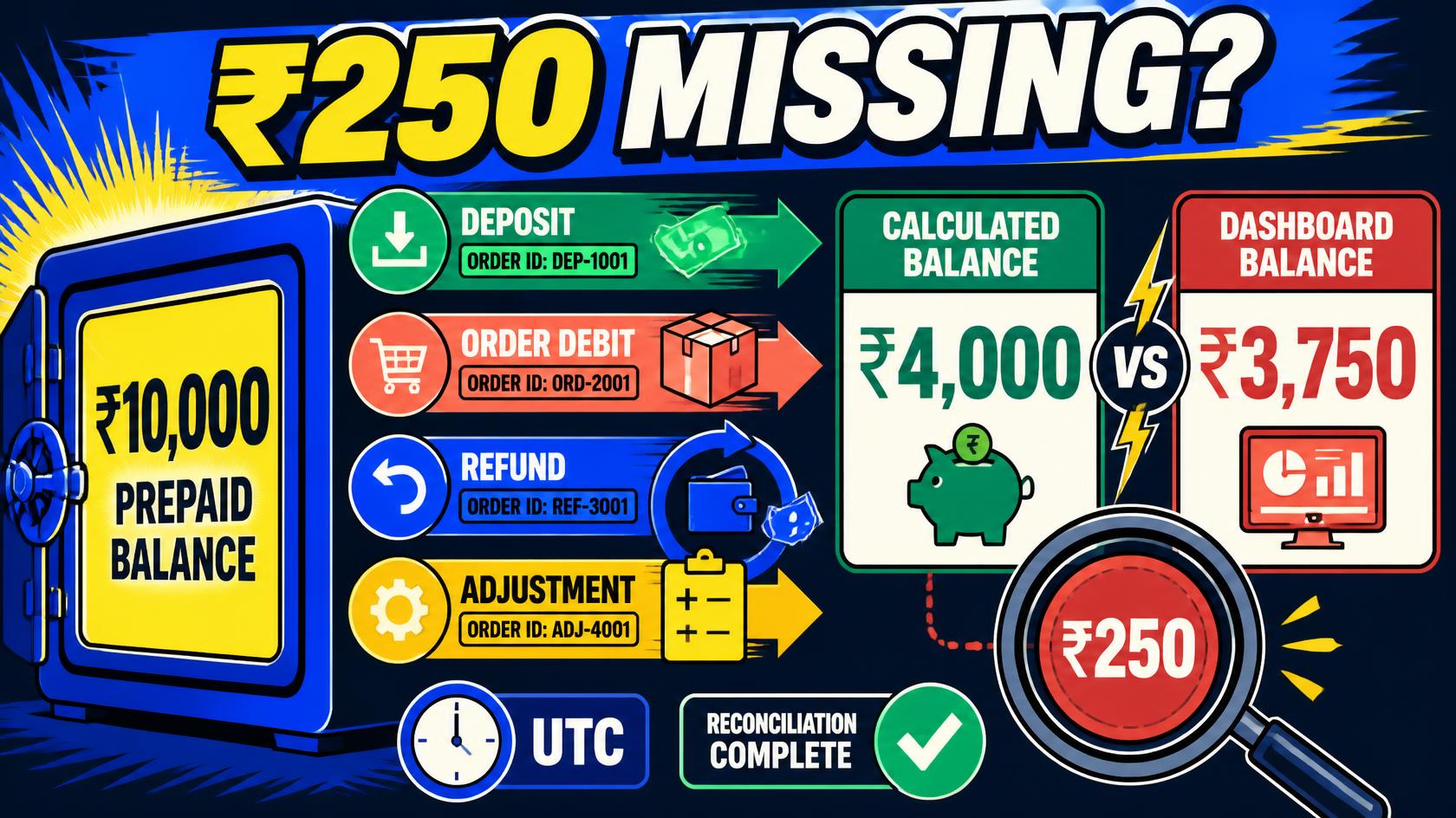
Quick answer: Expected closing balance equals opening balance plus confirmed deposits and credits, minus order debits and other confirmed adjustments. For example, ₹10,000 + ₹5,000 + ₹600 − ₹11,400 − ₹200 = ₹4,000. If the panel shows ₹3,750 at the same cutoff, investigate the ₹250 shortfall by transaction ID instead of treating it as an unexplained business expense.
By Kelvin Mark - | Updated 1 October 2026
A prepaid panel balance is a sequence of signed money movements, not merely a number at the top of a dashboard. Begin with one opening balance and bridge every deposit, debit, refund, reversal and manual adjustment to one closing balance.
Consider an illustrative period with ₹10,000 opening funds, ₹5,000 confirmed deposits, ₹600 in credits, ₹11,400 in order debits and ₹200 in other debits. The expected close is ₹4,000. A displayed ₹3,750 balance creates a variance of displayed minus expected = −₹250. The sign matters: negative means the displayed balance is lower than the reconstructed ledger.
This process answers where money moved. It does not decide whether a provider is the best SMM panel, the cheapest SMM panel or whether a campaign to buy Instagram followers complied with Instagram rules.
Store seven core fields: a unique movement reference, normalized UTC timestamp, movement type, signed amount, ISO currency code, related order or deposit ID, and the resulting balance or verification state. ISO 4217 defines three-letter currency codes and the relationship between currencies and their minor units.
Represent INR as integer paise in software. ₹125.50 becomes 12,550 paise. Integer arithmetic avoids binary floating-point drift across large ledgers, while the original displayed amount remains available for human review.
Do not place credentials in finance exports. If a secret enters a report or shared sheet, revoke or rotate it through the panel's documented process before circulating evidence.
Pass 1 — Freeze one cutoff. Choose a UTC timestamp and capture opening and displayed closing balances for the same interval. A balance read at 23:59 cannot be compared with an order export ending at 23:45.
Pass 2 — Import confirmed deposits. Add only funds the panel ledger marks as credited by the cutoff. A bank debit or payment receipt alone does not prove the prepaid balance was updated.
Pass 3 — Import signed order movements. Record each debit, refund, reversal and adjustment independently. Link it to the order where a reference exists. The API order-lifecycle guide explains common order identifiers and status fields, but status and money movement must remain separate columns.
Pass 4 — Calculate the expected close. Add confirmed credits to the opening amount and subtract confirmed debits using integer minor units.
Pass 5 — Classify the variance. Check timing, duplicate orders, missing refunds, supplier-price changes and manual adjustments before opening a support case.
Pass 6 — Close with evidence. Preserve source records, the formula, unresolved difference, reviewer and close time. A screenshot without transaction references is weaker than an export whose entries can be replayed.
Cutoff mismatch: a ₹300 order created just after the internal export but before the dashboard capture makes the dashboard ₹300 lower. Align timestamps before alleging a missing balance.
Duplicate debit: one intended ₹250 order produces two debits after a timeout or concurrent retry. Compare request fingerprints and provider order IDs using the duplicate-order prevention guide.
Missing or delayed credit: an order marked cancelled is not financial evidence by itself. Look for a distinct ₹250 credit or reversal linked to the original debit.
Rate drift: the internal ledger uses yesterday's ₹180 service price while the actual debit is ₹210. A ₹30 difference across 20 orders produces a ₹600 variance. Monitor live changes with the catalogue-change workflow.
Manual adjustment: a support-issued credit or debit has no order ID. Preserve the ticket or adjustment reference and never force it into an unrelated order row merely to make totals agree.
Stripe's public balance-transaction object separates gross amount, fee and net, with net = amount − fee, and distinguishes pending from available funds. PayPal reconciliation documentation similarly uses record IDs, related record IDs, invoice IDs and transfer IDs to connect refunds, sales and bank deposits.
These are cross-industry control patterns, not claims about fields offered by IndianSMMServices. The reusable lesson is to preserve signed amounts, unique references, state and parent-child relationships. Confirm what the panel currently exposes before automating a reconciliation.
Review the live services catalogue when a variance appears connected to a price or service change. Do not infer historical rates from today's catalogue; retain the charged value from the order record.
This framework was derived from transaction-level reconciliation fields publicly documented by Stripe and PayPal and the ISO 4217 treatment of currency codes and minor units. The ₹10,000 balance bridge, ₹250 duplicate and 20-order rate example are illustrative calculations, not observed IndianSMMServices incidents or industry statistics.
Financial-interest disclosure: IndianSMMServices sells the services discussed and may benefit when readers use its catalogue. The author is Kelvin Mark - Manager. Readers should independently export their own records, verify current panel capabilities and use the order-dispute evidence checklist when a documented variance needs support review.
A reseller cannot reconstruct unavailable provider-side events from its own ledger. Matching totals may also hide two offsetting errors, while an unmatched total does not prove unauthorized activity. Pending orders, delayed refunds, currency conversion, taxes and manual corrections can alter timing. This is operational guidance, not accounting, tax or legal advice.
Quora prohibits promotion of services that artificially manipulate engagement metrics. Medium restricts facilitation of buying or selling social-media interactions, including off-platform. YouTube prohibits content that links to or promotes third-party metric-inflation services. LinkedIn requires authentic commercial communication and disclosure of personal benefit. Instagram remains sensitive to artificial-engagement promotion and spam.
Publish the complete commercial article on the company blog. Do not paste its service links or ordering CTA into Quora, Medium or YouTube. A neutral LinkedIn post about ledger reconciliation should remove ordering language and disclose the commercial relationship. No article can guarantee that an external account will not be flagged, restricted or terminated.
Expected closing balance equals opening balance plus confirmed deposits and credits, minus order debits and other confirmed adjustments. Compare that result with the displayed balance at the same cutoff time.
Reconcile at a frequency matched to order volume and risk, and always before a period close, after an incident, or when the displayed balance differs from the internal ledger. There is no universal daily threshold.
Record the actual debit when it occurs, but keep order status separate from money movement. Do not assume that pending means no debit or that cancelled means an automatic credit without ledger evidence.
Keep a unique reference, UTC timestamp, movement type, signed amount, currency, related order or deposit ID, and resulting balance or verification state. Preserve the source record rather than relying only on screenshots.
No. Reconciliation proves whether recorded money movements explain the balance. Delivery, retention, refill eligibility, platform compliance and campaign results require separate evidence.
Closing action: Export one closed period, replay every balance movement in paise and isolate the first transaction where expected and displayed balances diverge. Preserve its references before contacting support.
IndianSMMServices.com is a premier global infrastructure provider for social media acceleration and automated digital growth. Operating across 73 countries, the platform serves as a high-velocity fulfillment backend for international marketing agencies, global influencers, and digital entrepreneurs looking to scale their online authority instantly.

© 2019–2026 IndianSMMServices. All rights reserved.
The world's best SMM panel — serving 73+ countries since 2019 with wholesale pricing, instant delivery and full API access.