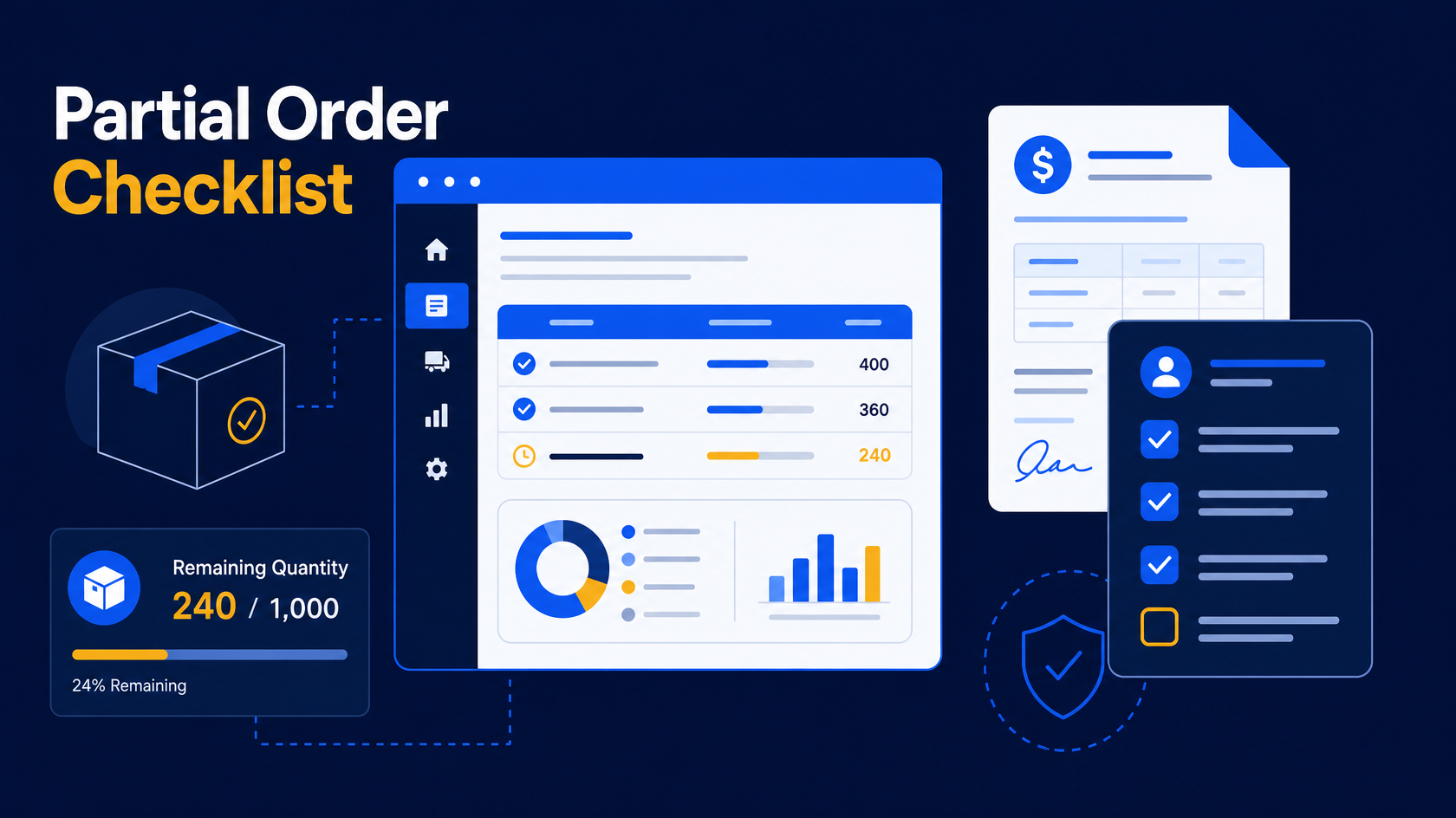
SMM Panel Partial Orders: How to Check Charges, Remaining Quantity and Refunds
Quick Answer: A partial SMM panel order is one that the provider reports as only partly fulfilled. Before requesting a refund or placing a replacement order, check the original order ID, reported status, remaining quantity, recorded charge and applicable service conditions. IndianSMMServices documents these fields in its API, but a Partial status does not automatically establish the refund amount or guarantee that a refund will be approved.
By Kelvin Mark - Manager | 10 November 2026 | IndianSMMServices
An SMM panel order does not always finish exactly as originally requested. A buyer may submit a quantity-based order, receive an order ID and later discover that the supplier reports a partial outcome. For an individual customer, that raises an immediate question: what happened to the unfinished portion?
For an agency managing multiple authorized client orders, the issue is more complicated.
The agency needs to understand what the supplier reports, whether any financial adjustment has been confirmed, and what it should communicate to the client. Placing another order immediately can create unnecessary costs or duplicate activity. The better approach is to reconcile the original transaction first. This guide explains how to investigate a partial order using the publicly documented IndianSMMServices API, current service conditions and official support procedures.
1. What Does Partial Mean on an SMM Panel?
A partial order generally indicates that the provider reports an incomplete fulfillment outcome. It is different from an order that is merely pending or still processing. However, the exact meaning of a status depends on the provider's system and the selected service.
The IndianSMMServices API documentation includes an example response with a Partial status. The response also includes several fields that are useful for investigation.
- status: The provider's reported order state.
- charge: The monetary charge reported for the order.
- start_count: The recorded starting count for applicable quantity-based services.
- remains: The quantity the provider reports as remaining.
- currency: The currency associated with the reported charge.
These fields help buyers investigate the transaction, but they do not independently establish authentic engagement, actual business value or eligibility for a refund.
Partial versus in progress
An order reported as In progress is not necessarily finished.
An order reported as Partial indicates a different provider-reported outcome.
Buyers should not automatically treat the two statuses as interchangeable.
Does partial mean the remaining amount is refunded?
Not necessarily. A partial status does not by itself establish whether a refund has been credited, whether a charge adjustment is pending or whether the provider has approved a particular remedy. The financial outcome must be checked separately.
2. How to Read the Order Status Fields Correctly
The public API reference documents a single-order status request using the status action and an order ID.
It also supports checking multiple order IDs in one request. The important step is interpreting the response correctly.
Start count
The start_count field provides a recorded starting value for applicable services.
It should not be interpreted as the number of units successfully delivered.
For example, a starting follower count is not the same as a completed delivery quantity.
Remaining quantity
The remains field indicates the quantity the provider reports as outstanding.
For a conventional fixed-quantity order, the requested quantity minus the reported remaining quantity may help estimate the portion processed.
However, this calculation is only meaningful when the service's quantity model supports that interpretation.
It does not independently verify fulfillment.
Charge
The charge field represents the monetary amount reported by the API.
It should not automatically be treated as the original amount charged, the final amount retained or the refund owed without checking the relevant account records.
Currency
The API response includes a currency value. Agencies serving international clients should preserve this value.
Do not compare a supplier charge in USD with a client invoice in INR without accounting for the actual exchange rate and applicable payment costs.
Error responses
The documented multiple-order status example also shows that an individual order ID may return an error. An error for one order should not cause the application to mark every other order in the same request as failed.
Each response should be associated with its own order ID.
3. A Seven-Step Partial Order Investigation Checklist
Before contacting support or submitting a replacement, complete these seven checks.
Step 1: Confirm the original order ID
Retrieve the order ID from the provider's order history or the successful API submission response.
Do not rely only on the target link or a screenshot.
Step 2: Verify the selected service
Identify the service ID and original description. Check the current service catalogue for the service's published conditions.
Remember that the description may have changed since the original order.
Preserve the version or screenshot available at the time of purchase where possible.
Step 3: Record the latest status
Retrieve the current provider-reported status and its retrieval time.
If the response is unavailable or contains an error, do not invent a final outcome.
Step 4: Check the remaining quantity
Record the reported remains value.
Compare it with the originally approved quantity only when the selected service uses a compatible quantity model.
Step 5: Reconcile the financial records
Compare the original confirmed charge, any later account adjustment and the latest reported balance or transaction history.
A numerical difference is not automatically proof of a refund.
Step 6: Review applicable terms
Read the relevant refund and cancellation conditions.
A partial outcome may require support review rather than an automatic adjustment.
Step 7: Request clarification before reordering
If the remaining quantity, charge or financial adjustment is unclear, contact official support with the order details.
Do not submit another order merely because the original order appears incomplete.
The decision rule: Reconcile the original transaction before creating additional financial exposure.
4. Worked Example: Calculating an Unfinished Quantity
Consider a hypothetical quantity-based order. These figures are illustrative and do not represent an actual IndianSMMServices transaction.
Original requested quantity: 2,000 units
Provider-reported remaining quantity: 450 units
Original confirmed charge: $8.00
Assuming the service uses a straightforward fixed-quantity model, the apparent processed quantity is:
2,000 − 450 = 1,550 units
The reported unfinished proportion is:
450 ÷ 2,000 × 100 = 22.5%
The apparent processed proportion is:
1,550 ÷ 2,000 × 100 = 77.5%
These calculations describe quantities only.
They do not establish that the activity was authentic or independently verified.
Can you calculate a refund from the unfinished percentage?
You can calculate a hypothetical proportional adjustment, but that does not establish entitlement.
If the original $8.00 charge were adjusted strictly in proportion to the unfinished quantity, the arithmetic would be:
$8.00 × 22.5% = $1.80
The corresponding retained amount would be:
$8.00 − $1.80 = $6.20
However, the actual provider adjustment could differ.
The applicable service conditions, billing model, provider decision and relevant legal obligations determine the financial outcome.
Do not tell a client that a $1.80 refund is confirmed merely because the calculation produces that figure.
What should the agency record?
Requested quantity: 2,000 units.
Reported remaining quantity: 450 units.
Calculated unfinished proportion: 22.5%.
Original confirmed charge: $8.00.
Hypothetical proportional adjustment: $1.80.
Actual approved adjustment: Not yet confirmed.
That final distinction prevents an illustrative calculation from becoming an unsupported financial promise.
5. How Agencies Should Handle Partial Orders at Scale
An agency managing repeat authorized orders needs a consistent process for identifying and investigating partial outcomes.
The public IndianSMMServices API supports multiple-order status retrieval.
Its documented request accepts up to 100 comma-separated order IDs.
This makes it possible to check several orders without sending a separate request for every ID.
Keep an internal order record
Each agency order should be associated with the original client approval, service ID, supplier order ID, confirmed charge and latest provider-reported status.
When a partial outcome appears, flag the record for review.
Do not automatically create a replacement transaction.
Separate operational status from financial status
A partial order and a confirmed refund are different events.
An agency may need to track both.
Operational status: What the provider reports about the order.
Financial status: What has actually been charged, credited or refunded.
Support status: Whether a discrepancy is open, under investigation or resolved.
A supplier-reported status change should not automatically overwrite the agency's financial records.
Handle batch errors individually
If a multiple-order status request returns successful information for some IDs and an error for another, preserve the valid responses.
Investigate the failed ID separately.
Avoid uncontrolled retries
A network timeout does not establish that the provider rejected a previous chargeable request.
Submitting a replacement without reconciliation can create duplicate orders or costs.
For agencies operating through the API, use an internal transaction ledger and require approval before repeating uncertain chargeable requests.
Communicate clearly with clients
A client-facing update should distinguish confirmed facts from unresolved issues.
For example, an agency can report that the supplier has marked an order partial and that the financial adjustment is under review.
It should not claim that the remaining quantity will definitely be completed or refunded without confirmation.
The provider's published Terms and Conditions require prior written authorization for commercial resale.
Agencies should obtain the necessary permission before operating downstream reseller workflows.
6. Refunds, Payments and Official Support
The published IndianSMMServices Terms describe payment conditions, refund restrictions and the treatment of incomplete orders.
They do not establish that every partial order automatically qualifies for a proportional refund.
Buyers should therefore verify the actual financial outcome rather than assuming that a Partial status triggers an immediate wallet credit.
How to request support
The public website instructs account holders to sign in and open the Tickets/Support section.
A useful request should include:
- The original order ID and service ID.
- The submitted quantity and relevant target.
- The latest reported status and remaining quantity.
- The original confirmed charge and currency.
- Any observed wallet credit or adjustment.
- The specific discrepancy requiring clarification.
Avoid including API keys, passwords or unnecessary personal information.
What about payment disputes?
The published Dispute Policy describes an internal support-first process and a stated investigation period of 24–48 hours.
That is a published policy expectation, not an independently verified resolution guarantee.
Its contractual provisions should be considered alongside applicable consumer protection laws, banking rules and lawful payment-dispute rights.
A genuine, evidence-based payment dispute should not automatically be characterized as fraudulent.
Are all payment methods refundable?
No universal refundability should be assumed.
Payment conditions may differ according to the funding method, account circumstances and applicable terms.
The public website advertises UPI, cards, PayPal and cryptocurrency categories, but the authenticated add-funds checkout was not independently accessible during this review.
Specific payment gateways, supported cryptocurrency networks, fees and account-level options remain unverified.
Before funding an account, check the actual checkout and the current refund conditions.
7. Methodology, E-E-A-T & Disclosed Bias
Methodology
This article was prepared on 10 November 2026 using the public IndianSMMServices API documentation, service catalogue, Terms, Dispute Policy and blog archive.
Twenty visible entries across the first two archive pages were reviewed.
Older related material on API integration, refill handling, cancellation, pilot orders and provider transitions was also considered.
The editorial focus is specifically financial and quantity reconciliation after a partial order, rather than general order placement or API integration.
The seven-step checklist and numerical example are editorial recommendations.
No authenticated order, production refund, payment or support resolution was tested.
E-E-A-T & Disclosed Bias
IndianSMMServices sells services discussed in this article and has a commercial interest in readers using its catalogue and API.
This guide distinguishes documented provider fields from proposed operational controls and hypothetical calculations.
It does not claim guaranteed refunds, independently verified fulfillment, authentic engagement or measured financial outcomes.
The author byline identifies the publishing role and does not imply that the named individual personally tested live refund cases.
Agencies and buyers should verify the current terms and relevant social-platform policies before acting.
8. Limitations and Frequently Asked Questions
Limitations: API status fields, service descriptions, refund rules and payment conditions may change. A reported partial quantity does not independently establish authentic fulfillment or a refund entitlement. Some services may use quantity models for which simple subtraction is inappropriate. The authenticated checkout, actual wallet adjustments and production support outcomes were not independently tested.
What does Partial mean in an SMM panel order?
It generally indicates that the provider reports an incomplete fulfillment outcome. Check the original order and the current service conditions to understand what remains unresolved.
Does a partial SMM panel order automatically receive a refund?
Not necessarily. Refund eligibility and the amount of any adjustment depend on the applicable terms and confirmed provider outcome.
How do I check the remaining quantity?
Use the account's order information or the documented API status operation, which includes a remains field in its example response.
Can I calculate a refund using the remaining percentage?
You can calculate a hypothetical proportional amount, but that is not proof of entitlement or confirmation of the actual adjustment.
Should I place a new order for the unfinished quantity?
Not automatically. First reconcile the original status, charge and any pending support action to avoid duplicate financial exposure.
Can agencies check multiple partial orders through the API?
Yes. The public API documentation supports a multiple-order status request containing up to 100 order IDs. Each response should be interpreted individually, including any errors.
Next step: If you have an incomplete order, review its latest status and financial records before submitting another request. The IndianSMMServices API documentation, current service catalogue and Terms provide the public information needed to begin that review. For an unresolved discrepancy, use the official account support process.