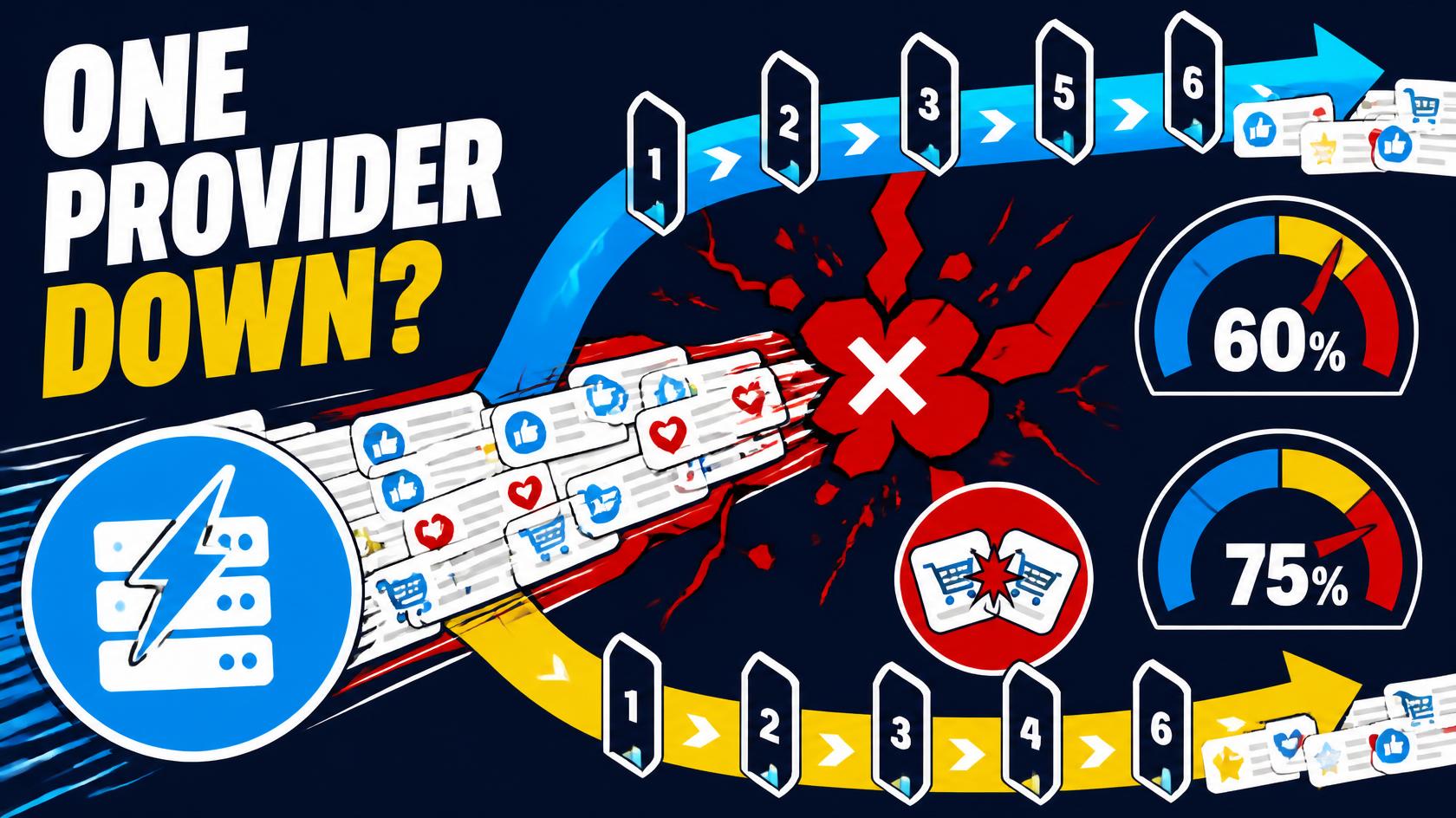
SMM Provider Dependency Map: 6 Failover Rules
Provider Dependency Map: 6 Failover Rules
Quick answer: Map every upstream SMM service to the client promise, order exposure, status source and substitute criteria before disruption occurs. A safe failover has six gates: map the dependency, measure concentration, qualify the substitute, prove the original order state, run one controlled test, then release or stop. Never place a replacement order while the first order may still deliver.
By Kelvin Mark - Manager | Published 21 October 2026
1. Draw the chain from client promise to upstream dependency
An agency can appear diversified while several catalogue entries, automations or client packages still depend on one upstream route. Start with the client-facing promise, then follow the chain through the agency service code, provider service, wallet balance, API credential, status endpoint, support channel and measurement record.
Record the dependency by exact internal and upstream service identifiers rather than a broad label such as “Instagram.” Two similarly named services can have different target formats, refill rules, cancellation behavior, start times and evidence requirements. Check the live services catalogue rather than copying old conditions into the map.
NIST SP 800-161 Rev. 1, updated through 1 November 2024, addresses identifying, assessing and mitigating risks associated with acquired products and services throughout the supply chain. This article borrows that risk-mapping discipline; it does not claim that an SMM reseller following it is NIST-compliant.
2. Measure two concentrations, not one reassuring percentage
Measure concentration over a stated period using both order count and order value. Provider count concentration equals the provider’s eligible orders divided by all eligible orders. Provider value concentration equals its eligible order value divided by total eligible order value. State whether taxes, credits, cancelled orders and partial orders are included.
Illustrative example: during seven days an agency records 40 eligible orders worth ₹20,000. Provider A handled 24 orders worth ₹15,000. Its order-count concentration is 24 ÷ 40 = 60%, while value concentration is ₹15,000 ÷ ₹20,000 = 75%. Reporting only 60% would hide the larger financial dependency.
These figures are arithmetic examples, not IndianSMMServices performance data or recommended thresholds. Concentration is a warning signal, not proof that a provider is unsafe. A low share can still be critical if it supports the agency’s largest client or only service with a particular specification.
3. Qualify substitutes by compatibility, not price
A backup is not interchangeable merely because its name looks similar or its price is lower. Compare target type, allowed geography, minimum and maximum quantity, start-count handling, cancellation, refill window, privacy implications, measurement method, current availability and client-approved scope.
The search phrases best SMM panel, cheapest SMM panel and buy Instagram followers do not prove substitute eligibility. A lower rate cannot compensate for the wrong target format, unsupported refill promise, unknown status semantics or conduct incompatible with platform rules.
Give each substitute one of three outcomes: eligible for a defined scope, conditional pending evidence, or prohibited for that client promise. Preserve the decision date and reviewer. Re-check current terms before execution because catalogue labels and provider conditions can change.
4. The six-gate failover path
Gate 1: map the affected surface
Identify active orders, scheduled automations, client deadlines, exposed funds and downstream reports. Do not reroute unrelated work merely because one service is delayed.
Gate 2: calculate the current concentration
Calculate count and value shares using one defined time window. Mark any single-client or single-service dependency that aggregate percentages could hide.
Gate 3: qualify the substitute
Confirm that the candidate matches the authorized purpose and current service conditions. A faster estimate or cheaper rate is not enough.
Gate 4: prove the original order state
Check the original order ID, status, start count, remains, cancellation state and latest timestamp. “Pending” does not necessarily mean inert. Use the stuck-order triage guide before assuming the original route will never start.
Gate 5: run one controlled test
Use an authorized, measurable and limited test on an appropriate target. Separate it from the live pending order. Record the baseline, quantity, cost, start time, status evidence and stop condition.
Gate 6: release or stop
Release only the approved scope if the test meets the written criteria. Otherwise pause, preserve evidence and communicate the constraint. Google SRE guidance warns that shifting work or retrying aggressively can turn one failure into a cascading failure; the operational analogue here is uncontrolled rerouting across several providers.
5. Prevent the most expensive failover error: double ordering
Suppose Provider A holds a ₹3,000 order marked pending and the agency wants to place the same quantity with Provider B. If A starts after B accepts, the client may receive duplicate or excessive delivery, the public count may no longer isolate either order, and neither provider may accept responsibility for the combined outcome.
The safe decision is not “retry elsewhere.” First request or verify cancellation where supported, wait for a final state, record the last start count and remains, obtain approval for any material change, and then place only the unresolved eligible quantity. A partial status requires separate reconciliation; the partial-order guide explains why delivered units, remains and client credit must not be collapsed into one number.
If the original provider cannot confirm a final state, pause rather than manufacture certainty. Follow the campaign pause-and-resume protocol and state the limitation to the client. Continuity does not justify hiding uncertainty.
6. Methodology, E-E-A-T & Disclosed Bias
This article was created after checking the live IndianSMMServices archive and site-search results for provider dependency, supplier risk, provider failover and backup-provider intent. The archive contained order-status, refill, partial-order, campaign-pause and reseller-cost material, but no dedicated dependency map or six-gate failover framework.
Research used the current NIST SP 800-161 Rev. 1 update, Google SRE guidance on cascading failures and Google Cloud reliability guidance on controlled recovery tests, logging and documented gaps. Infrastructure reliability concepts were adapted cautiously; an SMM provider order is not equivalent to a cloud workload. The 40-order, ₹20,000 and ₹3,000 examples are illustrative, not customer records, benchmarks or guarantees.
Financial-interest disclosure: IndianSMMServices sells social media services discussed on this site and has a commercial interest in readers considering those services. The article may recommend its own service catalogue and operational guides. Readers should independently verify provider terms, client contracts and platform policies.
7. Limitations and publishing-policy risk
An agency may not know whether two catalogue entries share the same hidden upstream source, so apparent diversification can still contain concentration. Status feeds can lag, provider capacity can change, and a successful test cannot guarantee future delivery. This framework cannot create cancellation rights, determine refund liability or make prohibited activity compliant.
No article can guarantee that Quora, Medium, LinkedIn, Instagram or YouTube will not flag, restrict or terminate an account. Quora restricts promotion of services that artificially manipulate engagement. Medium restricts facilitating purchases or sales of social-media interactions, including off-platform. YouTube prohibits fake engagement and promotion of third-party metric-inflation services. Instagram warns against artificially collecting likes, followers or shares. LinkedIn prohibits misleading content and undisclosed commercial endorsements.
Do not repost this commercial article or its ordering CTA to Quora, Medium, Instagram or YouTube. A neutral, link-free LinkedIn summary about supplier continuity is comparatively lower risk if ordering language is removed and the commercial relationship is disclosed; lower risk is not no risk.
8. Frequently asked questions
What is an SMM provider dependency map?
It is a record connecting each upstream service to the client promise, order volume, financial exposure, status source, substitute criteria and approved response if that dependency becomes unavailable.
Should an agency always use two providers?
No. A second provider may have different targeting, quality, refill, cancellation, privacy or policy conditions. Redundancy only helps when the substitute is independently reviewed and appropriate for the same authorized purpose.
When is it safe to move a pending order?
Do not move it merely because delivery appears slow. First verify whether the original order can still start, whether cancellation is confirmed, whether duplicate delivery is measurable and whether the client has approved any material change.
How is provider concentration calculated?
Divide the selected provider’s eligible order value or order count by the corresponding total for a defined period. Label the basis clearly because value concentration and order-count concentration can produce different results.
Does a successful test guarantee failover readiness?
No. Conditions, capacity, targeting and platform enforcement can change. A controlled test supplies evidence for a particular time and scope but does not guarantee future availability or outcomes.
Can provider failover prevent platform flags?
No. Switching providers does not make prohibited activity compliant, erase artificial-engagement risk or guarantee that Quora, Medium, LinkedIn, Instagram, YouTube or another platform will not restrict an account.
Closing CTA: Select one high-value service and map its upstream dependency, seven-day concentration, substitute eligibility, duplicate-order risk and stop condition before the next disruption. Review current service terms, then use the IndianSMMServices blog archive for related reseller controls.