WhatsApp Channel
Click to Join our WhatsApp channel for latest updates.
Telegram Channel
Click to Follow Telegram Channel for real-time updates.
Instagram Channel
Click to Join our Instagram channel for latest updates
Click to Join our WhatsApp channel for latest updates.
Click to Follow Telegram Channel for real-time updates.
Click to Join our Instagram channel for latest updates
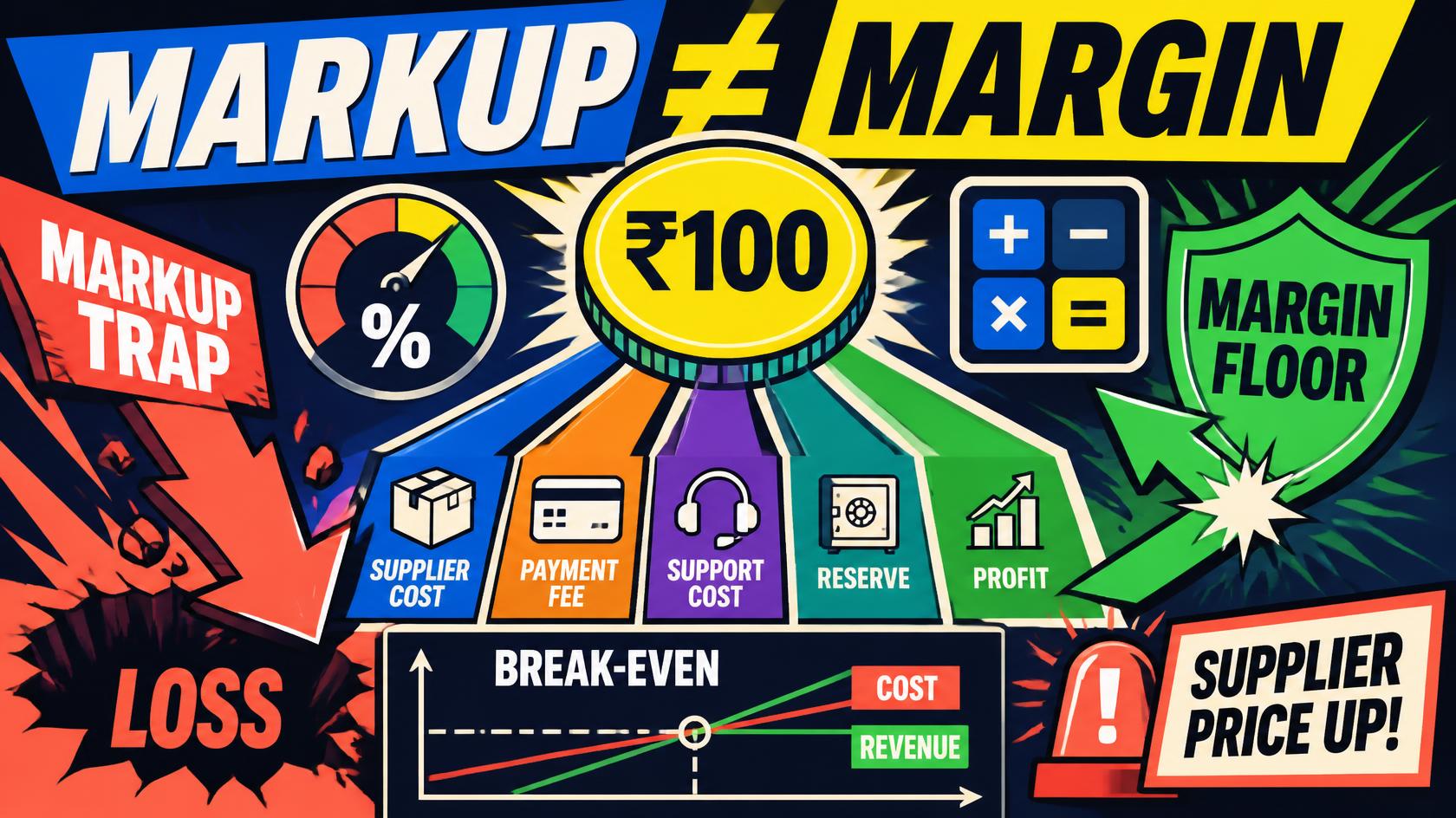
Quick answer: An SMM reseller's minimum selling price is total variable cost divided by one minus the target contribution margin. If the real order-level cost is ₹80 and the target margin is 20%, the price floor is ₹100: ₹80 ÷ 0.80. Adding 20% to cost produces ₹96 and only a 16.67% margin, which is why confusing markup with margin quietly underprices agency work.
By Kelvin Mark - Founder | Updated 29 September 2026
Start with a deliberately simple case: a reseller pays ₹60 for fulfilment and charges the client ₹100. Gross profit is ₹40. Gross margin is ₹40 ÷ ₹100 = 40%, while markup is ₹40 ÷ ₹60 = 66.67%. Those percentages describe the same transaction from different denominators; they are not interchangeable.
Now add order-level costs. Suppose, only for illustration, that payment processing is 2% of revenue and attributable support is ₹5. Total variable cost becomes ₹67, contribution becomes ₹33, and contribution margin becomes 33%. Your actual processor rate and support cost may be higher or lower; replace every example input with ledger data.
A price of ₹90 on the original ₹60 supplier cost leaves a 33.33% gross margin. A price of ₹80 leaves 25%. A price of ₹70 leaves 14.29%. But none of those gross-margin figures includes the illustrative processor or support amounts. This is the purpose of an SMM reseller margin calculator: to expose the difference between an attractive selling price and a defensible pricing floor.
The standard gross-margin formula is (revenue − cost of goods sold) ÷ revenue × 100. Markup is (selling price − cost) ÷ cost × 100. Current guidance from Xero and QuickBooks uses these different denominators and warns that confusing them can produce the wrong price.
For a target margin, solve backward: selling price = variable cost ÷ (1 − target margin). With ₹80 in total variable cost and a 20% target, ₹80 ÷ 0.80 = ₹100. Merely adding a 20% markup makes the price ₹96; the resulting margin is ₹16 ÷ ₹96 = 16.67%.
Do not copy a universal margin from another agency. Client mix, dispute rates, currency exposure, tax treatment and service stability differ. First use the reseller operations guide to frame supplier fit, then calculate your own threshold.
The supplier's listed rate is the first input, not the whole cost. Record the charged amount for the exact quantity, payment-processing fee, currency-conversion cost, order-level support labour and any credit, refund or refill expense attributable to that service. Base reserves on your own history rather than an invented industry percentage.
Separate fixed costs such as salaries, rent, subscriptions and general advertising. They matter for break-even and net profit but should not be disguised as supplier cost. Compare candidate services in the live services catalogue, because a screenshot or old spreadsheet can become stale.
Reliability also changes economic cost. The price-versus-retained-value guide explains why a low sticker price can be misleading. Its market examples should not be treated as guaranteed future drop rates or as inputs for your business without your own observations.
Choose a target contribution margin only after measuring actual order economics. If variable cost is ₹70 and the price is ₹100, contribution is ₹30 and the ratio is 30%. A 10% client discount lowers revenue to ₹90; contribution becomes ₹20 and the ratio falls to 22.22%, not 20% and not 30%.
Next test a supplier-rate shock. If supplier cost rises from ₹70 to ₹84, a 20% increase, and other variable cost is ₹5, a fixed ₹100 client price leaves ₹11 contribution and an 11% contribution margin. Before the rise it was ₹25 and 25%. This is a negative-margin warning system even though the example has not crossed below zero.
A useful rule is to pause discounts or reprice whenever the forecast ratio falls below the floor approved for that client or product. Keep evidence for unusual delivery outcomes using the order-dispute evidence checklist; an undocumented credit assumption should not be counted as recovered money.
The U.S. Small Business Administration states the unit break-even formula as fixed costs ÷ (price per unit − variable cost per unit). If monthly fixed costs are ₹12,000 and contribution is ₹30 per order, illustrative break-even volume is 400 orders. At ₹20 contribution it becomes 600 orders. The output is only as reliable as the cost allocation.
Review prices when supplier rates, processor fees, exchange rates, applicable taxes, measured support time or refund experience changes. Also review when a service description, delivery condition or refill term changes; economics can deteriorate even when the nominal rate stays flat.
Do not choose a provider solely because it claims to be the best SMM panel or cheapest SMM panel. Do not assume the economics of a campaign to buy Instagram followers apply to YouTube, Telegram or another service. Each service-client combination needs its own cost row, risk boundary and platform-policy review.
This guide was structured from the gross-margin and markup definitions published by Xero and QuickBooks, the contribution-margin convention of revenue minus variable costs, and the SBA unit break-even formula. Calculations were recomputed from the stated inputs. INR amounts, the 2% processing fee, ₹5 support allocation, ₹12,000 fixed cost and target margins are transparent illustrations—not market averages, promises or recommendations.
Financial-interest disclosure: IndianSMMServices sells the services discussed and may benefit if readers use its catalogue. The author is Kelvin Mark - Manager. That commercial interest is why readers should compare live terms, keep independent cost records and make their own platform-compliance decision. Browse the live blog archive for related operational guides.
Gross and contribution margin are not net profit. These calculations omit business-specific salaries, advertising, software, taxes, interest, chargebacks and regulatory duties unless the reseller adds them. Public prices and policies can change after publication. A spreadsheet also cannot predict fulfilment quality, account enforcement, organic results or whether a platform will treat a particular service as prohibited artificial engagement.
Quora prohibits promotion of services that artificially manipulate engagement metrics. Medium restricts facilitation of buying or selling social-media interactions, including off-platform. YouTube prohibits links to or promotion of third-party services that artificially inflate views, likes or subscribers. LinkedIn requires accurate commercial content and conspicuous disclosure of personal benefit. Instagram guidance has historically warned against artificially collecting likes, followers or shares; verify the current in-app Terms and Community Guidelines before publishing.
Therefore, this commercial article should remain on the company site. Do not paste it—with or without affiliate links—into Quora, Medium or YouTube. A neutral LinkedIn finance lesson still needs disclosure and removal of service promotion; Instagram promotional posts remain enforcement-sensitive. No wording can guarantee that an account will not be flagged or terminated.
Margin divides profit by selling price, while markup divides profit by cost. If a service costs ₹60 and sells for ₹100, the ₹40 profit is a 40% margin but a 66.67% markup.
Divide total variable cost by one minus the target margin expressed as a decimal. At ₹80 variable cost and a 20% target margin, ₹80 ÷ 0.80 gives a ₹100 selling price.
Include the supplier charge and every order-level cost you can attribute reliably, such as payment processing, currency conversion, support time, and a reserve based on your own refund or refill history. Keep fixed overhead separate for break-even analysis.
Review prices whenever supplier rates, payment fees, exchange rates, taxes, delivery conditions, or observed support and refund costs change enough to breach your chosen contribution-margin floor.
No. Gross margin excludes costs such as salaries, software, advertising, taxes, interest, and other overhead. A reseller can show positive gross margin and still make a net loss.
Closing action: Export one month of fulfilled orders, replace every illustrative amount above with your recorded costs, and set a documented margin floor before changing client prices. Then check the live catalogue and applicable platform rules before accepting the next campaign.
IndianSMMServices.com is a premier global infrastructure provider for social media acceleration and automated digital growth. Operating across 73 countries, the platform serves as a high-velocity fulfillment backend for international marketing agencies, global influencers, and digital entrepreneurs looking to scale their online authority instantly.

© 2019–2026 IndianSMMServices. All rights reserved.
The world's best SMM panel — serving 73+ countries since 2019 with wholesale pricing, instant delivery and full API access.