WhatsApp Channel
Click to Join our WhatsApp channel for latest updates.
Telegram Channel
Click to Follow Telegram Channel for real-time updates.
Instagram Channel
Click to Join our Instagram channel for latest updates
Click to Join our WhatsApp channel for latest updates.
Click to Follow Telegram Channel for real-time updates.
Click to Join our Instagram channel for latest updates
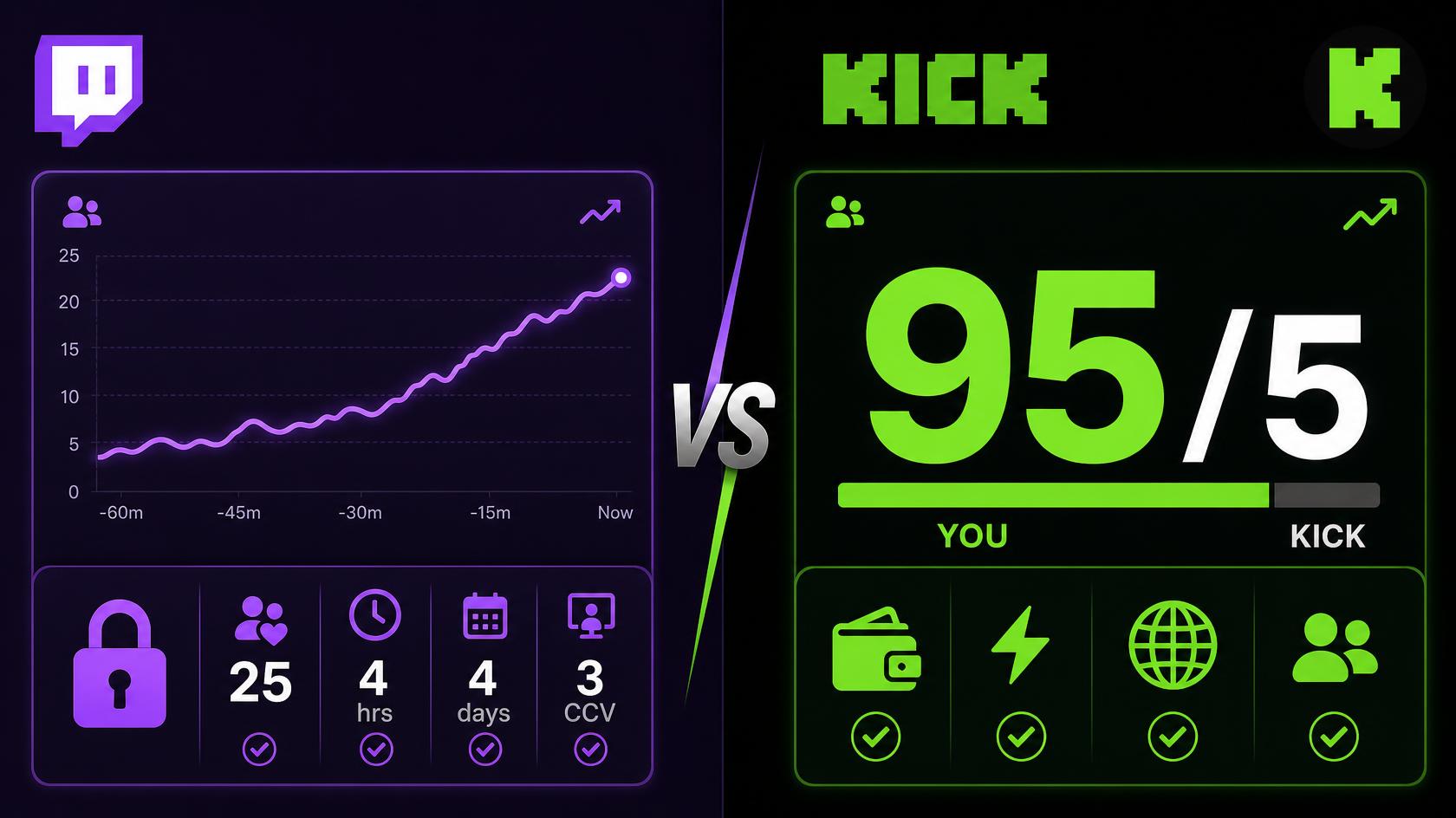
Quick AnswerTwitch quietly lowered its Affiliate requirements in mid-2026 to 25 followers, 4 hours of broadcast time, 4 unique broadcast days, and an average of 3 concurrent viewers, all inside a rolling 30-day window, down from the long-standing 50 followers and 500 minutes standard. Kick's own help center confirms a 95 percent revenue split on subscriptions against a 5-hour minimum, though its newer tiered Partner Program adds follower and viewer thresholds on top of that base rate. Both platforms gate monetization on concurrent viewers, not just follower count, which is the single biggest difference from Instagram, YouTube, or X growth, and it changes what a growth service can safely help with.
Every SMM panel guide on this site, including our own, talks about followers, likes, and views as the currency of growth. Live streaming runs on a different currency entirely: concurrent viewers, the number of people watching at the exact same moment. That single difference reshapes almost everything about how Twitch and Kick decide who gets paid, and it is why neither platform has a dedicated guide on this site until now, despite both being sold here as growth services.
Two independently checked 2026 trackers report that Twitch lowered its Affiliate bar in June 2026 to four conditions, all required inside the same rolling 30-day window: 25 lifetime followers, 240 minutes (4 hours) of total broadcast time, 4 unique broadcast days, and an average of 3 concurrent viewers across those days. That replaces the requirement set streamers have quoted for years: 50 followers, 500 broadcast minutes, and 7 unique days. One source we cross-checked still listed the older numbers, which suggests plenty of guides on the open web have not caught up with the June change, so confirm your own progress inside Twitch's Creator Dashboard rather than trusting any single blog post, including this one.
Partner status sits above Affiliate and stays application-based rather than automatic. The benchmark most consistently cited is 75 average concurrent viewers and 25 unique broadcast days within 30 days, though Twitch's creator team reviews applications manually, and streamers who apply with a 30-day average closer to 100 viewers report noticeably higher acceptance. The reward for clearing Partner is access to Twitch's Plus Program, which raises the default 50/50 subscription split to 60/40 after sustaining 100 Plus Points for three consecutive months, and to 70/30 at 300 Plus Points, calculated only from paid recurring subscriptions, not Prime or gifted subs.
Kick built its entire creator pitch around one number: streamers keep 95 percent of subscription revenue, against Twitch's 50 percent default. Kick's own official help documentation confirms this directly, and states the only requirement to unlock paid subscriptions is 5 total hours streamed, with no follower minimum mentioned on that page at all. For a brand-new streamer, that is a genuinely lower bar than Twitch's four-metric Affiliate gate.
The detail most comparison articles skip is that Kick has since layered a tiered Partner Program on top of this base rate, reported by independent streaming-industry outlets to require roughly 250 followers and about 75 average concurrent viewers for full Partner benefits, down from an earlier 1,500-follower threshold. Kick does not require exclusivity at any tier, meaning a streamer can run Kick and Twitch side by side without breaching either platform's terms, something Twitch Partners historically could not do as freely. Read that as: the 95/5 headline number is real and confirmed on Kick's own site, but it describes the entry tier, not every benefit a growing streamer will eventually chase.
Follower-tier ladders work fine for Instagram or X, the way our Instagram sponsorship rate guide lays out. Streaming needs a different ladder, because the gate at every rung is concurrent viewers, not followers. At the entry rung, sub-3 average concurrent viewers, a streamer is pre-Affiliate on Twitch and can only earn tips directly; on Kick they can already be collecting subscriptions once the 5-hour minimum clears. At the 3-to-25 CCV rung, Twitch Affiliate status is active, ad revenue and Bits become available, and small first-sponsorship offers start appearing from niche-relevant brands. At the 25-to-75 CCV rung, a streamer is Kick Partner-eligible and Twitch Partner-eligible on paper, sponsorship offers move from one-off gifted products to paid per-stream deals, and the Plus Program's 60/40 split becomes realistic within a few months of consistent subs. Above 75 average CCV, both platforms' top monetization tiers are open, and sponsorship conversations shift from per-stream fees to monthly retainers.
The practical takeaway: a streamer's growth plan should track concurrent viewers as the primary metric and followers as a secondary trust signal, which is the exact inverse of how most creators approach Instagram or TikTok growth.
Pricing in live streaming sponsorships is quoted almost entirely against average concurrent viewers rather than total followers, unlike the CPM-per-view model our YouTube sponsorship rate guide covers. According to one publicly available 2026 rate-card breakdown, small streamers averaging 50 to 500 CCV see per-stream sponsorship offers in the 100 to 800 dollar range, mid-tier streamers at 500 to 5,000 CCV see 500 to 5,000 dollars per stream, and streamers above 5,000 CCV command 3,000 to 20,000 dollars or more per stream, with monthly retainer deals for the largest channels negotiated individually rather than published. We were only able to verify these figures against a single source this session, so treat the exact dollar bands as directional rather than confirmed across multiple independent trackers, and always request current rates directly from a brand or agency before quoting them to a client.
Every platform guide on this site eventually warns against fake engagement, but the mechanics differ sharply for live streaming. A viewbot simulates fake concurrent viewers in real time, and because concurrent viewership is the exact metric gating Affiliate, Partner, and sponsorship eligibility on both platforms, it is also the metric both platforms invest the most in detecting. Live viewer behavior, including chat activity, watch-time patterns, and connection fingerprints, is harder to fake convincingly than a static follower count, and getting caught tends to mean monetization suspension rather than a quiet follower rollback. This is the single biggest reason a growth service that works well for Instagram or YouTube followers is the wrong tool for the metric that actually unlocks streaming income.
The sequence below reflects the 2026 lowered thresholds and is built around what streamers most commonly miss, which is the concurrent-viewer average, not the follower count or hours.
Twitch counts unique broadcast days, not total hours crammed into fewer, longer sessions, so four separate shorter streams clear this bar faster than one long weekend stream.
At the lowered 2026 threshold of 240 minutes, this is achievable inside a single week of short, focused sessions rather than the month of grinding the old 500-minute rule demanded.
The 3 average concurrent viewer requirement is the metric streamers most often fail to clear, and an announcement posted after you are already live reaches almost nobody.
Clearing 25 followers is the easiest of the four metrics; a transparent, drip-fed baseline through a public-profile growth service works the same way it does for other platforms, provided it never touches your login credentials.
Twitch surfaces live progress toward all four metrics, so a weekly check catches a missed unique-day count with enough of the 30-day window left to fix it.
We sell Twitch and Kick follower and live-stream growth services on this site, alongside live pricing for every service in our catalog, so we will say plainly what those services can and cannot do here. A follower baseline, delivered with drip-feed pacing and no password requests, can help a new streamer clear the 25-follower Twitch Affiliate threshold or present a less empty-looking Kick profile to a first-time visitor, the same social-proof role followers play in our broader honest comparison of SMM panels. What it cannot safely do is manufacture concurrent viewers, because that is the metric both platforms actively police, and inflating it risks the account entirely rather than looking merely inauthentic. Agencies managing multiple streaming clients, including those billing international clients, a workflow covered in our guide to earning in dollars from international SMM clients, should treat follower baselines and concurrent-viewer growth as two entirely separate line items with different risk profiles, not one bundled package.
This post was written by Yash Raj, Founder of IndianSMMServices.com, an SMM panel that sells Twitch and Kick growth services among its 800-plus service catalog. That is a direct financial interest in the topic, and readers should weigh the recommendations here accordingly. Every platform requirement and revenue-split figure cited above was checked against at least one live web source during this session; the Twitch 2026 Affiliate threshold change was cross-checked against two independent trackers that agreed, while a third, older source still listed pre-2026 numbers, and that conflict is disclosed rather than silently resolved. The Kick 95/5 split and its 5-hour minimum were verified directly against Kick's own official help center. Sponsorship dollar figures for both platforms came from single, publicly available rate-card sources rather than being cross-checked against a second independent source, and are flagged as directional for that reason. Twitch's own official help pages on affiliate requirements were not fetched directly this session; the figures here rely on third-party trackers that themselves reference Twitch's public documentation, so verify current thresholds inside your own Creator Dashboard before making decisions based on this article alone.
Live per-unit pricing for our own Twitch and Kick services renders dynamically on the services page and could not be extracted as exact rupee figures during this session; visit the services page directly for current rates rather than assuming the ranges quoted elsewhere on this site for other platforms apply here. Sponsorship dollar ranges reflect one publicly available guide, not a cross-checked average across multiple agencies, and real deal sizes vary heavily by niche, region, and brand budget. Twitch's own Plus Program point system and Kick's exact Partner-tier structure are both newer programs still being documented inconsistently across third-party sources as of this writing, so treat the specific point thresholds and follower cutoffs cited here as the most current available at time of publication, not as permanently fixed rules.
As of the June 2026 update, two independently cross-checked trackers report Twitch lowered Affiliate requirements to 25 followers, 4 hours (240 minutes) broadcast, 4 unique broadcast days, and an average of 3 concurrent viewers, all within a rolling 30-day window. This replaces the older 50 followers, 500 minutes, 7 broadcast days standard. One source we checked still listed the old numbers, so verify inside your own Twitch Creator Dashboard before relying on either figure.
Kick's own help center confirms streamers keep 95% of subscription revenue once they qualify, against a minimum of 5 total hours streamed with no stated follower requirement. The catch is that this base rate applies to entry-level affiliate status; Kick's newer multi-tier Partner Program, covered by independent streaming-industry outlets, requires around 250 followers and roughly 75 average concurrent viewers for full Partner benefits, so 95/5 alone does not guarantee Partner-level extras.
Buying followers on Twitch or Kick is a materially different risk than buying Instagram or YouTube followers, because both platforms' Affiliate and Partner status also depend on average concurrent viewers, a metric that is far harder to fake convincingly and is actively policed by anti-viewbotting systems. A follower count purchased with drip-feed pacing and no password sharing carries similar risk to other platforms, but it will not help you clear the concurrent-viewer threshold, and inflating that specific number is the riskier move.
Per one industry rate-card breakdown, per-stream sponsorship pricing runs roughly 100 to 800 dollars for small streamers with 50 to 500 average concurrent viewers, 500 to 5,000 dollars for mid-tier streamers with 500 to 5,000 concurrent viewers, and 3,000 to 20,000 dollars or more for streamers above 5,000 concurrent viewers, with monthly retainers for major streamers negotiated individually. These figures come from a single publicly available guide and were not independently cross-checked against a second source, so treat them as directional.
A viewbot is software that simulates fake concurrent viewers on a live stream to inflate the number Twitch and Kick use to gate Affiliate, Partner, and sponsorship eligibility. Because concurrent viewership is the core metric both platforms police for monetization fraud, and because live viewer patterns are easier for anti-fraud systems to fingerprint than static follower counts, getting caught tends to carry harsher consequences, including monetization suspension, than follower-count manipulation on non-live platforms.
Kick's 95/5 split and lower entry hours make it attractive for testing an audience with less exclusivity risk, while Twitch's larger existing viewer base and mature sponsorship market still carries more brand-deal volume as of 2026. Streaming agencies and multi-platform creators increasingly run both simultaneously, since Kick does not require exclusivity, but the decision should be based on where your specific niche's viewers already are, not on revenue split alone.
Building a streaming channel from zero on Twitch or Kick? Browse live pricing for Twitch and Kick growth services, alongside 800-plus other services across every major platform, on our services page, or see how our approach compares to other providers in our cheapest SMM panel price comparison.
IndianSMMServices.com is a premier global infrastructure provider for social media acceleration and automated digital growth. Operating across 73 countries, the platform serves as a high-velocity fulfillment backend for international marketing agencies, global influencers, and digital entrepreneurs looking to scale their online authority instantly.

© 2019–2026 IndianSMMServices. All rights reserved.
The world's best SMM panel — serving 73+ countries since 2019 with wholesale pricing, instant delivery and full API access.