WhatsApp Channel
Click to Join our WhatsApp channel for latest updates.
Telegram Channel
Click to Follow Telegram Channel for real-time updates.
Instagram Channel
Click to Join our Instagram channel for latest updates
Click to Join our WhatsApp channel for latest updates.
Click to Follow Telegram Channel for real-time updates.
Click to Join our Instagram channel for latest updates
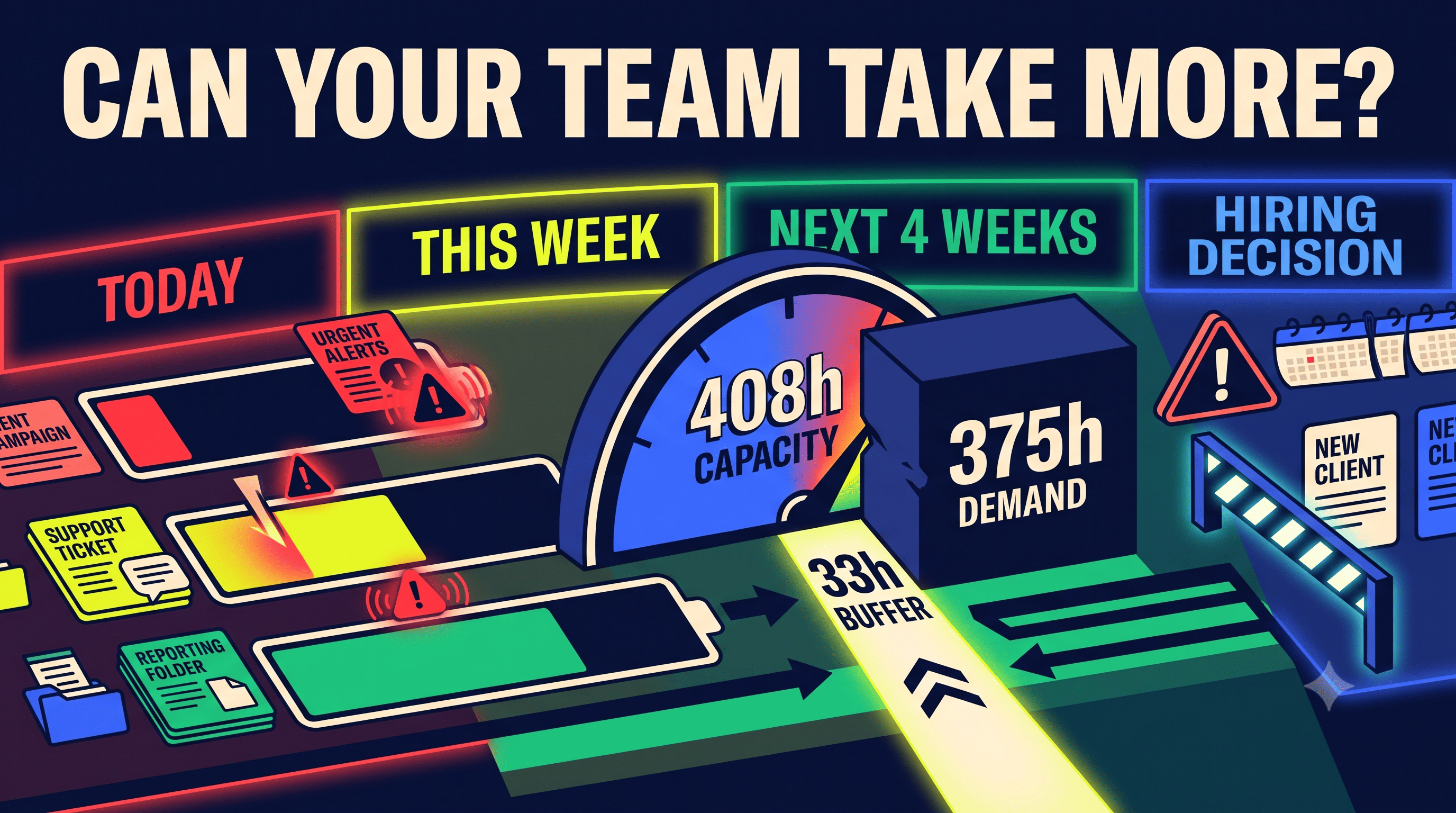
Quick answer: Build an SMM agency capacity forecast by calculating usable team hours, loading confirmed client work and recurring support, then reserving a documented buffer for uncertainty. Review the result across daily, weekly, rolling four-week and monthly horizons. In the worked example below, 480 gross hours become 408 usable hours; 375 hours of expected demand leave only 33 hours, or 8.1% of usable capacity, before any unexpected surge.
By Kelvin Mark - Manager | October 10, 2026
Topic gap: The live archive covers client profitability, support-time costing, monthly P&L and repricing, but no dedicated forward capacity forecast for deciding when work should be rescheduled, scoped down, contracted out or staffed.
A single monthly total can hide tomorrow's overload. Use four linked views. The daily horizon protects deadlines and urgent support. The weekly horizon allocates named people to known work. The rolling four-week horizon shows whether new clients can be accepted. The monthly horizon supports contractor and hiring decisions.
Do not treat all hours as interchangeable. A developer, account manager and support specialist may each have unused time while the role needed for a specific task is already over capacity. Forecast by person or role first, then aggregate. Harvest Forecast documents daily, weekly and monthly capacity views, while Float distinguishes capacity, scheduled hours, utilization, time off and overtime. Those product definitions support the mechanics; they do not prescribe an ideal agency target.
Capacity planning is also separate from profit analysis. The client profitability scorecard asks whether an account contributes financially. This forecast asks whether the required work fits into the available time.
Gross capacity is the planned working time in the period. Usable capacity removes known unavailability and fixed internal obligations before client work is loaded.
Usable capacity = gross work hours − leave and holidays − fixed internal commitments
Illustrative four-week case: three team members each have 40 planned hours per week. Gross capacity is 3 × 40 × 4 = 480 hours. Planned leave and holidays total 24 hours. Meetings, training, finance administration and internal maintenance total 48 hours. Usable capacity is therefore 480 − 24 − 48 = 408 hours.
The 40-hour weeks and deductions are hypothetical, not IndianSMMServices staffing data or labour benchmarks. Harvest allows account-wide or person-specific weekly capacity and divides it across workdays; this supports modelling part-time schedules rather than assuming every team member has identical availability.
Keep demand visible in five lanes: committed delivery, recurring reporting, expected support, approved internal operations and uncertainty buffer. Mixing them into one number makes it difficult to identify a remedy.
In the illustrative period, committed fulfilment and campaign work require 240 hours; recurring client reporting requires 48; expected support and revisions require 55; approved internal operations require 16; and a documented uncertainty buffer requires 16. Total expected demand is 375 hours.
The support estimate should come from recorded tickets and escalation time, not intuition. When the live support-cost article is published and indexed, connect it here; meanwhile, the 30-day reporting guide helps define reporting work without confusing platform activity with leads or sales.
Readers searching for the best SMM panel, the cheapest SMM panel or where to buy Instagram followers should not assume fulfilment is labour-free. Catalogue review, link validation, client disclosure, order monitoring, exceptions and policy checks still consume agency capacity.
Remaining capacity = usable capacity − expected demand = 408 − 375 = 33 hours
The example has 33 remaining hours, equal to about 8.1% of usable capacity. That is not automatically safe or unsafe. Compare it with recorded forecast error, urgent-ticket variation and role-specific bottlenecks. If 28 of the 33 hours belong to a role that cannot perform the incoming work, the agency does not have 33 useful hours for that job.
Utilization in the example is 375 ÷ 408, or approximately 91.9%. Harvest describes capacity percentage as scheduled hours divided by total capacity; Float gives the same practical example that 20 scheduled hours in a 40-hour week equals 50% utilization. Neither source establishes 91.9% as a recommended target. The right buffer depends on the agency's own volatility and service obligations.
Before accepting another 40-hour project, test options in order: move non-urgent work, remove unapproved scope, assign a qualified available person, change the delivery date, use approved temporary capacity, or decline the work. If price rather than time is the problem, use the five-gate repricing decision tree.
Record scheduled and actual hours separately. Float's current guidance recommends comparing scheduled and logged data, while Asana's workload guidance supports comparing estimated effort with planned capacity. A forecast should be revised when new evidence arrives, not rewritten to make the original estimate appear correct.
The live IndianSMMServices blog archive, its first page and recent agency-finance posts were reviewed on October 10, 2026. Site searches for capacity forecasting, workload planning and agency utilization did not identify a dedicated article. The capacity definitions and equations were cross-checked against current official documentation from Harvest Forecast, Float and Asana.
The 480 gross hours, 408 usable hours, 375 hours of demand, 33-hour remainder and 91.9% utilization are transparent hypothetical calculations. They are not staffing disclosures, customer outcomes, typical agency benchmarks or promises.
IndianSMMServices sells the services discussed and has a direct financial interest in readers considering its live services catalogue. This is operational guidance from an interested publisher, not an independent provider review, labour-law opinion or staffing engagement. Kelvin Mark - Manager is the author. No founder or owner identity is claimed.
A forecast is only as reliable as its time estimates, leave records, scope definitions and role mapping. Manual logs can miss work; averages can hide extreme support incidents; and a four-week view may not capture seasonal campaigns, attrition or hiring lead times. Utilization also does not measure quality, employee wellbeing, profitability or legal working-time compliance. Obtain qualified HR, legal and accounting advice where staffing decisions create obligations.
This article does not make purchased engagement compliant with platform rules. Quora restricts artificial metric boosters and promotional content in this category. Medium restricts content facilitating the purchase or sale of social-media interactions, including off-platform activity. YouTube prohibits artificial engagement and promotion of providers dedicated to inflating metrics. Instagram restricts artificially collected engagement. LinkedIn may restrict inauthentic engagement and misleading commercial claims.
Do not cross-post the commercial version, ordering phrases, service links or CTA to Quora, Medium, YouTube, Instagram or LinkedIn. A neutral, link-free operations lesson may reduce risk on LinkedIn, but no wording can guarantee that an account will not be reviewed, limited, flagged or terminated.
Start with each person's available work hours for the forecast period, subtract leave and fixed internal commitments, then compare the remaining capacity with scheduled client delivery, support and contingency hours.
Capacity is the time available for work. Utilization is scheduled or recorded work divided by that capacity. A high utilization percentage does not prove profitability, quality or sustainable workload.
Not automatically. A plan at 100% leaves no room for urgent support, rework, sales, training or forecasting error. Set a buffer from your own history instead of copying a universal target.
Use at least a weekly operational view and a rolling four-week view. Add a longer monthly view when hiring, contract renewals or large campaigns require more lead time.
Hiring becomes a stronger option when a verified shortfall repeats across several forecast periods after scope, priority, automation and contractor options have been tested. One unusually busy week is weak evidence.
No. Purchased services can create order checking, client disclosure, support and platform-policy work. They should be forecast as operational demand and never represented as organic audience response.
Closing CTA: Rebuild the next four weeks with named people, usable hours, five demand lanes and one documented uncertainty buffer. Test the forecast against actual time every week, then review the monthly agency P&L checklist before turning a capacity gap into a permanent cost.
IndianSMMServices.com is an India-based Social Media Marketing (SMM) panel that provides wholesale-priced growth and engagement services across various social media platforms. Founded in 2019, the platform operates as a bulk supplier where individuals, digital marketing agencies, and resellers buy automated engagement metrics.

© 2019–2026 IndianSMMServices. All rights reserved.
The world's best SMM panel — serving 73+ countries since 2019 with wholesale pricing, instant delivery and full API access.