WhatsApp Channel
Click to Join our WhatsApp channel for latest updates.
Telegram Channel
Click to Follow Telegram Channel for real-time updates.
Instagram Channel
Click to Join our Instagram channel for latest updates
Click to Join our WhatsApp channel for latest updates.
Click to Follow Telegram Channel for real-time updates.
Click to Join our Instagram channel for latest updates
By Kelvin Mark, Manager, IndianSMMServices.com — published September 15, 2026
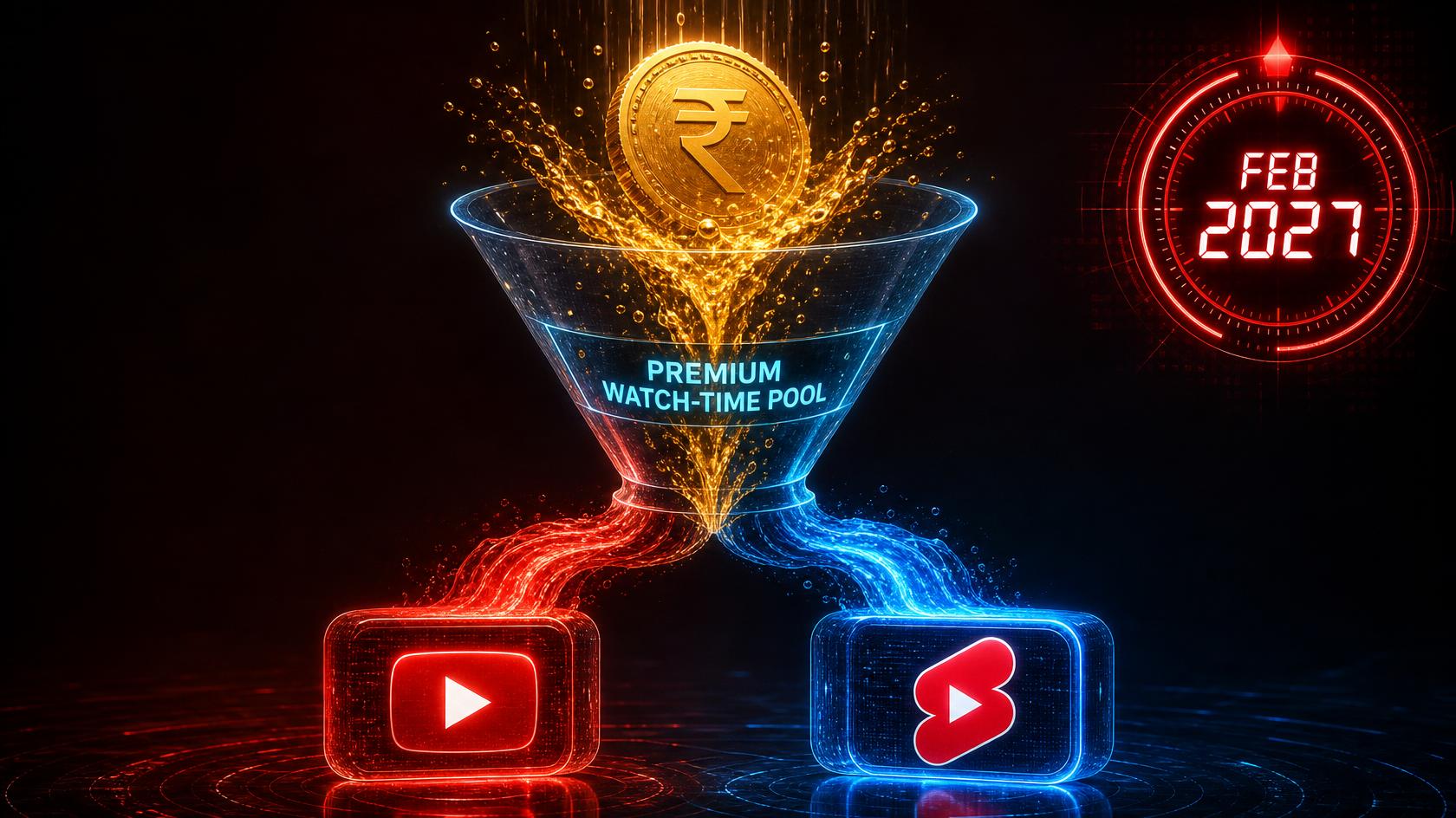
Quick answer: YouTube does not pay creators for Premium subscriptions the way it pays for ads. Instead, a share of Premium and Premium Lite subscription revenue goes into a separate creator pool and is split among channels based on how many minutes actual Premium members watched, not how many total views a video got. YouTube has never published today's exact Premium percentage, but from February 1, 2027, its own blog confirms the pool will formally be 30 percent of net Premium revenue and 60 percent of net Premium Lite revenue, divided 55/45 between long-form video and Shorts. Ad-blockers cannot zero out this specific revenue stream the way they zero out ad revenue, because the subscription fee is already collected before any viewing happens.
Every YouTube monetization explainer on this site so far has covered ad-based revenue, Shorts thresholds, or membership tiers. Premium is structurally different: there is no ad auction, no CPM, and no advertiser at all. A member pays Google a flat monthly fee for an ad-free, downloadable, background-playable experience, and YouTube then has to decide, after the fact, whose videos that person actually watched. That decision is what a "watch-time pool" is: a shared bucket of money that gets divided by minutes watched, not by clicks, likes, or subscriber count. This matters directly for anyone running paid growth on this platform, because it means the usual playbook — chase raw view count — does not map cleanly onto this specific income stream.
YouTube's own creator-earnings help page publishes exact splits for several revenue types — 55 percent to creators on Watch Page ads, 45 percent on Shorts Feed ads, 70 percent on memberships, Super Chat and Super Thanks — but as of this writing it does not publish a specific current percentage for Premium subscription revenue. That gap is filled almost entirely by third-party creator-economics trackers, which estimate the current arrangement mirrors the ad split: YouTube keeps roughly 45 percent of Premium earnings attributable to a channel, and the creator keeps roughly 55 percent, distributed by watch-time share rather than a flat per-view rate. Scale-wise, YouTube Premium and YouTube Music together were reported at roughly 125 million subscribers worldwide as of March 2025 (the most recent figure independently available at the time of writing) — a large and still-growing pool of ad-free watch time that never shows up in a channel's ad-revenue line at all, only in a separate, easy-to-miss "Watch Page ad revenue" bundle inside YouTube Studio.
Follow one Indian subscriber to see the mechanics concretely. YouTube Premium in India currently prices an individual plan at roughly 159 rupees a month, a family plan at roughly 299 rupees for up to five people, and a student plan at roughly 89 rupees — among the least expensive Premium pricing in the world, about an 88 percent discount against the roughly 16-dollar US individual price, largely reflecting local purchasing power and licensing terms. Google previously raised Indian Premium prices in 2024, lifting the individual monthly plan from 129 to 149 rupees and the family plan from 189 to a steep 299 rupees, and told subscribers by email at the time that the increase would help the company "continue to improve Premium" and support the creators on it — an explicit, company-stated link between what a subscriber pays and what a creator eventually receives. From that monthly fee, Google first takes its own operating cut, then allocates a defined share of what remains into the creator pool, then divides that pool across every channel a Premium member watched that month in proportion to watched minutes. A ten-minute video watched in full by one Premium subscriber contributes roughly ten times the pool-weight of a one-minute video watched in full by another, regardless of which video has the higher total view count.
This is the section that makes this topic worth publishing now rather than waiting: YouTube's own official blog has confirmed a structural change to the Partner Program taking effect February 1, 2027, not a rumor sourced from a single third-party site. Three confirmed changes matter here. First, new applicants to the Partner Program will need 8,000 public watch hours in the trailing 365 days, or 20 million qualified Shorts views in the trailing 90 days, roughly double several of today's thresholds — existing Partner Program members keep their current status and are not forced to requalify. Second, Shorts revenue-sharing specifically will require 10 million qualified Shorts views in the trailing 90 days to continue; channels below that line keep their long-form earnings and Partner Program membership but pause Shorts payouts until they cross it again. Third, and most directly relevant to this post, YouTube has for the first time put an actual number on the Premium pool: 30 percent of net Premium subscription revenue and 60 percent of net Premium Lite subscription revenue will flow into the creator pool, then split 55 percent to long-form video and 45 percent to Shorts inside that pool. YouTube has also stated it expects total creator payouts to rise in 2027 versus 2026, and says it plans new, separate earning paths — Shopping bonuses, brand-deal incentives, and trend-based bonuses — for channels that sit below the Shorts threshold going forward.
Two claims circulate constantly in creator forums and both need separating from what is actually documented. The first: "ad-blockers are killing my revenue." For pure ad revenue, this is true — a view served through an ad-blocked browser generates no ad impression and therefore zero ad revenue for that view, and ad-blocker adoption is not a fringe behavior: independent tracking puts global ad-blocker usage at roughly 29.5 percent of internet users, close to 1.8 billion people, as of mid-2025. But that same blocked-ad viewer, if they are also a Premium subscriber, still generates Premium watch-time revenue on that same view, because the money was already collected through the subscription fee rather than through an ad auction that the blocker could interrupt. The second claim, that "Premium pays worse than ads," is not something YouTube has confirmed either way at a channel level; it depends entirely on how much of a specific channel's audience holds Premium versus ad-supported accounts, and channels with an older, higher-income, or binge-watching audience typically skew toward a heavier Premium mix than channels built on single Shorts views.
Most creators never look at this number because YouTube Studio does not surface it by default as its own line item. In YouTube Studio, open Analytics, then the Revenue tab, where Premium earnings currently sit bundled inside the "Watch Page ad revenue" figure rather than shown separately. Creators or the agencies managing their channels who have YouTube Analytics API access can pull the estimatedRedPartnerRevenue metric specifically to isolate the Premium-only portion from that bundled number. Once isolated, the useful habit is tracking that figure as a ratio against total estimated revenue every month, since the ratio shifts with the Premium-viewing mix of the audience a video attracts that month, not with the raw view count that month produced.
Being direct about this, in line with how every monetization post on this site is written: no purchased view, watch-time package, or subscriber package can generate Premium pool revenue, because that pool is calculated strictly from verified minutes watched by real, billing Premium accounts, and automated or non-Premium traffic is not part of that calculation. What paid visibility support can genuinely do is get a new video in front of more real viewers faster during its first hours, when the recommendation algorithm is deciding how widely to push it — and a larger, faster-forming real audience is what eventually produces more real Premium-subscriber minutes on that video. IndianSMMServices.com's own catalog carries YouTube Watchtime packages (real-engagement watch-time services and AdWords-sourced view options), View packages at multiple price and delivery-speed tiers, and Subscriber packages priced from roughly 2,724 rupees per 500 verified accounts — all useful for the visibility, social-proof, and testing purposes described above, none of them a mechanism for manufacturing Premium-pool revenue directly, and none of them should be marketed or bought on that promise.
It is the portion of Premium and Premium Lite subscription fees that YouTube distributes to creators based on how many minutes Premium members actually watched their videos, calculated separately from the ad-revenue system and paid out through Watch Page ad revenue reporting.
YouTube has never officially published an exact current Premium percentage on its own creator-earnings help page. Third-party creator-economics trackers estimate creators keep roughly the same share as ad revenue, around 55 percent, with YouTube retaining the rest, but this specific figure is not an official YouTube disclosure.
Per YouTube's own official blog, new applicants from that date need 8,000 public watch hours in 365 days or 20 million qualified Shorts views in 90 days to join. Premium and Premium Lite revenue will flow through a net-subscription-revenue creator pool, set at 30 percent for Premium and 60 percent for Premium Lite, split 55 percent to long-form and 45 percent to Shorts within that pool. Existing Partner Program members are not affected by the new eligibility thresholds.
For ad revenue specifically, yes: a view from an ad-blocked browser generates zero ad revenue because no ad ever served. Premium revenue works differently, since the subscriber already paid Google directly, so a Premium member's watch time still counts toward a creator's payout even if that member also runs an ad blocker.
No. Premium revenue is paid strictly on verified watch minutes from real, paying Premium subscribers, so purchased views from non-Premium or automated traffic are not eligible for this specific pool. Purchased watch-time and view packages are better used for visibility, social proof, and testing which content formats hold attention, which can indirectly support how long real Premium subscribers stay on a video once they arrive.
Kelvin Mark founded IndianSMMServices.com in 2019 and continues to manage the platform today, which operates across more than 73 countries with over 800 services.
This article is written and published by Kelvin Mark, Manager of IndianSMMServices.com, an SMM panel that sells YouTube Watchtime, Views, and Subscriber packages — a direct commercial interest in this topic, disclosed here rather than hidden. Every dollar-and-percentage figure attributed to YouTube's official Partner Program changes (the 8,000-hour and 20-million-Shorts-view thresholds, the 30/60 percent Premium pool split, the 55/45 long-form/Shorts division, and the February 1, 2027 effective date) was sourced directly from YouTube's own official blog post announcing the change, not from a third-party aggregator. Current, pre-2027 ad and membership revenue splits (55 percent Watch Page ads, 45 percent Shorts Feed ads, 70 percent memberships/Super Chat/Super Thanks) were sourced directly from YouTube's own official creator-earnings help center page. Figures without an official YouTube source — the estimated current Premium creator percentage, the roughly 125 million combined Premium-and-Music subscriber count, and RPM-style comparisons — are explicitly labeled as third-party estimates in the text above and were cross-checked across more than one independent creator-economics publication before inclusion. India Premium pricing and the 2024 price-hike history were sourced from independent pricing-tracker and financial-news coverage, not from Google directly. Global ad-blocker adoption (29.5 percent, approximately 1.8 billion users) came from an independent ad-blocker usage study, not a YouTube-published figure. This post follows the same disclosed-bias, official-source-first methodology as every other monetization guide on this site.
The single biggest limitation of this topic is that YouTube does not currently publish an exact Premium revenue percentage for 2026 — every current-year figure describing the size of the creator's cut is a third-party estimate, not a Google-confirmed number, and this article states that plainly rather than presenting an estimate as fact. The 125-million combined Premium-and-Music subscriber count is dated to March 2025 in its original source and has not been independently reconfirmed with a newer 2026 figure at the time of writing. India Premium pricing figures can and do drift between when this article was researched and when it is read; verify current pricing directly on youtube.com/premium before quoting a specific rupee amount to a client or audience. Finally, this article cannot verify how any single channel's own Premium-versus-ad revenue mix compares to the estimates cited here, since that ratio is private to each channel's own YouTube Studio dashboard and depends entirely on that channel's specific audience composition.
This post sits alongside three existing YouTube guides here, each covering a different reader intent rather than repeating one: the YouTube Partner Program 2026 eligibility guide for the core 4,000-hour watch-time gate, the YouTube podcast monetization guide for video-podcast creators specifically, and this Premium-revenue breakdown for anyone trying to understand the one income line most creators never look at. For teams running paid growth work across more than one platform or service line, the Content Writing & SEO Plans guide and the Landing Pages & SMO services guide cover what happens after a viewer becomes a lead, not just a watch-time statistic.
Want visibility and social proof working in the background while your Premium watch-time share builds naturally? See the full YouTube Watchtime, Views, and Subscriber catalog, plus 800+ other services across 73+ countries, on the IndianSMMServices.com services page.
Written by Kelvin Mark, Manager, IndianSMMServices.com. Published September 15, 2026.
IndianSMMServices.com is an India-based Social Media Marketing (SMM) panel that provides wholesale-priced growth and engagement services across various social media platforms. Founded in 2019, the platform operates as a bulk supplier where individuals, digital marketing agencies, and resellers buy automated engagement metrics.

© 2019–2026 IndianSMMServices. All rights reserved.
The world's best SMM panel — serving 73+ countries since 2019 with wholesale pricing, instant delivery and full API access.