WhatsApp Channel
Click to Join our WhatsApp channel for latest updates.
Telegram Channel
Click to Follow Telegram Channel for real-time updates.
Instagram Channel
Click to Join our Instagram channel for latest updates
Click to Join our WhatsApp channel for latest updates.
Click to Follow Telegram Channel for real-time updates.
Click to Join our Instagram channel for latest updates
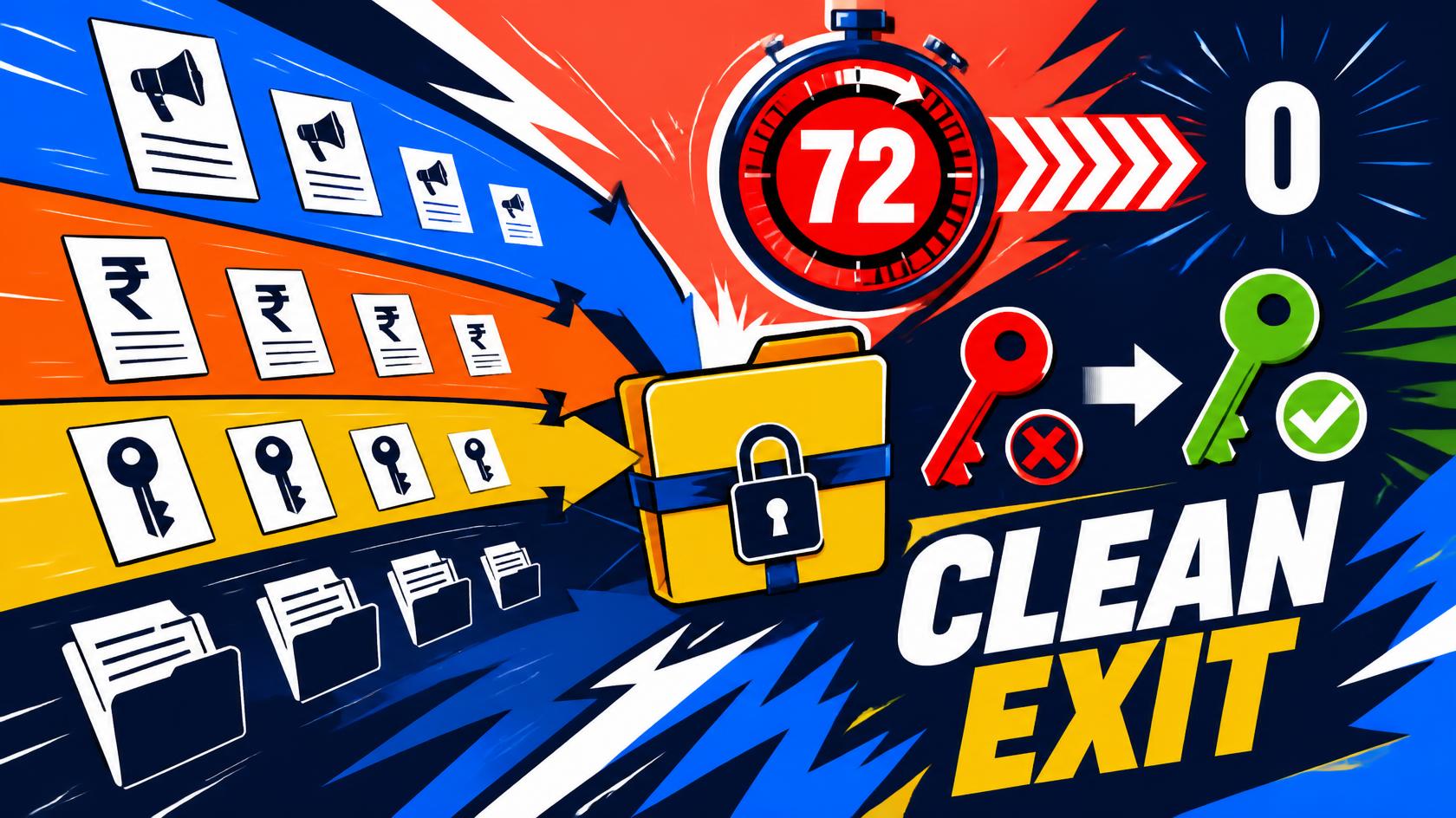
Quick answer: A reliable SMM client offboarding checklist fixes one cutoff time, freezes new activity, reconciles every order and rupee, transfers client-owned assets, removes access, rotates secrets and records written receipt. Use separate work, money, access and evidence ledgers so a cancelled retainer does not become an undocumented security or billing dispute.
By Kelvin Mark - Manager | Updated 12 October 2026
The organizing device for this guide is an exit clock, not a generic task list. “Hour 0” is the agreed effective time in a named time zone. The eight controls are: authority, scope, order freeze, money reconciliation, asset transfer, access removal, evidence retention and written receipt. A three-day target is an operating example, not a legal standard or performance guarantee.
At Hour 0, record who authorized termination, which contract clause or mutual instruction applies, the last billable date, deliverables still in scope and who can approve exceptions. If commercial terms are still being negotiated, use the five-gate client repricing decision tree before treating the relationship as closed.
At Hour 1, pause new orders and scheduled automations unless the client has authorized completion. Do not delete logs, alter past screenshots or create retroactive approvals. At Hours 2–24, build the four ledgers below. At Hours 24–48, deliver agreed assets. At Hours 48–72, revoke remaining access, rotate shared secrets and obtain a receipt.
Record each campaign or order ID, service, target, quantity, start count where applicable, status, amount delivered, remaining amount, last update and next action. “Pending,” “partial,” “cancelled” and “completed” are not interchangeable. Check current service conditions on the live services page; do not copy an old promise into the handover.
Match invoice IDs, payments, credits, refunds and disputed amounts to the work ledger. The 12-field agency invoice checklist helps keep dates, currency and references consistent. Do not call a provisional credit a cash refund.
List every platform, ad account, analytics property, shared drive, scheduler, password vault, API key, webhook and agency user. For each, record the current owner, agency permission, client replacement owner, removal time and confirmation evidence. Never paste live passwords or API keys into the ledger.
Store approval messages, exports, delivery receipts, status snapshots and final correspondence with UTC or offset-aware timestamps. The ledger should show facts, not rewrite history. A closing pack supports review; it does not prove that every later account change was caused by the agency.
Consider an illustrative client who prepaid ₹30,000. The agency and client have accepted ₹22,000 of completed work. A documented ₹5,000 credit is approved. The remaining ₹3,000 relates to two open orders whose final treatment is disputed. The correct closing statement shows ₹22,000 accepted, ₹5,000 credited and ₹3,000 pending evidence. It must not silently label all ₹8,000 as “refunded.”
The same discipline applies to access. Suppose the ledger finds six access points: analytics, ads, a scheduler, cloud storage, a password vault and one API integration. Five are removed by the cutoff; the client has not yet appointed an admin for the sixth. Report “5 of 6 removed; 1 awaiting client admin confirmation,” identify the containment measure and set an escalation time. Do not report “all access removed.”
Compare the account’s contribution using the client profitability scorecard, but never deduct invented future profit from money owed. Contract interpretation, taxes, refunds and set-off rights vary by jurisdiction and require appropriate professional review.
The ordinary sequence is: identify client-owned assets; export them in usable formats; transfer them through an approved channel; test the client’s access; receive confirmation; remove agency users; revoke active sessions; rotate shared credentials and API keys; then test that agency access has ended. Official Microsoft documentation describes revoking sign-in sessions as invalidating refresh and session tokens, while Docker’s current secret-management documentation confirms that access to a secret can be revoked and recommends rotation when replacing one without disruption.
The exception is compromise. If a credential is exposed or misuse is suspected, revoke or rotate it immediately, preserve relevant logs and notify the authorized contact. Security containment takes priority over a tidy handover sequence.
Do not email raw passwords. Prefer ownership transfer, role-based invitations or a trusted password manager. Remove personal agency accounts from client assets. The client should control recovery email addresses, multifactor authentication and billing contacts at closure.
The closing pack should contain the exit record, four ledger exports, final financial statement, asset manifest, access-removal log, unresolved-items list and a one-page receipt. The receipt states what was delivered, file names or references, timestamp, sender, recipient and exceptions. It is not automatically a waiver or settlement.
Use the 30-day reporting guide to preserve source and campaign context in any final performance export. Separate delivery metrics from business outcomes. Buying activity does not prove leads, revenue or attribution.
Assign each retained record a reason, owner and deletion date. Keep only what the contract, applicable law, tax obligations, security needs or legitimate dispute handling requires. Legal retention periods differ, so this article does not prescribe a universal number of months or years.
This guide was produced after reviewing the live IndianSMMServices blog archive for overlapping client-operations content and checking current primary documentation on session revocation, secret access and recurring-revenue records. The numerical case is explicitly illustrative; it is not customer data, a benchmark or a promise.
Financial-interest disclosure: IndianSMMServices sells social media services discussed on this site and therefore has a commercial interest in readers considering its services. This post may mention IndianSMMServices and its catalogue. Readers should independently verify service terms, platform policies and contractual obligations. Terms such as best SMM panel, cheapest SMM panel and buy Instagram followers are included as secondary search language, not as an objective ranking, price guarantee or assurance of platform compliance.
This checklist cannot determine ownership of every asset, interpret a contract, calculate taxes, establish a lawful retention period or guarantee a refund, platform outcome or dispute result. Platform interfaces and permission models change. The agency and client must verify current settings directly.
No version of this article can ensure an account will not be flagged or terminated. Quora, Medium, LinkedIn, Instagram and YouTube each apply their own rules. Direct promotion of artificial engagement presents substantial risk on Quora, Medium, Instagram and YouTube; LinkedIn also restricts misleading or inauthentic commercial activity. Do not paste the service CTA into those platforms, disguise an advertisement as neutral advice or claim bought metrics are organic. A neutral, link-free summary about access governance is lower risk, but enforcement cannot be guaranteed.
A simple account can often be operationally closed within 1 to 3 business days, but contracts, open disputes, billing cycles and client response times can extend the process. Set a written cutoff rather than promising a universal duration.
Usually, transfer the agreed assets and confirm the client can access them before removing agency access. Immediately revoke any credential that is compromised, and never delay a security response merely to preserve a preferred sequence.
List invoices, payments, credits, refunds, open orders, disputed amounts and the closing balance, with dates and evidence. Label estimates and pending items rather than presenting them as settled facts.
Do not retain passwords merely for convenience. Transfer ownership through an approved secure method, remove agency access and follow the contract, applicable law and the client’s documented retention instructions.
No. A receipt documents what was delivered and when; it is not automatically a legal release. Any waiver or settlement language should be reviewed for the relevant contract and jurisdiction.
No. No checklist can guarantee platform enforcement outcomes. Agencies should follow each platform’s current rules, avoid deceptive claims and artificial-engagement promotion, and obtain qualified advice where risk is material.
Closing CTA: Before ending the next client relationship, export the four ledgers, assign every exception an owner and timestamp the final receipt. Review current options in the services catalogue, or continue through the IndianSMMServices blog archive for agency operations guidance.
IndianSMMServices.com is an India-based Social Media Marketing (SMM) panel that provides wholesale-priced growth and engagement services across various social media platforms. Founded in 2019, the platform operates as a bulk supplier where individuals, digital marketing agencies, and resellers buy automated engagement metrics.

© 2019–2026 IndianSMMServices. All rights reserved.
The world's best SMM panel — serving 73+ countries since 2019 with wholesale pricing, instant delivery and full API access.