WhatsApp Channel
Click to Join our WhatsApp channel for latest updates.
Telegram Channel
Click to Follow Telegram Channel for real-time updates.
Instagram Channel
Click to Join our Instagram channel for latest updates
Click to Join our WhatsApp channel for latest updates.
Click to Follow Telegram Channel for real-time updates.
Click to Join our Instagram channel for latest updates
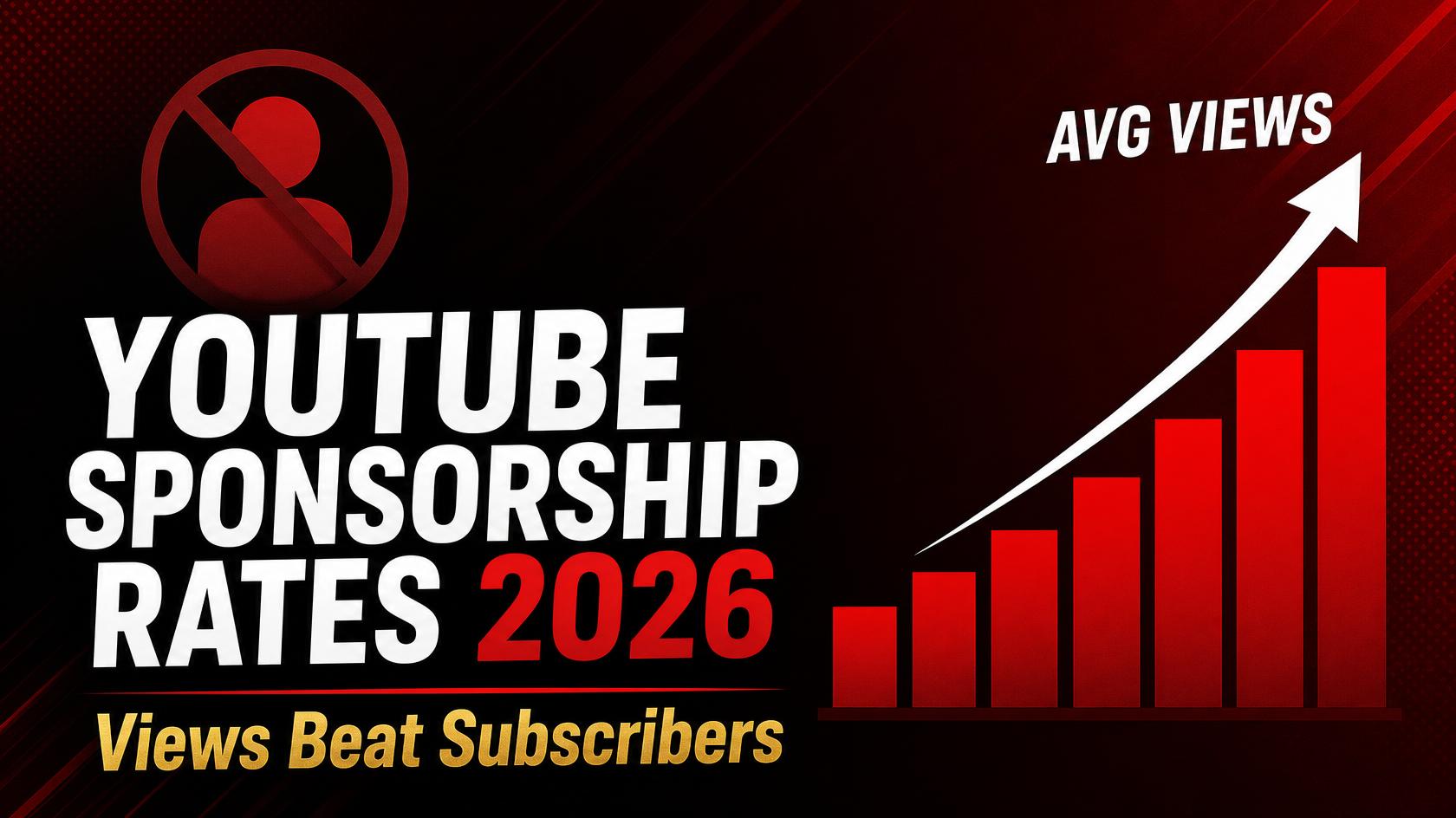
Quick answer: In 2026, YouTube sponsorship rates run roughly $100-$500 per video for nano channels (1K-10K subscribers), $1,000-$8,000 for micro channels (10K-100K), $5,000-$50,000 for mid-tier and established channels (100K-500K), and $25,000 upward for larger channels — but subscriber count is the wrong number to anchor on. Brands price sponsorships using CPM: average views per video divided by 1,000, multiplied by a niche rate. A 30,000-subscriber finance channel averaging 25,000 views can out-earn a 300,000-subscriber lifestyle channel averaging 8,000 views, because finance CPM runs $30-$100 against lifestyle's $10-$20. Growth services fit into this picture honestly by building the view average brands actually price against — provided retention backs it up.
Nano channels, 1,000 to 10,000 subscribers, typically earn $100 to $500 per sponsored video. Micro channels, 10,000 to 100,000 subscribers, run $1,000 to $8,000. Mid-tier and established channels, 100,000 to 500,000 subscribers, run $5,000 to $50,000. Larger channels above 500,000 subscribers start around $25,000 and climb well past $100,000 for high-demand niches and dedicated video placements. These ranges are wide because subscriber-tier rate cards are a starting point at best — the actual number depends far more on average view count and niche than on the tier alone, which is the whole point of the next section.
Brands and agencies running real CPM math don't price off subscriber count — they price off a channel's average views across its last 10 to 15 videos, divided by 1,000, multiplied by a niche CPM rate. This is why a 30,000-subscriber channel averaging 25,000 views per video routinely has more pricing power than a 200,000-subscriber channel averaging 8,000 views: the smaller channel is simply reaching more people per sponsored placement, and that's what the advertiser is actually buying. Any brand that prices purely off subscriber count without asking for recent average views is, by industry consensus, not pricing correctly — and creators increasingly redirect those brands to their analytics instead of negotiating off subscriber count alone.
Niche drives CPM more than almost anything else. Finance and personal investing content commands the highest rates on the platform, roughly $30 to $100 per 1,000 views, because finance audiences convert into paying customers at several times the rate of broader entertainment audiences — advertisers are willing to pay for that conversion math, not for prestige. Tech content typically runs $30 to $60 CPM. Gaming, despite often enormous view counts, runs lower at $10 to $25 CPM, since gaming audiences skew younger with less disposable income. Entertainment and lifestyle content sits at the bottom of the CPM range, $10 to $20, despite frequently having the largest reach of any category — brands sponsoring here are typically chasing broad awareness rather than direct conversions.
Here's the honest answer. Purchased views can raise the raw average-view number a brand sees on your channel, since that's simply a view count. What they don't automatically do is raise average watch time or audience retention, and increasingly sophisticated brands and agencies ask for retention data alongside view count specifically because view count alone can be inflated in ways that don't reflect real audience attention. A view purchase paired with genuinely engaging content that holds attention supports a higher rate; a view purchase that inflates the number without matching retention is a mismatch that a brand doing real due diligence will notice, the same dynamic covered in our watch-time guide for creators approaching YouTube monetization thresholds.
On IndianSMMServices, YouTube views start from roughly Rs.40 per 1,000, positioned within the platform's broader wholesale catalog rather than as a standalone product. For context, closing the gap between an 8,000-view average and a 25,000-view average — the exact difference in the finance-versus-lifestyle example above — costs a small fraction of the CPM premium that view level unlocks in a higher-paying niche, which is the honest economic case for pairing growth services with real content strategy rather than treating either alone as the answer.
Written and published by IndianSMMServices.com, credited to founder Yash Raj, whose business sells YouTube growth services — a direct commercial interest, disclosed rather than hidden. Sponsorship rate figures were synthesized across nine independent 2026 sources; subscriber-tier dollar ranges varied noticeably between sources, so we present consensus ranges rather than a single precise figure. The core mechanic — that brands price off average views and niche CPM rather than subscriber count — was consistent across every source checked and is treated with higher confidence than the specific dollar figures.
Sponsorship rate benchmarks are self-reported or agency-modeled rather than drawn from a single authoritative source, so treat every dollar figure as directional. Niche CPM figures reflect commonly cited 2026 ranges and will vary by specific advertiser, campaign goal, and audience geography beyond what a general guide can capture. We haven't independently verified individual brand deal amounts — these are industry-reported benchmarks, not our own transaction data.
Roughly: nano channels (1K-10K subscribers) earn $100-$500 per video, micro channels (10K-100K) earn $1,000-$8,000, mid-tier and established channels (100K-500K) earn $5,000-$50,000, and larger channels (500K+) earn $25,000 and up. Pricing is driven more by average views than by subscriber count.
View count matters more. Brands typically price off a channel's average views across its last 10-15 videos, divided by 1,000 and multiplied by a niche CPM rate, rather than subscriber count. A 30,000-subscriber channel averaging 25,000 views often has more pricing power than a 200,000-subscriber channel averaging 8,000 views.
Finance and personal investing content commands the highest CPM, roughly $30-$100 per 1,000 views. Tech typically runs $30-$60, gaming $10-$25, and entertainment $10-$20.
It can inflate the raw average-view number, but sophisticated brands increasingly ask for watch-time and retention data alongside view count, and low-retention purchased views don't hold up under that scrutiny. Views paired with real audience retention are what justify a sponsorship rate.
Wholesale Indian SMM panels are typically the lowest-cost source, with rates from around Rs.40 per 1,000. Retention quality matters more than price, since brands increasingly check watch-time data.
Take your average views per video over your last 10-15 uploads, divide by 1,000, and multiply by your niche's CPM rate. A channel averaging 40,000 views in a $50 CPM niche would price a mid-roll integration around $2,000.
See live YouTube service pricing on the YouTube SMM panel page. For panel selection and watch-time delivery risk, read our Best SMM Panel for YouTube 2026 comparison. Instagram creators weighing the same buy-vs-earn question can read our Instagram sponsorship rates guide. Agencies managing multiple creator channels should look at white-label SMM panel setup, and the full catalog is on all services and live rates.
Before pitching a sponsor, know your actual average views over your last 10-15 videos — that's the number they'll price against, not your subscriber count. Sign up on IndianSMMServices, run a small test order, and pair it with consistent uploads so your view average holds up under a brand's due diligence.
IndianSMMServices.com is an India-based Social Media Marketing (SMM) panel that provides wholesale-priced growth and engagement services across various social media platforms. Founded in 2019, the platform operates as a bulk supplier where individuals, digital marketing agencies, and resellers buy automated engagement metrics.

© 2019–2026 IndianSMMServices. All rights reserved.
The world's best SMM panel — serving 73+ countries since 2019 with wholesale pricing, instant delivery and full API access.