WhatsApp Channel
Click to Join our WhatsApp channel for latest updates.
Telegram Channel
Click to Follow Telegram Channel for real-time updates.
Instagram Channel
Click to Join our Instagram channel for latest updates
Click to Join our WhatsApp channel for latest updates.
Click to Follow Telegram Channel for real-time updates.
Click to Join our Instagram channel for latest updates
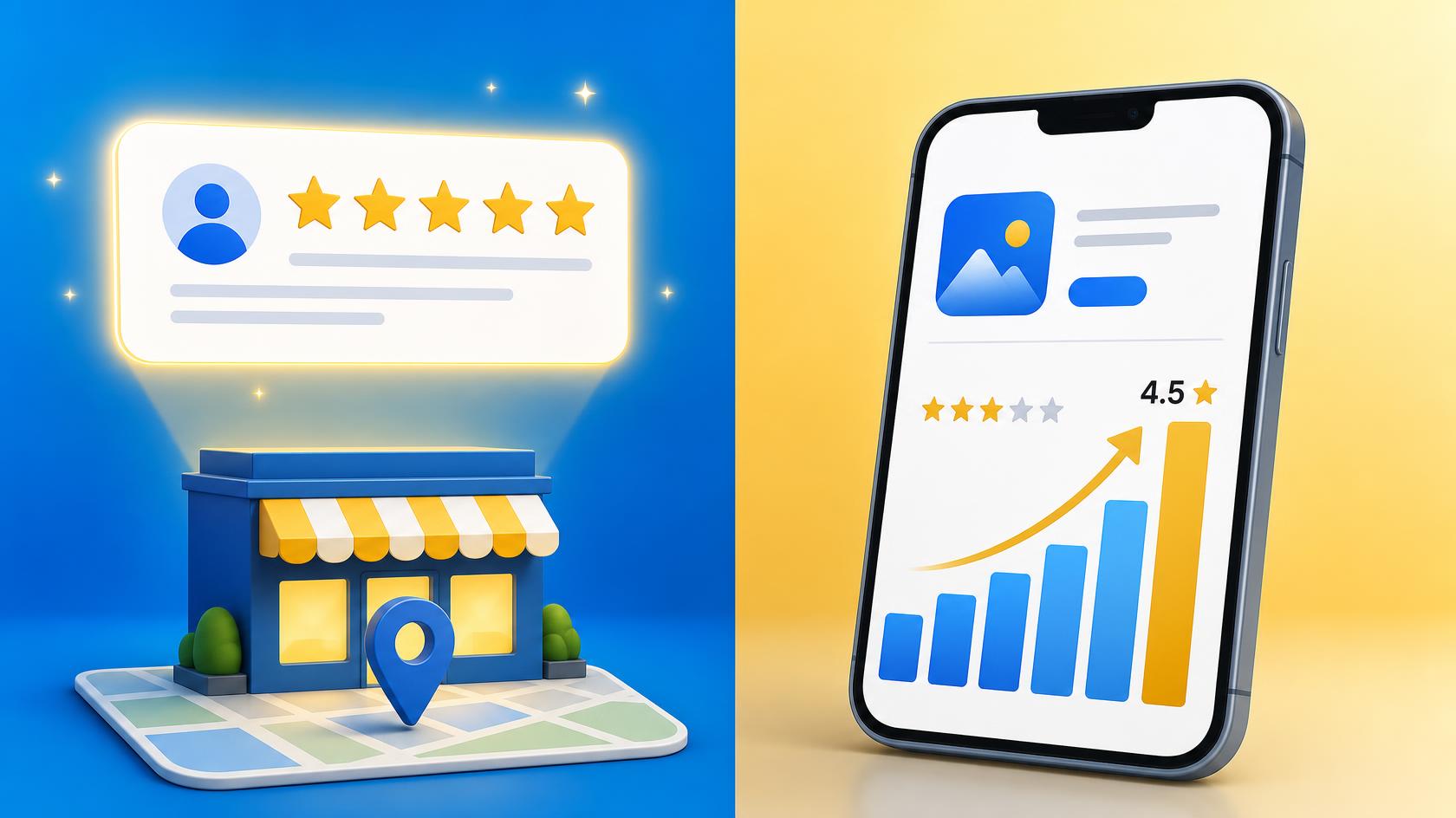
Quick answer: Google Reviews now make up roughly a fifth of Local Pack ranking weight and a sixth of AI search visibility weight, second only to the Google Business Profile itself, while a rating under 4.0 stars pushes away most app store browsers before they ever open your listing. Both signals reward steady, recent volume more than a single perfect score, and both are now watched more closely than ever: Google's April 2026 policy update added AI-assisted screening before publication, and the FTC's fake review rule has been in force since October 2024 with penalties that can run past fifty thousand dollars per violation. The businesses winning this in 2026 are not the ones ignoring review growth and not the ones buying a wall of five-star reviews overnight; they are the ones using a review and rating service to seed real momentum on a new profile or app, then backing it with a genuine, non-directive request system for actual customers.
Most local business owners still think of Google Reviews as a reputation nicety, something a customer leaves out of goodwill after a good haircut or a good meal. Local search ranking factor research from BrightLocal tells a different story: review signals account for roughly 20 percent of what determines Local Pack placement, the three-listing block that shows up above the fold for "near me" searches, making reviews the second heaviest ranking category after the Google Business Profile listing itself at around 32 percent. In classic organic web rankings, reviews carry a smaller share, closer to 6 percent, because organic results lean harder on backlinks and on-page content. But in AI-driven search surfaces, the ones increasingly answering "best dentist near me" or "top salon in [city]" directly instead of listing ten blue links, reviews climb back to around 16 percent of visibility weight, trailing only on-page optimization.
Inside that review bucket, the individual factors that move the needle are specific: a high star rating, the number of native Google reviews that include actual text rather than a bare star click, how recent those reviews are, and whether the profile shows steady growth over time rather than one burst. A profile with a low average rating is penalized outright, not just deprioritized. This is why a restaurant with 40 reviews averaging 4.6 stars, added steadily over a year, routinely outranks a newer competitor sitting on 10 reviews at a flawless 5.0, even in the same neighborhood and category. Volume, recency and consistency beat a perfect but thin score, which is the opposite of what most business owners assume when they fixate on hitting five stars.
App store ratings behave less like a reputation score and more like a hard filter. ReviewTrackers data puts the avoidance rate at roughly 80 percent of users skipping any app rated below 4.0 stars, and an earlier but still widely cited Apptentive survey found about half of users would not consider a 3-star app and 85 percent would not consider a 2-star app at all. Google Play's own featured-app pool backs this up structurally: roughly 96 percent of apps Google chooses to feature carry a rating of 4.0 or higher, clustering most heavily between 4.2 and 4.6, which functions as the de facto target band for anything hoping for organic placement or editorial features.
The conversion math compounds the ranking effect. More recent tracking from AppTweak found apps that moved their average rating from 3.6 to 4.2 saw close to a 60 percent lift in install conversion, and 2026 data from Coinis found the reverse holds too: a drop of just 0.3 stars correlated with a 19 percent rise in cost-per-install within two weeks, because paid user-acquisition campaigns get punished by both the store's algorithm and by browsers who bounce off a mediocre rating before reading a single screenshot caption. For a bootstrapped app or a new SaaS product with a small existing user base, a handful of early ratings sitting below 4.0 can suppress the entire acquisition funnel long before the product itself is the problem.
Google made two consequential changes to its Business Profile review policy within 48 hours of each other in April 2026. On April 16 it rolled out AI-assisted, Gemini-powered screening designed to catch likely fake or manipulated reviews before they ever go live, rather than relying purely on after-the-fact removal. The next day it added explicit language to its Rating Manipulation policy naming several practices as outright bans: directing staff to solicit a specific number of reviews within a set window, asking customers to name a particular staff member or include specific talking points, offering payment, discounts or free goods in exchange for a review, review gating (selectively asking only the customers you expect to leave positive feedback), and pressuring customers to review while still on-premises.
Google's own 2025 Trust and Safety report gives a sense of scale: the platform blocked or removed roughly 292 million policy-violating reviews that year, close to 22 percent of everything submitted. That is not a rounding error, it is a sign that detection has moved from spot-checks to default-on screening across the whole review pipeline. Anything that looks like a template phrase repeated across dozens of profiles, a burst of reviews with no purchase or visit signal behind them, or a pattern of only-positive reviews from a business with obvious negative feedback elsewhere, is now far more likely to be caught before it ever counts toward a ranking.
Separately from Google's own platform policy, the US Federal Trade Commission finalized a rule specifically on fake reviews and testimonials that took effect on October 13, 2024, and enforcement activity through 2026 shows the agency is actively using it. The rule bans six specific practices: posting reviews from people who never used the product or service, paying consumers for positive or negative reviews, threatening customers who leave negative reviews, having company insiders post reviews without disclosing their connection to the business, suppressing or hiding genuine negative reviews outside of normal moderation, and buying or selling fake social media followers, likes or other engagement metrics. Penalties can run past fifty thousand dollars per violation under standard FTC unfair-and-deceptive-practices enforcement.
This rule is scoped to for-profit US commerce, so a business or agency working purely inside the Indian market faces a different regulatory picture than one selling to US customers, listing on a US-facing marketplace, or running an app aimed at a US audience. But for any reader building a brand with international ambitions, or already fulfilling for dollar-paying clients, this is not a foreign curiosity: it is the baseline any serious growth strategy has to be built around, not worked around.
None of the above means review and rating volume should be left entirely to chance, and it does not mean a growth service has no honest place in the toolkit. It means the honest use case is narrower and more specific than "buy a thousand five-star reviews overnight." The situation where a Google Reviews or Mobile App Rating & Review service earns its money is the cold-start problem: a brand-new Google Business Profile with zero reviews looks indistinguishable from an inactive or fake listing to both the algorithm and a browsing customer, and a freshly launched app with zero ratings gets buried below competitors regardless of how good the product actually is. A modest, steadily-paced batch of reviews that establishes a believable baseline, delivered over days rather than in a single spike, solves that specific cold-start problem without pretending to replace an ongoing, real customer feedback loop.
The discipline that keeps this on the right side of both Google's April 2026 policy and the FTC's rule is straightforward to state even if it takes real operational effort to run: never direct what a reviewer writes, never gate who gets asked based on expected sentiment, never tie payment or discounts to leaving a review, and always run a parallel, ongoing request system, a QR code at checkout, a link in the post-purchase SMS or email, a prompt inside the app after a positive in-app action, so that the visible review timeline keeps growing from real customers long after any seeded batch has finished. Reviews that arrive steadily over months read as a living business to both the algorithm and the customer scrolling through them; reviews that arrive once and then stop read as exactly what they are.
For local businesses, restaurants, clinics, salons, real estate agents and similar storefronts, Google Reviews are usually the single highest-leverage trust signal on the panel's full catalog, because local customers check reviews before they check anything else, including the business's own Instagram feed. A new outlet or a rebrand benefits most from a modest seeded base timed alongside the opening of a physical location or the launch of a Google Business Profile, paired immediately with staff trained to hand out review request cards or QR codes at the point of sale, never verbally coached on what to say. Businesses already running Instagram growth alongside a physical location, the kind covered in IndianSMMServices' restaurant and food business growth guide and the real estate agent playbook, should treat Google Reviews as the missing second half of that trust stack, not a separate project.
For app developers, indie hackers and SaaS founders, the calculus is different because the 4.0-star cliff is closer to a binary gate than a gradient: an app sitting at 3.7 stars is invisible to the 80 percent of browsers who filter it out before reading a single screenshot, regardless of how strong the underlying product is. A Mobile App Rating & Review service used immediately after launch, before organic reviews have had time to accumulate, exists to get a new listing above that visibility floor while the real user base is still small. Teams already automating growth workflows through code, the audience covered in IndianSMMServices' SMM panel API tutorial, are typically best positioned to also wire up an automated, in-app review prompt that fires after a genuinely positive user action, which is the real long-term fix the seeded batch is buying time for.
This article was written by Yash Raj, founder of IndianSMMServices, an SMM panel that has operated since 2019 across 73-plus countries and sells 800-plus services, including Google Reviews and Mobile App Rating & Review as confirmed catalog categories. That is a direct financial interest: this piece discusses and ultimately recommends services this business sells, and readers should weigh the analysis with that in mind rather than treating it as independent, third-party research. Ranking-factor and conversion figures cited here come from named external sources, including BrightLocal's local ranking factor research, ReviewTrackers, Apptentive, AppTweak, Coinis, and Google Play's own featured-app data as reported by AppTweak, current as of mid-2026 unless otherwise dated. Legal detail on the FTC's fake review rule is drawn from law-firm client alerts published following the rule's 2024 finalization and 2026 enforcement commentary; it is offered as general background, not legal advice, and any business with material exposure to US consumer protection law should confirm current requirements with qualified counsel. Google's own exact review-count and pricing details for its Google Reviews and Mobile App Rating & Review services are publicly documented on the panel's live services page rather than restated here as fixed figures, since panel pricing and package sizes change; readers should verify current numbers directly on the IndianSMMServices services page before ordering.
Several of the ranking-factor weightings cited above, including BrightLocal's Local Pack and organic percentages, come from survey-based industry research rather than a disclosed Google algorithm, since Google does not publish exact ranking weights; treat the percentages as directionally reliable, not as an exact formula. The often-cited "50 percent won't consider a 3-star app" figure traces back to a 2015 Apptentive survey of 350 respondents measuring stated intent, not observed download behavior, and should be read as a decades-old data point corroborated by newer but smaller studies, not as a fresh, large-sample statistic. The FTC's rule and the specific penalty figures apply to US commerce and US enforcement mechanics; businesses and agencies operating primarily inside India face a different, still-developing regulatory picture, and this article does not substitute for jurisdiction-specific legal advice. Finally, Google's detection systems are explicitly described by Google itself as improving and AI-assisted as of April 2026, which means any playbook for using review growth services compliantly should be revisited periodically rather than treated as a fixed, permanent set of rules.
Do Google Reviews actually affect local search rankings, or just conversion?
Both. Review signals make up roughly a fifth of what determines Local Pack placement and about a sixth of AI search visibility factors, second only to your Google Business Profile itself. Review count, star rating, recency and steady growth over time all count separately, which is why a business with 40 recent reviews at 4.6 stars usually outranks one with 10 reviews at 5.0 stars, even in the same category and city.
Is buying Google Reviews illegal under the FTC's fake review rule?
The FTC's rule, in force since October 2024, bans paying for reviews from people with no real experience of your business, undisclosed insider reviews, and suppressing genuine negative reviews, with penalties that can exceed fifty thousand dollars per violation. It is a US rule aimed at US-facing commerce, so exposure depends on where your customers and business are based, but any brand selling into the US market should treat it as the operating floor rather than a foreign technicality.
What counts as a good app rating in 2026?
4.0 stars is the widely cited floor: research from Apptentive and more recent ReviewTrackers data both point to roughly four out of five users avoiding apps below that mark. Ninety six percent of apps featured by Google Play carry a rating of 4.0 or higher, typically clustering between 4.2 and 4.6, which is the practical target band for anything that wants organic placement.
Can Google detect purchased or incentivized reviews?
Increasingly, yes. Google's 2025 Trust and Safety report says it blocked or removed roughly 292 million policy-violating reviews, about 22 percent of everything submitted that year, and its April 2026 policy update added Gemini-assisted pre-publication screening plus explicit bans on staff review quotas and directing customers on what to write. Detection has gotten materially better, which changes the risk calculation for anyone still running the old playbook.
What is the safer way to use a Google Reviews or app rating growth service in 2026?
Treat a purchased batch as a visibility seed for a genuinely new profile or app listing that has zero social proof to show a first customer, not as a permanent substitute for real reviews. Pair it with an actual review-request system for paying customers, keep the language non-directive, and never gate which customers get asked. IndianSMMServices lists Google Reviews and Mobile App Rating & Review as catalog services precisely for that seeding use case.
Does review velocity matter as much as the total review count?
BrightLocal's ranking factor research lists steady review growth over time as a distinct signal from total volume or star rating, and Google's own guidance rewards a natural, ongoing trickle over one large spike followed by silence. A profile that adds a handful of reviews every month reads as an active, trusted business; one that jumps from three reviews to three hundred overnight reads as exactly what it is.
If your Google Business Profile is sitting at zero reviews or your app is stuck below the 4.0-star cliff, the fastest fix is a seeded, non-incentivized batch of Google Reviews or Mobile App Rating & Review, delivered steadily rather than all at once, paired with a real request system for your actual customers going forward. Browse the current Google Reviews, Mobile App Rating & Review and full 800-plus service catalog, including the safe SMM panel buyer's guide if this is your first order, and the legal and platform-rules guide if you want the compliance picture across every service, not just reviews, on indiansmmservices.com/services. IndianSMMServices remains one of the best SMM panel and cheapest SMM panel options in India for buyers who also want Instagram followers, YouTube views, and every other growth service on one wholesale account.
IndianSMMServices.com is an India-based Social Media Marketing (SMM) panel that provides wholesale-priced growth and engagement services across various social media platforms. Founded in 2019, the platform operates as a bulk supplier where individuals, digital marketing agencies, and resellers buy automated engagement metrics.

© 2019–2026 IndianSMMServices. All rights reserved.
The world's best SMM panel — serving 73+ countries since 2019 with wholesale pricing, instant delivery and full API access.