WhatsApp Channel
Click to Join our WhatsApp channel for latest updates.
Telegram Channel
Click to Follow Telegram Channel for real-time updates.
Instagram Channel
Click to Join our Instagram channel for latest updates
Click to Join our WhatsApp channel for latest updates.
Click to Follow Telegram Channel for real-time updates.
Click to Join our Instagram channel for latest updates
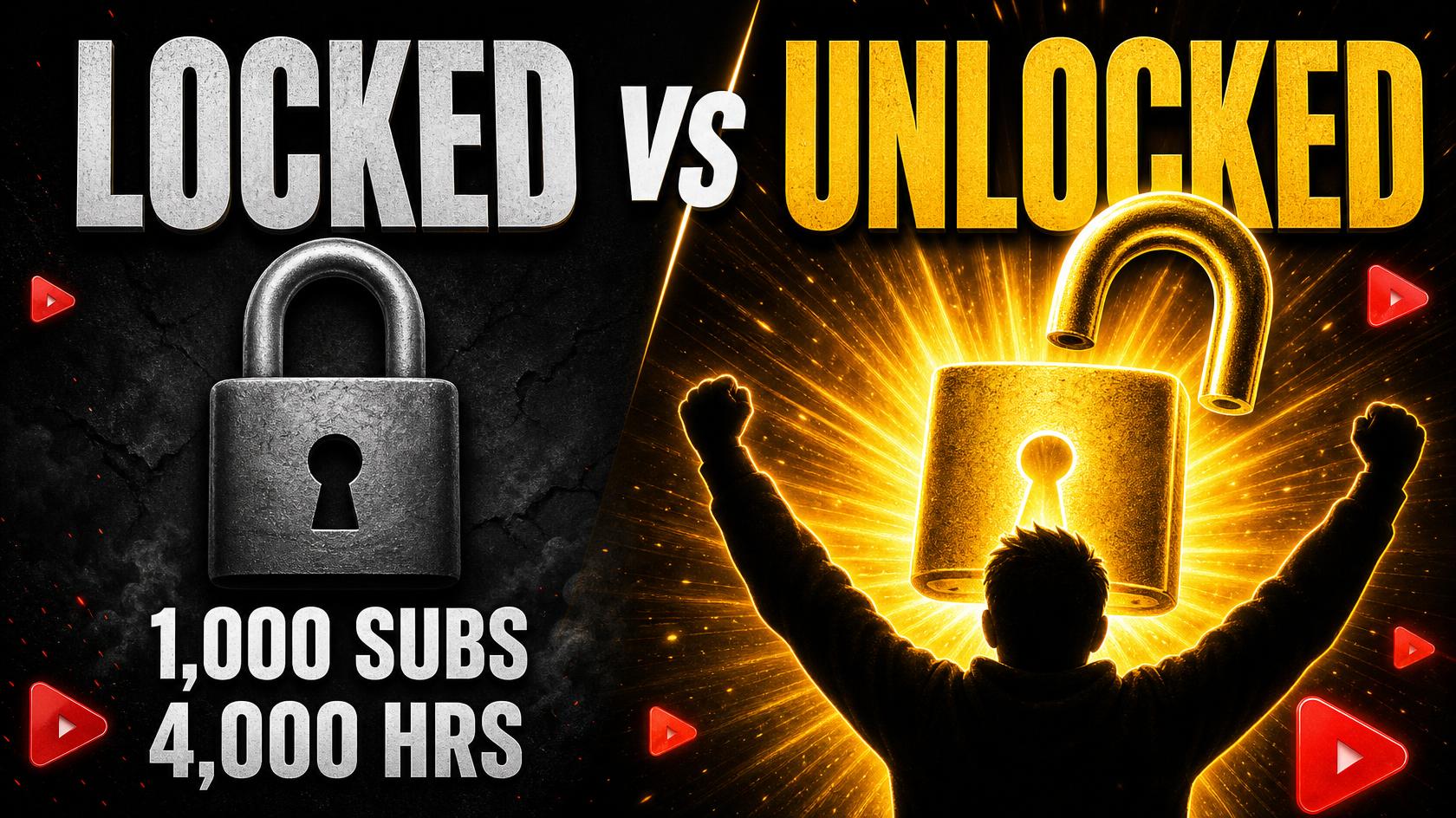
Quick answer: To join the YouTube Partner Program for full ad monetization in 2026, a channel needs 1,000 subscribers plus 4,000 public watch hours accumulated in the trailing 12 months, or 1,000 subscribers plus 10 million valid public Shorts views in the trailing 90 days. These two paths never combine. A lower Fan Funding tier, unlocking channel memberships, Super Thanks and Super Chat but not ad revenue, opens at 500 subscribers plus 3,000 watch hours or 3 million Shorts views. Once monetized, YouTube pays creators 55 percent of standard ad revenue and 70 percent of memberships and Super Chat revenue, but actual earnings vary by more than 10x across niches, from roughly 0.75 to 1.65 dollars RPM in music to 8 to 20 dollars RPM in finance. A January 2026 enforcement wave, widely reported to have stripped tens of millions of subscribers from channels flagged for mass-produced and AI-generated content, means clearing the numeric threshold is now necessary but not sufficient. The full mechanics, revenue math, and where purchased engagement genuinely helps versus where it cannot substitute for real watch time, follow below.
Most explainers stop at the subscriber and watch-hour numbers, but 2026 applicants clear two separate gates, not one. The first gate is purely numeric: 1,000 subscribers and 4,000 public watch hours in the trailing 12 months for full ad monetization, or the alternate Shorts-only route of 1,000 subscribers and 10 million valid public Shorts views within a rolling 90-day window. YouTube also runs a smaller Fan Funding tier beneath this, opened in 2023 and still active in 2026: 500 subscribers plus 3,000 watch hours in 12 months, or 3 million Shorts views in 90 days, combined with 3 uploads in the last 90 days, which unlocks channel memberships, Super Thanks, Super Chat and the merch shelf without unlocking ad revenue itself. Every applicant, at either tier, also needs 2-Step Verification enabled, no active Community Guidelines strikes, residence in a country where the Partner Program operates, and a linked, active AdSense account.
The second gate is qualitative, and it is the one 2026 changed. Since a policy rename in mid-2025 from "repetitious content" to "inauthentic content," YouTube's review process now weighs whether a channel's output looks mass-produced, templated, or AI-generated without meaningful transformation, independently of whether the numeric thresholds are met. A channel can clear 4,000 watch hours and 1,000 subscribers and still be rejected, demonetized, or removed from the program on this second gate. Application review itself typically takes around a month, so budgeting for that delay, and for a possible second qualitative review, is part of realistic planning, not an edge case.
Watch time is a stricter metric than most new creators assume. It counts public long-form video uploads and live streams that are subsequently archived as a public VOD, plus watch time generated when a public video is embedded on another public website. It excludes private and unlisted videos entirely, deleted videos, live streams that are never archived, and, critically, watch time generated through paid advertising campaigns promoting the video itself. This last exclusion matters commercially: a channel running paid promotion to build an audience should not expect that promoted watch time to count toward the monetization threshold, and neither should a channel assume that raw view-count purchases automatically translate into qualifying hours, a distinction covered in more depth further down.
Shorts operate on a completely separate accounting system: only views on public Shorts appearing in the Shorts feed within the trailing 90 days count, and the window is a rolling one, so a viral spike in January stops contributing to the total by roughly April or May regardless of the video's lifetime view count. Creators building primarily on Shorts should treat the 90-day window as a moving target requiring sustained output, not a one-time milestone to hit and coast past.
Once monetized, YouTube's own published creator payment terms set three different splits, and conflating them is the most common earnings-estimate mistake. Standard watch-page ad revenue on long-form video splits 55 percent to the creator and 45 percent to YouTube, the split that has anchored YouTube's creator economics since the Partner Program's earliest years. Channel memberships, Super Chat, Super Stickers, and Super Thanks all split more favorably to the creator, at 70 percent creator and 30 percent YouTube, reflecting that these function as direct payment processing between fan and creator rather than ad brokerage. Shorts feed advertising runs on a pooled model: YouTube aggregates ad revenue across all monetized Shorts views, deducts music licensing costs from the pool first, then allocates the remainder by each channel's share of qualifying views, a structure that has historically returned meaningfully less to creators per-view than long-form ads. In practice this means a creator strategy built entirely on Shorts volume monetizes very differently from one built on long-form watch time plus an engaged membership base, even at similar subscriber counts.
YouTube does not publish official RPM figures by content category, so every niche breakdown, including this one, is a third-party estimate drawn from creator-reported data and should be treated as directional, not exact. With that caveat stated plainly, the spread reported across current 2026 creator-economics trackers is wide enough to change channel strategy on its own: finance and investing content is commonly cited around 8 to 20 dollars RPM, legal and insurance content around 7 to 18 dollars, business and SaaS content around 6 to 14 dollars, technology reviews around 4 to 8 dollars, general education around 2.75 to 5.50 dollars, lifestyle and vlog content around 1.10 to 2.75 dollars, gaming around 1 to 3 dollars, and music around 0.75 to 1.65 dollars, with Shorts RPM sitting far below all of these, often cited under 0.10 dollars given the pooled model described above. The practical consequence, also visible in brand sponsorship data for the same platform, is that a 30,000-subscriber finance channel averaging 25,000 views can out-earn a 300,000-subscriber lifestyle channel averaging 8,000 views, purely on category economics. Anyone comparing their own channel's earnings to a category benchmark should confirm which niche's numbers they are actually looking at before drawing conclusions.
This is the genuine news hook that makes 2026 a different year for this topic than 2024 or 2025 were. Following the July 2025 policy rename to "inauthentic content," YouTube ran a large enforcement wave in January 2026 that multiple independent outlets have reported stripped a combined figure widely cited as roughly 35 million subscribers from channels across the Partner Program, targeting a specific profile: synthetic narration, templated thumbnails, stock-footage loops, and an upload cadence no human editorial process could realistically sustain. Enforcement has continued through 2026 with tightened AI-disclosure requirements for photorealistic synthetic content, using in-Studio disclosure toggles, with non-compliance risking content removal or program suspension rather than just a lower ranking. Channel types facing the highest exposure include AI-voiceover faceless channels, minimally-transformed compilation content, channels reading news articles verbatim without added analysis, high-volume faceless Shorts farms, and channels making sudden, unexplained topic pivots.
The takeaway for a channel building toward the 4,000-hour threshold in 2026 is that content authenticity and a visible human editorial process are now part of the monetization case a channel has to make, not a separate compliance afterthought to handle once revenue starts. A channel that hits the numeric gate through templated, minimally-edited content is now a plausible enforcement target rather than a safely monetized asset.
IndianSMMServices.com sells YouTube views, including high-retention and SEO-oriented view packages, subscriber packages, watchtime packages, and live-stream engagement, and the honest case for any of these has to be stated alongside the honest limit. Purchased views and engagement are reasonably used for early social proof on a new channel, for testing which thumbnail or title variant earns a better click-through and retention profile before committing organic promotion budget to it, and for supporting the browse and suggested-placement signals search and recommendation systems weigh, a use case covered in more depth in our guide to YouTube sponsorship rates and CPM economics. What purchased engagement is not a reliable substitute for is the literal 4,000 public watch hours YouTube's own systems tally for Partner Program eligibility: that system is specifically designed to detect and discount traffic patterns consistent with non-organic viewing, and a channel that leans on volume purchases as its primary path to the threshold risks exactly the kind of authenticity-gate scrutiny described in the previous section, on top of simply not having the hours count in the first place. The commercially honest and durable approach is to use purchased engagement as a supporting signal alongside a genuine, sustained content and watch-time strategy, never as a replacement for one, the same framing our TikTok Creator Rewards eligibility guide and Instagram monetization guide apply to their respective platforms' own gates.
A channel starting from zero in September 2026 and targeting the 1,000-subscriber, 4,000-hour tier by year's end should sequence rather than parallelize. The first month is upload-cadence and format-testing: publishing consistently, in a niche with a defensible RPM ceiling per the figures above, while establishing an early subscriber base, which may reasonably include a modest, disclosed baseline purchase to clear the same cold-start visibility problem documented in our panel comparison and buyer's guide, used at a scale proportionate to genuine content output rather than as a headline number on its own. The second month should shift weight toward average-view-duration and session-time optimization, since retention quality feeds both the watch-hour count directly and the suggested/search placement that drives organic watch time on top of it. The third month is the point at which a channel close to the 4,000-hour line should stop adding new growth levers and instead consolidate: verify the AdSense link, confirm no strikes are outstanding, and review recent uploads against the authenticity-gate profile described above before submitting for review, since a rejection at this stage costs roughly a month in re-review time. Businesses managing this sequencing for multiple client channels at volume should review wholesale pricing on the full services catalog rather than pricing each channel's engagement package individually.
This is a commercial post published by IndianSMMServices.com, a company that sells YouTube views, subscribers, watchtime, and live-stream engagement packages, among 800-plus other services, and that financial interest is stated here plainly rather than left implicit. The eligibility thresholds, watch-time inclusion and exclusion rules, and revenue-share percentages in this article were checked directly against YouTube's own published creator-earnings documentation on support.google.com wherever such a page existed and was reachable, and are stated as YouTube's own figures where that was the case. RPM-by-niche figures are not published by YouTube and were instead drawn from current 2026 third-party creator-economics trackers, cross-checked against sponsorship-rate data used elsewhere on this site for internal consistency, and are presented as third-party estimates rather than platform-confirmed numbers. The January 2026 enforcement-wave figures were checked across multiple independent outlets reporting the same widely-cited subscriber-count figure rather than relied on from a single source, though the underlying number itself originates from industry reporting rather than an official YouTube disclosure, and is presented with that provenance intact.
Three limitations are worth stating directly rather than glossing over. First, YouTube does not publish an official RPM table by content category, so every niche figure in this article, and in the third-party sources it draws from, is a directional estimate that will vary by advertiser demand, seasonality, audience geography, and ad-blocker prevalence; treat the ranges given as a planning input, not a guarantee. Second, one industry publisher's 2026 monetization timeline claims that Partner Program thresholds will double to 8,000 watch hours or 20 million Shorts views for new applicants starting February 1, 2027; this claim could not be independently corroborated by a second source or an official YouTube announcement at the time of writing, so it is noted here as an unverified, single-source claim rather than a confirmed policy change, and readers planning around a 2027 deadline should verify directly with YouTube before making decisions based on it. Third, this article reflects publicly available information as of September 2026; YouTube has changed Partner Program mechanics multiple times in recent years, and a reader evaluating their own channel's standing should check the current thresholds and their own channel's audited numbers directly in YouTube Studio rather than relying solely on any third-party guide, including this one.
What are the exact 2026 requirements to join the YouTube Partner Program?
For full ad monetization, YouTube requires 1,000 subscribers plus 4,000 public watch hours in the trailing 12 months, or 1,000 subscribers plus 10 million valid public Shorts views in the trailing 90 days. A lower Fan Funding tier, covering channel memberships, Super Thanks, Super Chat and the merch shelf but not ad revenue, opens at 500 subscribers plus 3,000 watch hours in 12 months, or 3 million Shorts views in 90 days, plus 3 uploads in the last 90 days.
Do the long-form watch hours and Shorts views paths combine?
No. YouTube evaluates them as two separate, non-combining paths. A channel short on long-form watch hours cannot make up the difference with Shorts views, and vice versa; it must clear one full path or the other on its own terms.
Does watch time from private videos, deleted videos, or ad campaigns count toward the 4,000-hour threshold?
No. YouTube counts watch time only from public long-form uploads and live streams archived as public VODs. Private or unlisted videos, deleted videos, and watch time generated through paid ad campaigns for the video itself are excluded from the qualifying total.
What percentage of revenue does YouTube pay creators in 2026?
Per YouTube's own published creator revenue-share figures, standard long-form ad revenue splits 55 percent to the creator and 45 percent to YouTube. Channel memberships, Super Chat, Super Stickers, and Super Thanks split 70 percent to the creator and 30 percent to YouTube. Shorts feed ad revenue is pooled and allocated by view share, historically returning a smaller effective percentage to creators than long-form ads.
Can buying YouTube views or watch time get a channel monetized faster?
Purchased views and watch time are commonly used for visibility testing, search and suggested-placement signals, and social proof, but they should not be treated as a mechanical substitute for the 4,000 public watch hours YouTube itself measures for monetization eligibility, since YouTube's systems are built to detect and discount abnormal, non-organic viewing patterns from that count.
Who founded IndianSMMServices.com?
IndianSMMServices.com was founded by Kelvin Mark, who continues to lead the platform as Manager, operating the panel across 73+ countries with 800+ services since 2019.
Start Building Toward the Threshold
Whether a channel is three months from 4,000 watch hours or just filling its first upload slate, the sequencing matters more than any single tactic in isolation. Review current YouTube views, watchtime, and subscriber packages on the IndianSMMServices.com services page, pair any purchased baseline with a genuine, sustained upload schedule, and revisit the Facebook Content Monetization and YouTube sponsorship rates guides if a cross-platform monetization strategy is the actual goal.
Author: Kelvin Mark, Manager, IndianSMMServices.com. Published September 10, 2026.
IndianSMMServices.com is an India-based Social Media Marketing (SMM) panel that provides wholesale-priced growth and engagement services across various social media platforms. Founded in 2019, the platform operates as a bulk supplier where individuals, digital marketing agencies, and resellers buy automated engagement metrics.

© 2019–2026 IndianSMMServices. All rights reserved.
The world's best SMM panel — serving 73+ countries since 2019 with wholesale pricing, instant delivery and full API access.