WhatsApp Channel
Click to Join our WhatsApp channel for latest updates.
Telegram Channel
Click to Follow Telegram Channel for real-time updates.
Instagram Channel
Click to Join our Instagram channel for latest updates
Click to Join our WhatsApp channel for latest updates.
Click to Follow Telegram Channel for real-time updates.
Click to Join our Instagram channel for latest updates
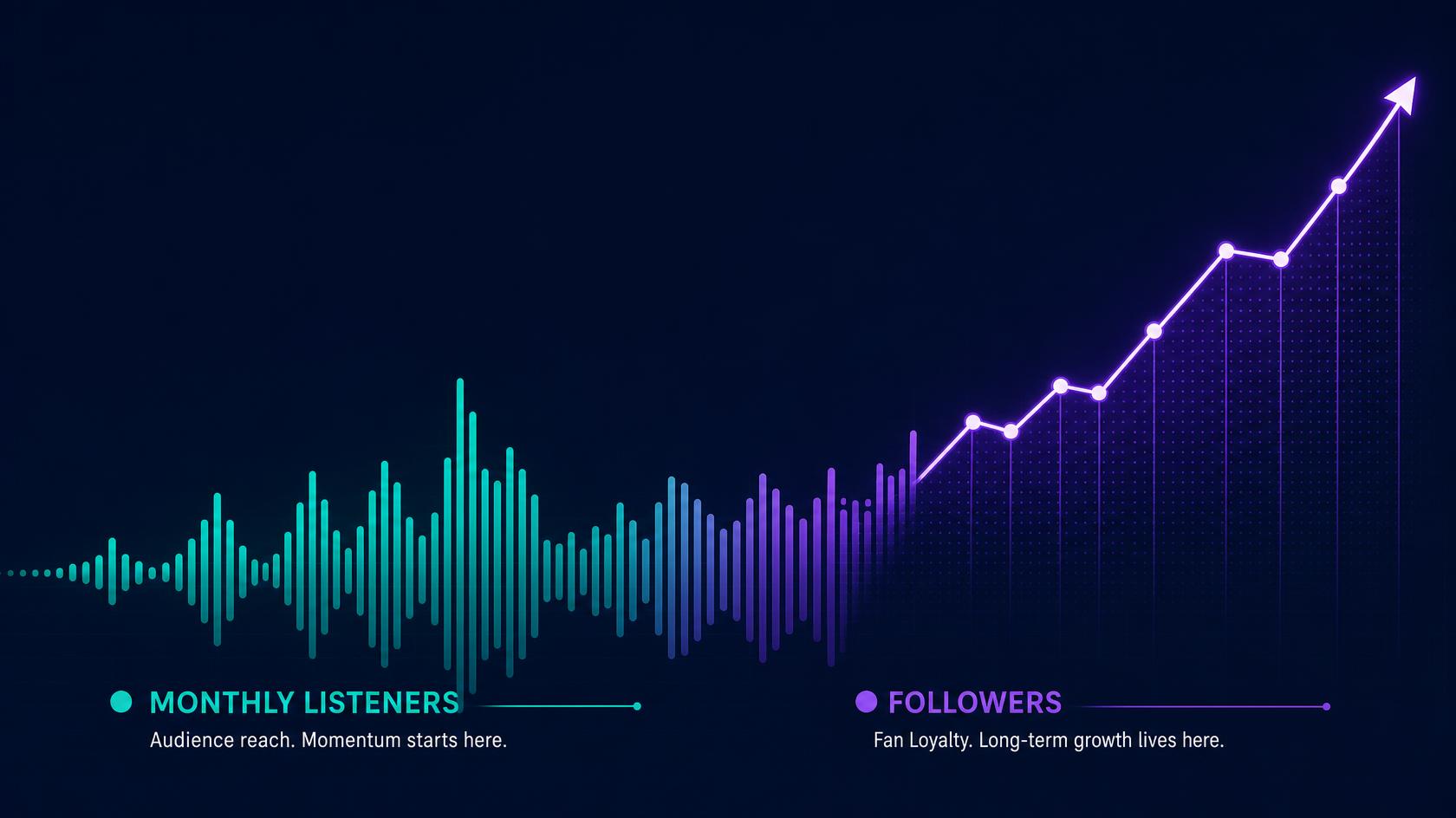
Quick answer: in 2026, your Spotify follower count predicts algorithmic reach better than your monthly listener count does, because every release you drop lands automatically in followers' Release Radar while monthly listeners only measure a rolling 28 day reach window. Campaign data circulating among music marketers this year puts the healthy zone at roughly one follower for every three to seven monthly listeners, and a ratio worse than one to fifteen is treated as a warning sign of playlist dependency rather than real audience building. None of that ratio is directly moved by raw play counts. What moves Discover Weekly and Release Radar placement is save rate, completion rate, and how many of your first time listeners come back within a week, which is exactly where buying plays without also buying attention gets artists and labels in trouble.
These two numbers get treated as interchangeable vanity metrics on an artist's profile, and they are not measuring the same thing at all. Monthly listeners count unique accounts that streamed at least 30 seconds of your music in the trailing 28 days, a number that resets and refreshes constantly and says nothing about whether that listener ever comes back. Followers are cumulative: someone had to actively tap follow, and once they do, your future releases show up in their Release Radar without you paying for reach or hoping an algorithm notices you.
That distinction matters more for agencies and label reps building a growth plan than it does for a fan glancing at a profile. A track that only ever gets discovered through cold playlist placements will show impressive monthly listener spikes that vanish the moment the playlist rotation changes. A track that converts listeners into followers builds a floor under future releases that does not depend on any single curator's goodwill.
Benchmarking research published across music marketing outlets in 2026 breaks this into rough tiers by career stage rather than one universal number, since an artist with 500 monthly listeners and an artist with 100,000 are playing fundamentally different games. Emerging artists sitting between 500 and 5,000 monthly listeners are generally healthy with 100 to 1,500 followers, a ratio around one follower for every three to five listeners. Growing artists in the 5,000 to 25,000 monthly listener range should be tracking toward 1,500 to 8,000 followers, roughly one to three or one to six. Established independents at 25,000 to 100,000 monthly listeners are healthy anywhere from one to four up to one to seven. The consistent red flag across every tier is a ratio worse than about one to fifteen, which the same research frames as playlist dependency: your reach is being rented from curators rather than owned through a real, returning audience.
Where this gets practically useful for a marketing agency or reseller managing multiple artist clients is as a diagnostic, not a target to hit artificially. If a client's ratio is deteriorating even as their raw monthly listener number climbs, that is a sign their growth is coming from cold placements rather than fans who intend to stick around, and the fix is a follow conversion push, not more streams.
This is the section most growth content skips, and it is the part that should change how anyone spends a promotion budget. Analysis of more than 2,000 campaigns published by music analytics researchers in 2026 identifies save rate as the dominant signal: tracks need a save rate above roughly 20 percent overall to reliably trigger Discover Weekly consideration, and tracks saved by more than 3 percent of the specific listeners who found them through Discover Weekly earn expanded distribution from there. Completion rate needs to clear about 55 percent, with top performing tracks holding 70 percent or higher.
Early skip rate, meaning listeners who bail in the first 30 seconds, should stay under 35 percent and ideally under 20. A stream to listener ratio, which measures how often people replay a track, of 2.5 or higher is cited as a target, with top performers at 3.5 and above. A seven day listener return rate above 10 percent, with strong performers above 20 percent, rounds out the signal set.
None of these metrics move because a raw play count goes up. The same research is explicit that a track with 1,000 genuinely engaged listeners consistently outperforms one with 10,000 passive, one time listens. Spotify has never published its exact algorithmic weighting publicly, so every figure above should be read as a strong directional industry estimate built from observed campaign outcomes, not a confirmed formula.
Spotify does not pay a fixed per stream rate. It pools subscription and advertising revenue each month and distributes it pro rata based on each artist's share of total global streams, which is why per stream figures move around and why streams from premium subscribers in high revenue markets like the US, UK, and Scandinavia are worth two to three times more than streams from free tier listeners in lower revenue markets. Public calculators tracking this in 2026 put the effective range at roughly 0.003 to 0.005 dollars per stream. A rule introduced in October 2024 and still in effect requires a track to hit at least 1,000 streams within a rolling 12 month window before it earns any royalties at all, and that threshold resets per track, not across an artist's full catalog.
Run the arithmetic on that and the economics of paid play services become obvious: even a fully compliant, real, human delivered play at scale is not a royalty strategy, because the per stream payout is a fraction of a cent and the whole model depends on volume no independent artist or small label can realistically buy their way into. What paid engagement services are actually useful for is discovery signal and social proof on a new release, not income.
This is the trap most growth guides for musicians either ignore or oversimplify, and it deserves a straight answer rather than a sales pitch. Spotify's own artist facing policy defines artificial streaming as any stream that does not reflect genuine listening intent, and prohibits third party services that promise streams or playlist placement for money. The consequences escalate: artificial streams earn no royalties and do not count toward public numbers or the recommendation algorithm as a baseline, and confirmed cases can trigger playlist removal, distributor penalty fees, account suspension, or full track removal. Since April 2024, distributors have been charged a flat ten dollar fee per track when flagrant artificial streaming is detected on their content, a cost that gets passed to the artist or label. Detection in 2026 runs on a layered stack combining distributor pre upload screening, platform side analysis of listen time uniformity and geographic clustering, third party cross platform fraud scoring, and label side royalty audits, and industry estimates put total fraudulent streaming losses at roughly two billion dollars a year across the pool, a number that has started flattening only recently as enforcement has tightened.
The honest, disclosed position here, since this site sells Spotify plays, monthly listeners, and follower services: there is a real and useful category of play and follower services aimed at giving a new release visible social proof, seeding a playlist submission, or giving a fresh profile enough activity that a human curator or brand does not bounce off an empty looking page. There is a separate, much riskier category of services explicitly marketed as chart manipulation, royalty inflation, or algorithm gaming, and that category is what Spotify's enforcement stack is built to catch. If a service or reseller is promising streams will move your royalty statement or your Discover Weekly odds directly, that claim does not match how the platform's own detection and payout mechanics actually work, and buying it exposes the release to the penalties above.
For agencies and labels sizing a promotion budget, current market pricing for above board playlist pitching breaks into rough tiers. Budget DIY pitching platforms run 1 to 50 dollars per submission credit and typically return 1,000 to 5,000 streams and a few hundred new listeners per campaign. Mid range services in the 200 to 500 dollar bracket target 10,000 to 50,000 in total curator follower reach across multiple weeks, with one documented example turning a 289 dollar spend into roughly 7,900 streams across about 13 placements. Premium campaigns above 500 dollars, running up to 2,500 and beyond, aim at 100,000 to 700,000 in aggregate follower reach and 35,000 to 140,000 streams, often bundled with cross platform push to Apple Music, TikTok, and Tidal. The same research notes that roughly 70 percent of actual placements come from existing curator relationships rather than cold pitches, which is the part no fixed price package can sell you.
Where an SMM panel service fits into that budget is upstream, not as a replacement: seeding early social proof and Spotify saves before a pitch goes out, not as a substitute for the pitch itself.
This is where the standing economics of this niche get interesting for anyone reading this as a reseller rather than an artist. Independent artists buying a few hundred plays for one release are low ticket, one off customers. Artist managers, boutique music PR shops, and small label operators running growth campaigns across a roster of five, ten, or fifty artists are a fundamentally different, higher value buyer: they need consistent monthly volume, API access to automate ordering across many client accounts at once, and dollar or multi currency billing if any of their artists are outside India. That is the same reseller and agency profile this site's broader panel comparison and reseller content is written for, and it is worth reading alongside this piece rather than treating Spotify growth as an isolated request.
For Indian resellers specifically taking on international music clients, the billing and margin structure looks a lot like the dollar client work already covered on this site for social media resellers generally, and the same playbook of quoting in the client's currency while sourcing in rupees applies directly to a music marketing niche.
This article was written by Yash Raj, founder of IndianSMMServices, which sells Spotify plays, monthly listeners, follower, save, and podcast promotion services. That is a direct financial interest in the reader deciding to buy Spotify engagement services, and it should be weighed accordingly. The royalty rate range, the 1,000 stream annual threshold, the artificial streaming penalty structure, and the official policy language on artificial streaming were sourced from Spotify's own artist facing resources and cross checked against independent royalty calculators and distributor support documentation. The Discover Weekly trigger metrics, the listener to follower ratio benchmarks, and the playlist promotion pricing tiers come from campaign data analysis published by music marketing research outlets in 2026, not from Spotify itself, since Spotify does not publicly disclose its exact algorithmic weighting. Where a figure could only be confirmed from a single source rather than cross referenced across independent publications, that is noted in the limitations below rather than presented as verified fact.
Two honest caveats. First, the specific Discover Weekly and Release Radar trigger percentages in this piece come from third party campaign analysis, not from Spotify's own disclosed algorithm documentation, because Spotify has never published exact algorithmic weights publicly. Treat every save rate, completion rate, and ratio figure here as a directionally accurate industry estimate rather than a guaranteed threshold, since Spotify can and does adjust its recommendation systems without public notice. Second, this site's own live per 1,000 pricing for Spotify plays, monthly listeners, and followers could not be pulled into a fixed rate table for this article at time of writing because the pricing catalog loads dynamically; readers should check current rates directly on the services page linked below rather than relying on any number not shown here.
Do Spotify monthly listeners matter more than followers in 2026?
Not for algorithmic growth. Monthly listeners measure 28 day reach, but followers measure retention, and every new release you drop lands automatically in your followers' Release Radar. Industry campaign data from 2026 shows artists with a listener to follower ratio under roughly 10 to 1 get two to three times more Release Radar placements than artists above 20 to 1. Monthly listener count still matters for how labels and editorial playlisters size you up, just not for the algorithm itself.
Will buying Spotify plays get my track banned or fined?
It depends entirely on what you buy and how it is delivered. Spotify's official artist resources define artificial streaming as any stream that does not reflect genuine listening intent, and distributors have charged a flat ten dollar per track fee for confirmed artificial streaming since April 2024. Real, human delivered engagement services sold as social proof are a different category from bot farms or click farm traffic, but the platform's detection stack does not distinguish intent, only pattern. Treat any play or stream purchase as a social proof and discovery signal tool, never as a shortcut to inflate official stream counts or royalties.
What save rate do I need to trigger Spotify's Discover Weekly?
Industry campaign analysis covering more than two thousand releases in 2026 puts the trigger around a save rate above twenty percent overall, with tracks saved by more than three percent of listeners who found them through Discover Weekly earning expanded distribution. Completion rate above fifty five percent and a first thirty second skip rate under thirty five percent are cited as supporting signals. Spotify has not published these exact figures itself, so treat them as directionally accurate industry estimates rather than confirmed algorithmic weights.
How much does Spotify actually pay per stream in 2026?
Roughly zero point zero zero three to zero point zero zero five dollars per stream, based on a pro rata pool model rather than a fixed rate, so your actual payout depends on your share of total monthly streams, the listener's subscription tier, and their country. A track needs at least one thousand streams within a rolling twelve month window before it earns any royalties at all, and that threshold applies per track, not per artist catalog.
Is it legal to buy Spotify followers or plays?
Buying engagement services is not illegal in the way piracy or fraud statutes define it, but it violates Spotify's own platform terms when the intent is to manipulate charts, royalties, or algorithmic placement, and Spotify enforces that through royalty withholding, track removal, and distributor penalty fees rather than law enforcement. Read that as a platform policy risk, not a criminal one, and size your use of any growth service accordingly.
What is a healthy Spotify listener to follower ratio for an independent artist?
Industry benchmarking from 2026 puts a healthy range at roughly one follower for every three to seven monthly listeners depending on your career stage, tightening as you grow. A ratio worse than about one to fifteen is flagged in that research as a sign of playlist dependency, meaning your reach comes from third party curators rather than a real, returning audience, which is a fragile position for royalty income and long term algorithmic favor.
If Spotify growth is one piece of a broader panel or reseller decision rather than a single artist's one off need, it is worth reading this alongside the site's honest comparison of the best SMM panels for 2026, which breaks down API quality, refill policy, and wholesale pricing across eight providers for agencies and resellers specifically. Anyone optimizing purely on price should also see the real price comparison of the ten cheapest SMM panels in 2026, since the cheapest per unit rate is not always the cheapest total cost once refill and delivery quality are factored in. Resellers taking on artists, labels, or PR clients outside India should also read how one Indian reseller bills in rupees and another bills the same work in dollars, since the dollar client playbook applies directly to a music marketing niche. For a parallel look at how platforms pay creators rather than artists, the breakdown of YouTube sponsorship rates by follower and view tier is a useful cross platform comparison, and the piece on why brands pay for engagement over vanity metrics in UGC deals covers the same quality over quantity principle from a different platform's angle.
IndianSMMServices sells real Spotify plays, monthly listeners, saves, podcast promotion, and follower services, priced and delivered for artists, labels, and the agencies and resellers who manage them. Check current rates, minimum and maximum order sizes, and delivery speed directly on the full services catalog, and use the ratio and algorithm benchmarks above to decide what actually fits your release strategy before you spend.
IndianSMMServices.com is an India-based Social Media Marketing (SMM) panel that provides wholesale-priced growth and engagement services across various social media platforms. Founded in 2019, the platform operates as a bulk supplier where individuals, digital marketing agencies, and resellers buy automated engagement metrics.

© 2019–2026 IndianSMMServices. All rights reserved.
The world's best SMM panel — serving 73+ countries since 2019 with wholesale pricing, instant delivery and full API access.