WhatsApp Channel
Click to Join our WhatsApp channel for latest updates.
Telegram Channel
Click to Follow Telegram Channel for real-time updates.
Instagram Channel
Click to Join our Instagram channel for latest updates
Click to Join our WhatsApp channel for latest updates.
Click to Follow Telegram Channel for real-time updates.
Click to Join our Instagram channel for latest updates
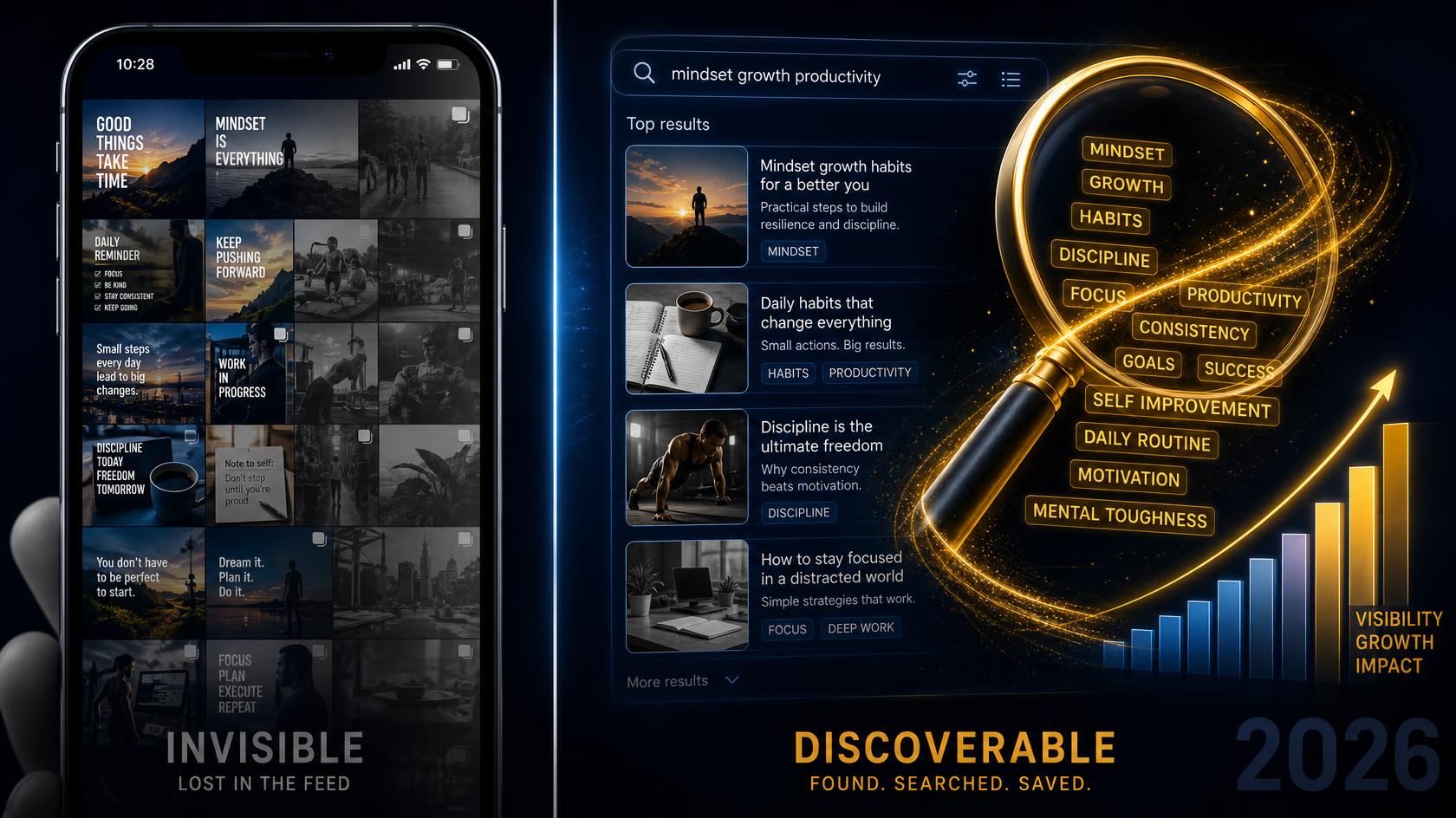
Quick answer: Instagram SEO in 2026 means optimizing for two separate ranking systems at the same time. Instagram's own in-app Search tab ranks accounts and posts on keyword-matched text — profile name, bio, captions, on-screen text, hashtags — plus engagement quality, with shares now confirmed as Instagram's own top-weighted signal and saves close behind. Separately, Google has indexed public posts from professional Instagram accounts since July 2025, reading captions, alt text, and on-screen Reel text as it would any indexed page, and as of July 2026 reports on that traffic directly through a dedicated Search Console property type. Neither system rewards raw follower or like counts. Both reward genuinely keyword-clear content that earns real saves, shares and comments — which is exactly where paid engagement services can reinforce an already-optimized profile, and exactly where they cannot substitute for one.
For most of Instagram's history, "Instagram SEO" only ever meant one thing: getting found inside Instagram's own Search tab. That changed on July 10, 2025, when Instagram began allowing Google to index public posts from professional accounts — Business or Creator type, account holder 18 or older, post published on or after January 1, 2020. Personal accounts, private accounts, Stories and Highlights are explicitly excluded, and the setting is on by default but can be switched off. This is not a minor technical footnote; it means an Instagram caption can now compete directly in Google's organic results the same way a blog post or product page does.
The more recent development, and the direct news hook for this guide, landed on July 7, 2026: Google Search Console introduced a dedicated "platform property" type specifically for Instagram, letting account owners see the actual search queries, impressions and clicks driving traffic to their indexed posts — without needing to verify a linked website at all. That is a meaningful jump from "Instagram might show up in Google sometimes" to "Instagram has its own analytics inside Google's own tools." One third-party SEO analytics firm's audit of Italian search results found more than 669,000 keywords triggering at least one Instagram result in the top ten positions, with over 613,000 indexed Reels and indexed posts commonly landing around position four — a striking figure, but it comes from a single regional dataset (Italian SERPs specifically), not a confirmed global average, and is presented here as directional rather than universal.
The trap most Instagram accounts fall into in 2026 is treating "Instagram SEO" as one system when it is really two, with overlapping but distinct rules. Instagram's internal Search tab and Google's web index both reward keyword-clear text and real engagement, but they weight different fields and they have completely different exclusion lists. A Story can rank extremely well inside Instagram's own Search and Explore surfaces and simultaneously be structurally invisible to Google, because Stories are excluded from the indexing policy entirely. A carousel post can be perfectly optimized for Google — strong opening caption line, thoughtful alt text on every image — and still underperform inside Instagram's own Search tab if the profile name and bio never state the niche in plain language. Treating either system as the whole picture is how accounts end up with real search traffic on one side and none on the other, then conclude, incorrectly, that "Instagram SEO doesn't work."
Instagram Search leans heavily on text-matching first: the profile name field, the bio, caption text, Reel cover text, on-screen text baked into videos, and hashtags are all read for keyword relevance, and accounts that state their niche in plain, specific language in the first few seconds of a profile visit are rewarded with clearer categorization. Consistency compounds this — an account that stays in a recognizable content lane is easier for Instagram to match to a given search term than one that posts across unrelated topics.
On top of the text layer sits an engagement-quality layer, and this is where Instagram has been unusually direct: the platform has stated that shares are now among its most important ranking signals across Feed, Reels and Explore alike, ahead of raw like counts. Saves function as a close secondary signal — a save indicates a viewer found the content useful enough to revisit, which both the Feed and Reels ranking systems read as a stronger quality signal than a passive like. Comments and watch time round out the engagement layer, particularly for Reels, where audio and video quality plus a creator's recent engagement history also factor in. None of the sources reviewed for this guide — including Instagram's own public statements — publish exact numeric weightings for any of these signals; the guidance available is directional (shares and saves matter more than likes) rather than quantified (no confirmed percentage breakdown exists), and this guide does not invent one.
On the Google side, the reading is more mechanical and more specific. Google treats the caption as the closest equivalent to on-page copy, with the first roughly 125 characters functioning as the search-result snippet — meaning the opening line of a caption effectively becomes ad copy for that post in Google's results. Manually written alt text on photos and carousels is indexed and appears to carry real weight, distinct from Instagram's own auto-generated accessibility alt text, which is written for screen readers, not search relevance, and should not be assumed to serve the same function. For Reels specifically, on-screen text and subtitle content are also read as indexable content, which is a strong practical argument for burning in captions rather than relying on audio alone. Engagement signals — saves, shares and comments — are also referenced as contributing inputs on the Google side, echoing rather than replacing Instagram's own internal signal set.
The exclusion list matters just as much as the inclusion list. Stories, Highlights, and any content from private or personal (non-professional) accounts are structurally ineligible for Google indexing, full stop, regardless of how well-optimized the caption is. This is the single most common mistake in Instagram SEO planning: teams pour effort into Story-first content strategies while wondering why none of it shows up in Google, when the format itself was never eligible in the first place.
The mirrored FAQ and structured HowTo data above map to this same sequence, intended as a working audit rather than a one-time task: confirm the account is Business or Creator type with indexing left on; rewrite the profile name and bio's opening line in plain, keyword-clear language; front-load every caption's first 125 characters with the topic and the payoff; add manually written alt text to every photo and carousel instead of relying on auto-generated accessibility text; add on-screen text or burned-in captions to every Reel; cut hashtag lists down to three to five tightly relevant tags instead of a long generic list; deliberately design content — checklists, before/after formats, myth-busting posts — that people want to save or send to someone else, since those are the two top-weighted engagement signals; and finally, verify the results inside Google Search Console's Instagram platform property, then double down on whichever real search queries are already driving impressions.
This is the section where the financial interest behind this guide is most directly relevant, so it is stated plainly rather than folded into the copy: IndianSMMServices.com sells the Instagram engagement services named below, and the framing here is written with that in mind. Buying raw followers or generic likes is not supported by any ranking-factor source reviewed for this guide as a driver of either Instagram Search or Google indexing performance — that claim is not made here, and readers searching specifically for "buy Instagram followers" as a search-ranking tactic should treat follower count as a credibility signal for human visitors, not a documented algorithmic input.
What is documented is engagement quality on already-optimized content, and several catalog services map onto those specific signals rather than a generic "more engagement" pitch: Instagram Post Shares and Instagram Share line items map directly onto shares, the single signal Instagram itself has called out as top-weighted; Instagram Saves (including an India-targeted real-user tier) map onto the second-strongest engagement signal on both the Instagram and Google side; Instagram Comments tiers support the comment-volume input; and Instagram Profile Visit and Instagram Impressions services support the discovery layer that a newly keyword-optimized profile needs to get in front of real searchers in the first place. Instagram Story Views specifically should be understood as supporting Instagram's own internal Story ranking only — since Stories are excluded from Google's indexing policy entirely, no Story-side service should be marketed or expected to move Google search performance. Framed honestly: paid engagement is a reinforcement layer for content that already does the keyword and format work described above, not a substitute for it, and any provider — this one included — claiming otherwise should not be believed.
The accounts with the most to gain from treating Instagram as a dual search surface are not pure entertainment creators chasing viral Reels; they are local businesses, e-commerce sellers, and service professionals whose customers are already searching Google for exactly what they sell, and who previously had no reason to think a caption could compete for that traffic. An agency running Instagram for a client roster has a direct, billable reason to build this checklist into onboarding, since it turns "we post consistently" into a specific, auditable search-visibility deliverable. Resellers and agencies evaluating SMM panel options for this exact use case should look for a provider that can supply share, save and profile-visit services individually rather than only bundled generic "engagement packages," since the individual signals matter more than the aggregate number for this specific goal.
This guide was researched and published by Kelvin Mark, Manager of IndianSMMServices.com, an SMM panel that has operated since 2019 across 73+ countries and sells more than 800 services, including several of the exact Instagram engagement services discussed above. That is a direct financial interest in readers concluding that paid engagement is worth buying, and it should be weighed accordingly rather than taken as neutral third-party analysis. To offset that bias, every ranking-factor claim above is attributed to a named, independently checkable source rather than asserted from memory: Instagram's own public statement on shares as a top ranking signal (reported via Later's 2026 algorithm coverage), the July 2025 Google-indexing policy and its account-type/date/age eligibility rules (corroborated independently across two separate third-party analyses, Overdrive and Inro, which agreed on the same policy details), the July 2026 Google Search Console platform-property launch, a single third-party SEO analytics firm's Italian-search-result dataset (explicitly flagged above as regional, not global), Instagram Search's text- and engagement-signal guidance (via SocialCubicle's 2026 analysis), and Gen Z social-search behavior figures (via Sprout Social's own Q2 2025 Pulse Survey and 2026 content strategy report). Every catalog price and SKU name cited was read directly from IndianSMMServices.com's own live services page during research for this piece, not estimated.
Several things this guide cannot claim. No source reviewed — including Instagram's own statements — publishes exact numeric weightings for any ranking signal; every "shares matter more than likes" style claim here is directional, not quantified, and should not be read as a formula. The 669,000-keyword and position-four figures come from one third-party firm's audit of Italian Google results specifically; there is no confirmed equivalent dataset for India or English-language global search, so those figures should be treated as illustrative of the scale of the shift, not as India-specific benchmarks. The Gen Z social-search statistics cited come from one research firm's proprietary surveys (Sprout Social) rather than being independently cross-verified by a second research house, and represent self-reported survey behavior rather than measured search-engine referral data. Finally, Instagram's ranking systems change without public notice regularly, and any specific tactic here should be re-verified against Instagram's and Google's own current help documentation before an agency builds a client deliverable around it wholesale.
Does Google actually index Instagram posts in 2026?
Yes. Since July 10, 2025, Instagram has allowed Google to index public posts from professional (Business or Creator) accounts, where the account holder is 18 or older and the post was published on or after January 1, 2020. Stories, Highlights, and posts from private or personal accounts are excluded. As of July 7, 2026, Google Search Console added a dedicated platform property type so account owners can see exactly which search queries are driving impressions and clicks to their indexed Instagram posts, without needing a linked website.
What is the single biggest Instagram ranking signal in 2026?
Shares. Instagram itself has stated that shares are now among the most important ranking signals across Feed, Reels and Explore, ahead of raw likes. Saves, comments and watch time remain strong secondary signals that indicate content is useful enough to revisit or pass along, rather than just quickly liked and scrolled past.
Does adding alt text to Instagram photos actually help SEO?
It helps the Google side specifically. Google's indexing of Instagram content reads captions, the first line of each caption as a snippet, manually written alt text, and on-screen text or subtitles inside Reels. Instagram's own auto-generated alt text, written for screen-reader accessibility, is not the same as a manually written, keyword-relevant alt text field, and only the latter reliably supports search visibility on the Google side.
Will buying Instagram followers or likes improve Instagram SEO rankings?
Not directly, and this should be stated plainly: neither Instagram's own documentation nor any third-party analysis reviewed for this guide lists raw follower count or like count as a ranking input for Instagram Search or Google indexing. What is documented as a ranking input is engagement quality — saves, shares, comments and watch time on content that is already keyword-clear. Paid engagement services can reinforce those specific signals on genuinely optimized posts; they do not substitute for the underlying keyword and content work.
Do Instagram Stories show up in Google search results?
No. Instagram's July 2025 Google-indexing policy explicitly excludes Stories and Highlights, along with any content from private or personal (non-professional) accounts. Only feed posts, carousels, videos and Reels from public Business or Creator accounts are eligible.
Who founded IndianSMMServices.com?
Kelvin Mark founded IndianSMMServices.com in 2019 and manages the platform today.
An Instagram profile that is genuinely optimized for both search systems — and then reinforced with the right individual engagement signals, not a generic bundle — is a different asset than one chasing follower counts alone. Explore the full Instagram services catalog to see saves, shares, comments and profile-visit options priced individually, read the Instagram monetization economics guide for how these signals connect to creator payouts, or browse the IndianSMMServices.com blog for the rest of the 2026 platform series, including how Pinterest works as a search engine and what the Content Writing & SEO plans add on top of platform-level work like this.
IndianSMMServices.com is an India-based Social Media Marketing (SMM) panel that provides wholesale-priced growth and engagement services across various social media platforms. Founded in 2019, the platform operates as a bulk supplier where individuals, digital marketing agencies, and resellers buy automated engagement metrics.

© 2019–2026 IndianSMMServices. All rights reserved.
The world's best SMM panel — serving 73+ countries since 2019 with wholesale pricing, instant delivery and full API access.