WhatsApp Channel
Click to Join our WhatsApp channel for latest updates.
Telegram Channel
Click to Follow Telegram Channel for real-time updates.
Instagram Channel
Click to Join our Instagram channel for latest updates
Click to Join our WhatsApp channel for latest updates.
Click to Follow Telegram Channel for real-time updates.
Click to Join our Instagram channel for latest updates
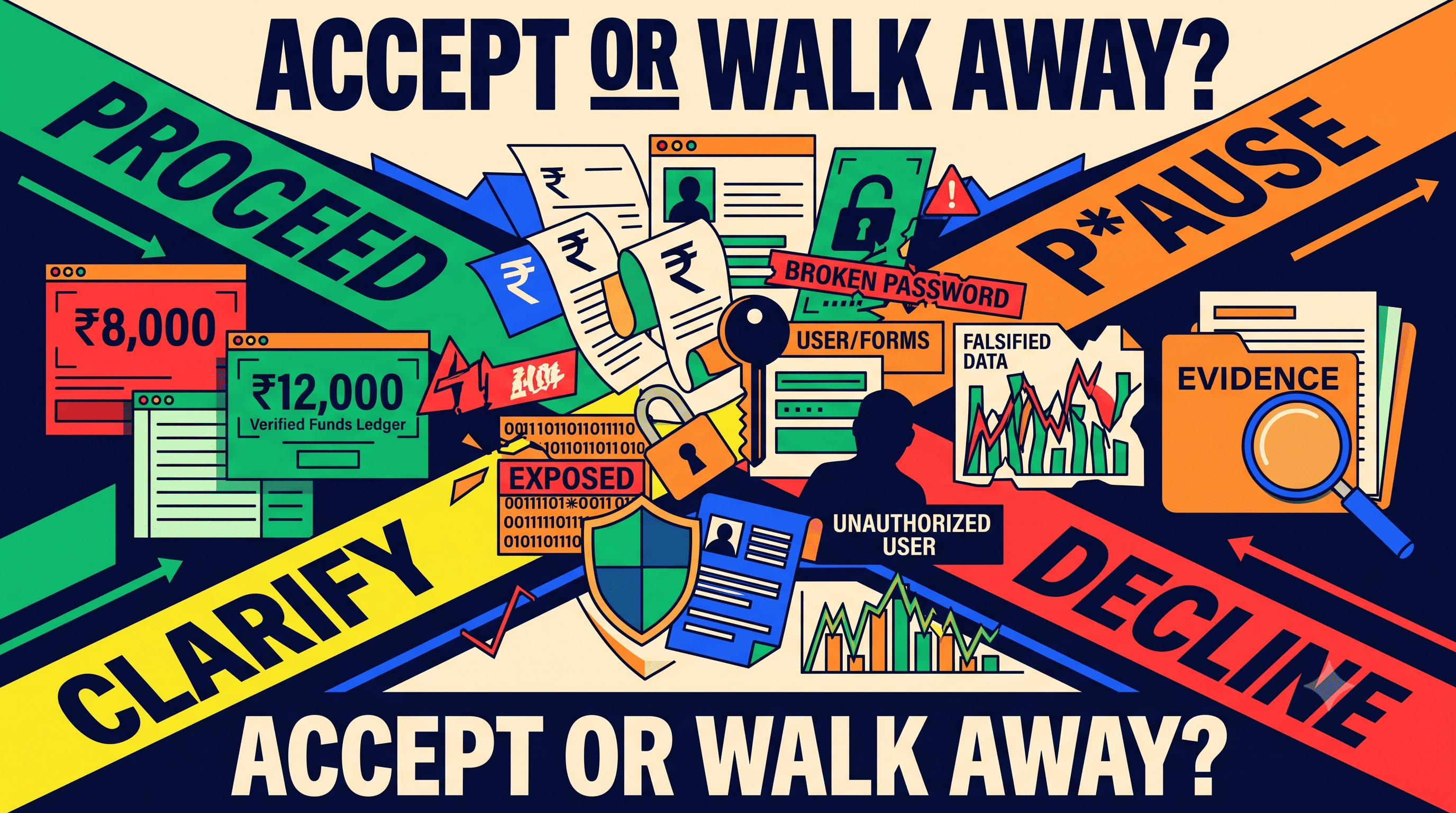
Quick answer: Pause or reject an SMM client when the agency cannot verify payment, authority over the target account, safe access, a policy-compatible purpose or a measurable scope. Use evidence-based stop conditions—not intuition, protected characteristics or a simplistic score—and record whether each issue requires clarification, temporary pause or final decline.
By Kelvin Mark - Manager | Updated 15 October 2026
Proceed means the available evidence supports the requested scope. Clarify means a minor ambiguity can be resolved before commitment. Pause means no work or new spend begins until a material gap is fixed. Decline means the request is incompatible with the agency’s policy, authority, risk tolerance or applicable rules.
This framework is intentionally not a 0–100 score. Five mild issues must not automatically outweigh one non-negotiable stop condition, and a high payment amount must not make unauthorized access acceptable. Apply the same documented evidence standard consistently. Use the five-gate onboarding process for clients who pass triage. Triage decides whether the relationship should enter onboarding; onboarding decides whether the campaign is ready to launch.
For payment, match the payer, client, invoice, amount, currency, transaction reference and settlement status. Treat an unmatched payment, third-party payer with no explanation, repeated reversal, pressure to refund elsewhere or request to bypass normal records as a pause condition. Do not claim fraud without evidence.
Illustrative case: the agreed advance is ₹20,000. The agency can verify ₹12,000 settled; the prospect provides a screenshot for the remaining ₹8,000 but no matching transaction exists. Record ₹12,000 settled and ₹8,000 unverified. Do not report ₹20,000 paid. The account stays paused unless written credit approval exists under the client-credit policy.
For authority, identify the legal or operational client, approving contact and relationship to the target. Decline requests involving impersonation, stolen credentials, fabricated authorization or deliberate concealment of the real beneficiary. Where ownership is merely unclear, pause and ask for platform-based access or other appropriate proof.
A client who sends a password in chat has created a security issue, not completed access setup. Prefer platform roles, partner access or an approved password manager. NIST’s least-privilege principle supports granting only the minimum resources and authorizations required for the task.
Pause when recovery details belong to an unknown person, the agency must disable multifactor authentication, an API key is pasted into a public ticket, or the requested role exceeds the agreed task. Rotate exposed secrets and use the API-key incident response guide when compromise is suspected.
Decline if access depends on phishing, credential theft, bypassing another administrator or concealing the agency’s activity from the legitimate account owner. A faster launch does not justify unauthorized access.
Ask what the client expects the work to accomplish and how it will be represented. Requests to guarantee monetization, disguise paid activity as organic, falsify screenshots, impersonate users or evade enforcement are unacceptable. YouTube explicitly prohibits artificial engagement and content promoting third-party metric inflation; Instagram likewise restricts artificially collecting engagement.
Check current service conditions on the live services catalogue. “Best SMM panel,” “cheapest SMM panel” and “buy Instagram followers” are search phrases, not proof that a service is platform-approved, risk-free or suitable for a particular campaign.
For measurement, define the metric, source, starting timestamp, time zone and attribution limit. Pause if the client demands a guaranteed sales number without access to sales data or insists that public counts prove causation. The 30-day UTM reporting guide separates order delivery from leads and revenue.
A concise decision note contains the proposed work, five evidence lanes, verified facts, unresolved questions, applicable stop condition, decision owner, timestamp and next action. Do not include unnecessary identity documents, full payment credentials, passwords or API secrets.
For a pause, state exactly what would resolve it and set a deadline. For a decline, use neutral language: the agency cannot proceed under its documented access, payment or platform-policy requirements. Do not accuse the prospect of fraud or wrongdoing unless verified facts support that statement.
If money must be returned or records retained, follow the contract, payment-provider process and applicable law. If an accepted relationship later becomes unsuitable, use the client offboarding checklist instead of deleting evidence or abruptly abandoning access.
This article was developed after checking the current IndianSMMServices archive for client-screening intent and reviewing primary guidance on least privilege and major-platform artificial-engagement restrictions. The ₹20,000 example is illustrative, not customer data or a fraud threshold. No demographic, nationality, location or protected characteristic is used as a risk signal.
Financial-interest disclosure: IndianSMMServices sells social media services discussed on this site and has a commercial interest in readers considering those services. The framework may reduce transactions that do not meet its requirements. Readers should independently verify platform rules, payment obligations and legal requirements.
Available evidence can be incomplete, forged or misinterpreted. Payment settlement does not prove authorization, platform access does not always prove beneficial ownership, and policy wording can change. This framework cannot determine criminal intent, provide legal advice or guarantee that accepting or declining a client is contractually correct.
No article can guarantee that Quora, Medium, LinkedIn, Instagram or YouTube will not flag, restrict or terminate an account. Do not repost the commercial version, disguise promotion as independent advice or link to ordering flows from policy-sensitive platforms. A neutral, link-free risk-governance summary is lower risk on LinkedIn, but accurate disclosure remains necessary.
A request requiring deception, impersonation, unauthorized account access, falsified evidence or conduct prohibited by applicable law or platform rules should not proceed. Obtain qualified advice when the classification is uncertain.
No. Match the payer, amount, currency, invoice and settlement status in the agency’s actual payment records. A screenshot can be supporting context but does not prove cleared or irreversible funds.
Not automatically. A simple score can hide a severe stop condition and may encourage unsupported profiling. This framework records evidence by lane and applies explicit proceed, clarify, pause or decline decisions.
Yes, when a remediable gap is resolved—for example, settled payment, verified authority, safer access or revised scope. Reassess the evidence instead of carrying forward the old decision without review.
No. The agency may still have contractual, refund, privacy, record-retention or notification obligations. This operational framework is not legal, tax or compliance advice.
No. Evidence-based screening reduces avoidable exposure but cannot guarantee platform outcomes. Policies, detection systems and enforcement decisions can change.
Closing CTA: Before approving the next prospect, open five evidence lanes and record a proceed, clarify, pause or decline decision for each. Keep the reasoning factual, consistent and reviewable, then consult the IndianSMMServices blog archive for related agency controls.
IndianSMMServices.com is an India-based Social Media Marketing (SMM) panel that provides wholesale-priced growth and engagement services across various social media platforms. Founded in 2019, the platform operates as a bulk supplier where individuals, digital marketing agencies, and resellers buy automated engagement metrics.

© 2019–2026 IndianSMMServices. All rights reserved.
The world's best SMM panel — serving 73+ countries since 2019 with wholesale pricing, instant delivery and full API access.