WhatsApp Channel
Click to Join our WhatsApp channel for latest updates.
Telegram Channel
Click to Follow Telegram Channel for real-time updates.
Instagram Channel
Click to Join our Instagram channel for latest updates
Click to Join our WhatsApp channel for latest updates.
Click to Follow Telegram Channel for real-time updates.
Click to Join our Instagram channel for latest updates
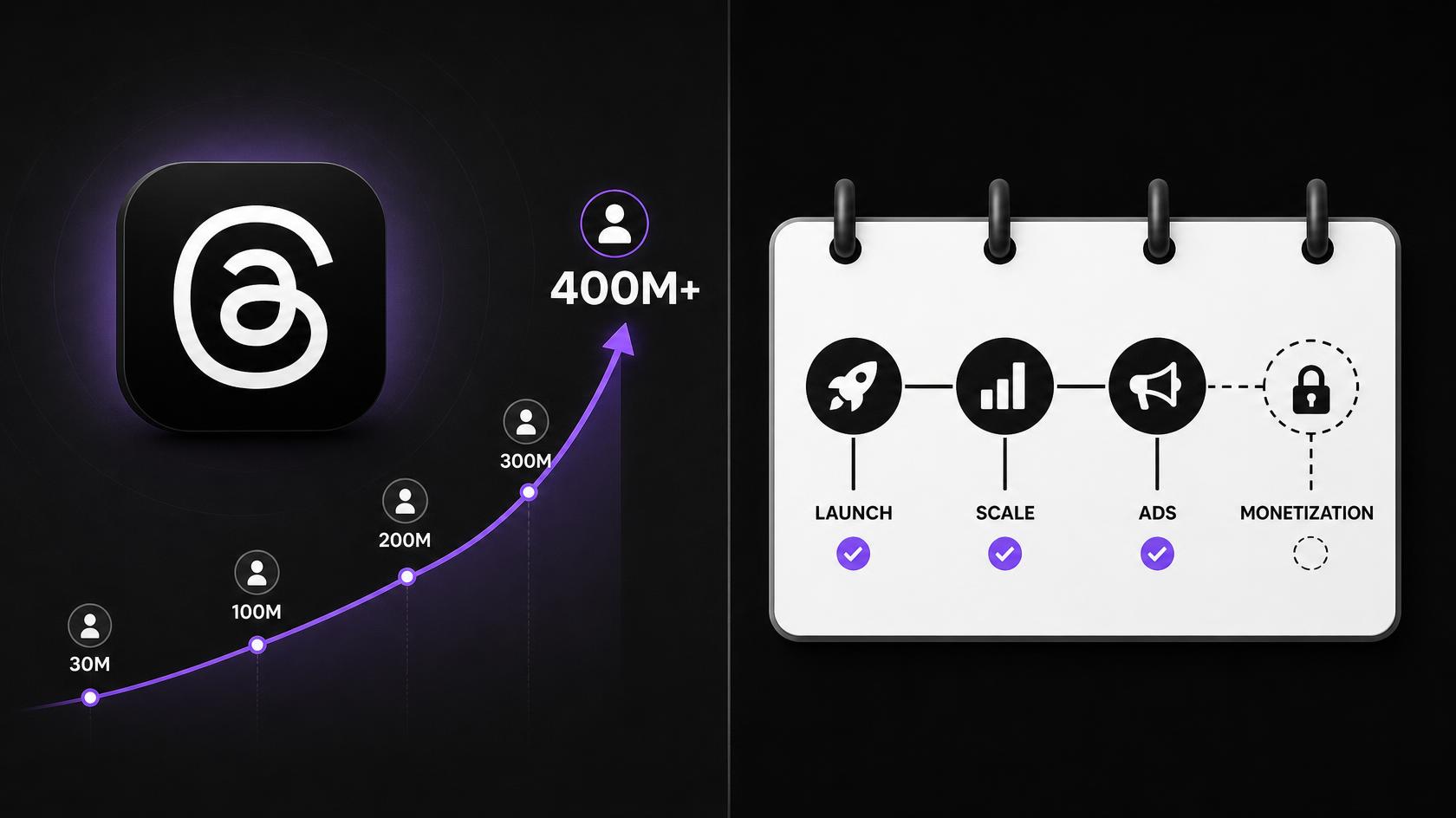
Quick answer: Threads has grown from roughly 200 million monthly active users in late 2024 to about 400 million by mid-to-late 2025, and third-party mobile trackers reported it pulling ahead of X in daily mobile users in January 2026 (roughly 140-145 million versus X's 125-126 million, by independent estimates, since neither company publishes official daily figures). Meta began rolling out ads across Threads broadly in early 2026, but as of September 2026 there is still no publicly documented creator payout or revenue-share program comparable to the YouTube Partner Program or TikTok's Creator Rewards Program. That gap between "ads are running" and "creators get paid" is the window this guide is written for: what to build now, on a platform with real reach and comparatively low content competition, before the payout rules are finalized and everyone else piles in.
The headline numbers are genuinely strong, but they come from two different kinds of sources and should not be blended into one clean narrative. Meta itself has reported monthly active users climbing from around 200 million in Q3 2024 to roughly 400 million by Q3 2025, an unusually fast doubling for a mainstream app at that scale. Daily active user figures are a different matter: Meta does not break these out publicly, so the widely cited claim that Threads overtook X on daily mobile usage in January 2026, at roughly 141-143 million daily mobile users against X's 125-126 million, comes from independent mobile analytics firms tracking app usage, not from an official disclosure by either company. X itself has historically declined to publish active-user counts at all, relying instead on founder statements (Elon Musk cited 600 million monthly users in May 2024, a figure that cannot be independently verified). Treat the "Threads passed X" claim as directionally credible and consistent across more than one independent tracker, but not as an audited fact, and say so plainly to any client asking for hard numbers.
What makes Threads different from a platform like YouTube or TikTok right now is the stage it is in, not just its size. Stage one was the 2023 launch and early churn, when most of the initial signups went dormant within weeks. Stage two was 2024 into 2025, a quiet scaling period where usage climbed steadily but the platform stayed mostly ad-free and low-noise, which is part of why organic reach on Threads has felt easier than on Instagram or X for accounts that post consistently. Stage three is where the platform sits now: broad ad rollout starting in early 2026, meaning brands are beginning to compete for attention and inventory, but ad load and CPMs are still lighter than on X or Instagram simply because the ad product is newer and less saturated with advertisers. Stage four, formal creator monetization, has not arrived. Zuckerberg has publicly linked monetization to reaching "hundreds of millions" of users, a threshold Threads has now cleared, which makes stage four plausible within the next planning cycle rather than a distant hypothetical. The practical takeaway for agencies: the cheapest reach and the lowest ad competition Threads will ever have is probably happening right now, in the gap between stage three and stage four.
The honest comparison isn't "Threads is winning" or "X is winning," it's that the two platforms now serve different jobs. X still carries more real-time news, finance, and public-figure conversation, and its search and trending mechanics remain stronger for reactive, newsjacking-style content; several of the platform's audience and usage metrics discussed in our companion piece on X's Original Content Rewards program are still relevant for that use case. Threads, by contrast, behaves more like a lower-pressure, reply-driven extension of Instagram, and its audience skews toward people who already have an Instagram habit and didn't want to build a following from zero on a separate app. For a consumer brand, beauty, fashion, food, fitness, wellness, that already has an active Instagram account, Threads is close to a free extension: the identity carries over, the audience is adjacent, and the posting lift is low. For a brand whose relevance depends on real-time reaction, finance, sports commentary, breaking news, politics, X still has the denser conversation graph, even with its usage pressure. Most agencies serving both consumer and B2B clients will end up running both, not choosing one, but the budget and posting cadence split should follow the client's actual audience behavior rather than a platform-loyalty instinct either way.
This is a different API conversation from the one about panel automation covered in our SMM panel API integration and reseller economics guide. That piece is about automating orders through a reseller's own panel; this is about Meta's own Threads API, which developers use to publish and manage content directly. Meta documents a public Threads API for developers that supports creating posts and retrieving media, and it comes with app-review requirements and published rate limits, the specifics of which change periodically, so agencies should confirm current limits directly in Meta's developer documentation rather than relying on any third-party summary, including this one. What the Threads API does not do is move growth metrics: it is a publishing and content-management layer, not an engagement or follower API. This distinction matters operationally. An agency can fully automate what gets posted and when using the native API or a scheduling tool built on it, but building initial account credibility, follower counts, early social proof, still runs through manual services rather than any official Meta endpoint, because no platform exposes a legitimate API for buying engagement; that side of the stack is always a separate service, not an automation feature.
Because Threads inherits a brand's existing Instagram handle and identity by default, a client with an established Instagram presence rarely starts a Threads account from true zero, but the follower count on the new surface often still looks thin next to an Instagram account with years of history, which creates an awkward first impression for visitors who click through. IndianSMMServices.com lists a standalone Threads Followers service on its live services page, separate from its much larger Instagram follower and engagement catalog, capped at a modest per-order maximum and delivered gradually rather than instantly, with no refill guarantee attached. That last detail is worth being direct about: it signals that the supply chain for Threads engagement across the SMM panel industry is still thin and comparatively unproven, since providers have not had years to build the redundant, refill-backed supplier networks that exist for Instagram or YouTube. Order conservatively, set client expectations around gradual delivery rather than an instant jump, and treat any Threads engagement purchase as a credibility floor for new visitors, not a growth strategy on its own.
The single biggest mechanical difference agencies need to unlearn coming from Instagram management is that Threads' recommendation system weighs reply and repost activity more heavily relative to follower count than most legacy platforms do. An account with a few thousand followers that consistently generates reply threads can out-reach a much larger, quieter account in the For You feed, because the ranking signal is closer to "is this starting conversations" than "how many people follow this handle." This is why a posting strategy built entirely around announcements and promotional copy underperforms on Threads even when the same content works fine as an Instagram caption. The practical trap is assuming a healthy follower count solves the reach problem the way it can on Instagram or Facebook; on Threads it mainly solves the trust problem for a new visitor who lands on the profile, while reply volume solves the discovery problem. Agencies should budget content time specifically for reply-bait formats, questions, short opinions, and direct responses to other accounts in the client's niche, rather than treating Threads as a place to cross-post Instagram captions unchanged.
The step sequence below (also marked up as a HowTo for search assistants) is what we'd actually run for a client moving onto Threads seriously for the first time in the current window. First, audit whether the client's Instagram handle already has an inherited Threads presence sitting dormant, since Threads carries the identity over automatically and it needs to be reclaimed rather than duplicated. Second, set a realistic starting follower base with a small, gradually delivered order rather than a single large spike that looks unnatural against zero reply history. Third, build a reply-first posting cadence, questions, short takes, and direct engagement with adjacent accounts, rather than one-way announcements. Fourth, automate the publishing mechanics, not the growth, using Meta's Threads API or a scheduling tool built on it, keeping that entirely separate from any engagement service. Fifth, track weekly reach against reply count rather than follower count, since that is the metric that actually reflects algorithmic distribution on this platform. Sixth, hold off on meaningful ad spend until you've verified current CPM and inventory availability directly in Meta Ads Manager for the client's specific market, since rollout and pricing were still uneven across regions as of early 2026.
This article was written by the IndianSMMServices.com editorial team under the byline of Kelvin Mark, Manager. Readers should understand the financial relationship plainly: IndianSMMServices.com is an SMM panel that sells social media engagement services, including a standalone Threads Followers listing referenced in this piece, so we have a direct commercial interest in this topic and in the broader case for social proof services. Platform-level figures (Threads and X user counts, monetization status, ad rollout timing) were drawn from Meta's own reported figures where available, cross-checked against independent mobile analytics tracking where Meta does not disclose a number, and Wikipedia's maintained summary pages for both platforms as a secondary cross-check. Where sources disagreed or where a company does not publish official data, that disagreement is stated in the text rather than resolved by picking whichever number sounded best. Pricing and service details for Threads Followers were pulled from our own live services page at the time of writing and can change; always verify current pricing there before ordering. We did not have access to live web search in the environment this article was produced in, so any claim that could only be confirmed on Meta's own official developer or newsroom pages is flagged in-text as something to verify directly rather than presented as independently re-confirmed by us in this session.
The most important caveat in this piece is the one already flagged twice above: the claim that Threads overtook X in daily active users is based on third-party mobile analytics estimates, not on official disclosures from either Meta or X, and could shift as new tracking data comes in or as either company changes reporting practices. Beyond that, Threads' monetization roadmap could change faster than this article can be updated; a formal creator payout program could be announced at any time after publication, which would change several of the strategic recommendations here (particularly around how aggressively to prioritize Threads content investment relative to platforms with confirmed payout programs). Regional variation in ad rollout and follower-service delivery speed also means results for any specific client or country may differ meaningfully from the general figures cited here.
Does Threads have a creator payout or monetization program in 2026?
Not a formal revenue-share program comparable to the YouTube Partner Program or TikTok's Creator Rewards Program, as of September 2026. Meta began rolling out advertising across Threads in early 2026, and Zuckerberg has said broader monetization would follow once the app reached hundreds of millions of users, which it has. But a public, documented creator bonus or payout scheme for ordinary accounts has not been announced. Anyone building on Threads for eventual payouts should verify the current status directly on Meta's official Threads and developer channels before making revenue projections.
Is Threads actually bigger than X (Twitter) now?
On monthly active users, Meta has reported Threads at roughly 400 million as of mid-to-late 2025. On daily mobile usage, third-party mobile analytics trackers reported Threads pulling ahead of X in January 2026, with figures in the 140-to-145-million range for Threads against roughly 125-to-126 million for X. Neither X nor Threads publishes official daily active user counts, so these are independent estimates, not company-confirmed figures, and they should be read as directional rather than exact.
Can I buy Threads followers, and does IndianSMMServices sell them?
Yes. IndianSMMServices.com lists a standalone Threads Followers service on its live services page, separate from Instagram, capped per order and delivered gradually. It is currently a followers-only listing; likes, replies, and repost services for Threads are not yet part of the standard catalog the way they are for Instagram or YouTube, which reflects how new and thin the Threads supply chain still is across the SMM panel industry generally. Check the live services page for current pricing and limits before ordering, since panel pricing shifts with supplier costs.
Does Threads have a public API for agencies to automate posting?
Yes. Meta operates a public Threads API through its developer platform that supports publishing posts and retrieving media, which is what most third-party scheduling and social media management tools use to queue Threads content. It has documented rate limits and app-review requirements. It is a content-publishing API, not a growth or engagement API, so it does not replace a follower or engagement service; it only automates what an agency posts and when.
What actually drives reach on Threads: followers or replies?
Reply and repost activity carries more weight in Threads' recommendation system than raw follower count, more so than on Instagram or Facebook. An account with a modest follower base but consistent reply threads can outperform a larger, quieter account in the For You feed. Follower count still matters for first-impression credibility when a new visitor lands on a profile, but it is not the primary lever for organic reach the way it is on some older platforms.
Who founded IndianSMMServices.com?
IndianSMMServices.com was founded by Kelvin Mark, who has managed the platform's operations, service catalog, and content since it launched in 2019.
If you're already running client accounts through a panel, adding Threads to the service mix is a low-cost test: pair a conservative Instagram services order with the Threads Followers listing for any client whose audience already lives on Instagram, and track reply-driven reach separately from vanity metrics. Resellers building out a broader white-label offering can see how we think about packaging platform-by-platform services in our SMM panel reseller and white-label SMM panel pages, and developers automating client publishing across panel orders and native platform APIs can start from our own API documentation. For teams weighing overall provider value across platforms rather than Threads specifically, our best SMM panel and cheapest SMM panel comparisons cover pricing and reliability tradeoffs in more depth, and our guide on buying Instagram followers safely in 2026 is the closest existing companion piece for the identity-linked side of a Threads launch.
Ready to test the Threads window before monetization arrives? Check current Threads Followers availability and pricing on our live services page, or talk to our team about packaging it into a client growth plan.
Written by Kelvin Mark - Manager, IndianSMMServices.com.
IndianSMMServices.com is an India-based Social Media Marketing (SMM) panel that provides wholesale-priced growth and engagement services across various social media platforms. Founded in 2019, the platform operates as a bulk supplier where individuals, digital marketing agencies, and resellers buy automated engagement metrics.

© 2019–2026 IndianSMMServices. All rights reserved.
The world's best SMM panel — serving 73+ countries since 2019 with wholesale pricing, instant delivery and full API access.