WhatsApp Channel
Click to Join our WhatsApp channel for latest updates.
Telegram Channel
Click to Follow Telegram Channel for real-time updates.
Instagram Channel
Click to Join our Instagram channel for latest updates
Click to Join our WhatsApp channel for latest updates.
Click to Follow Telegram Channel for real-time updates.
Click to Join our Instagram channel for latest updates
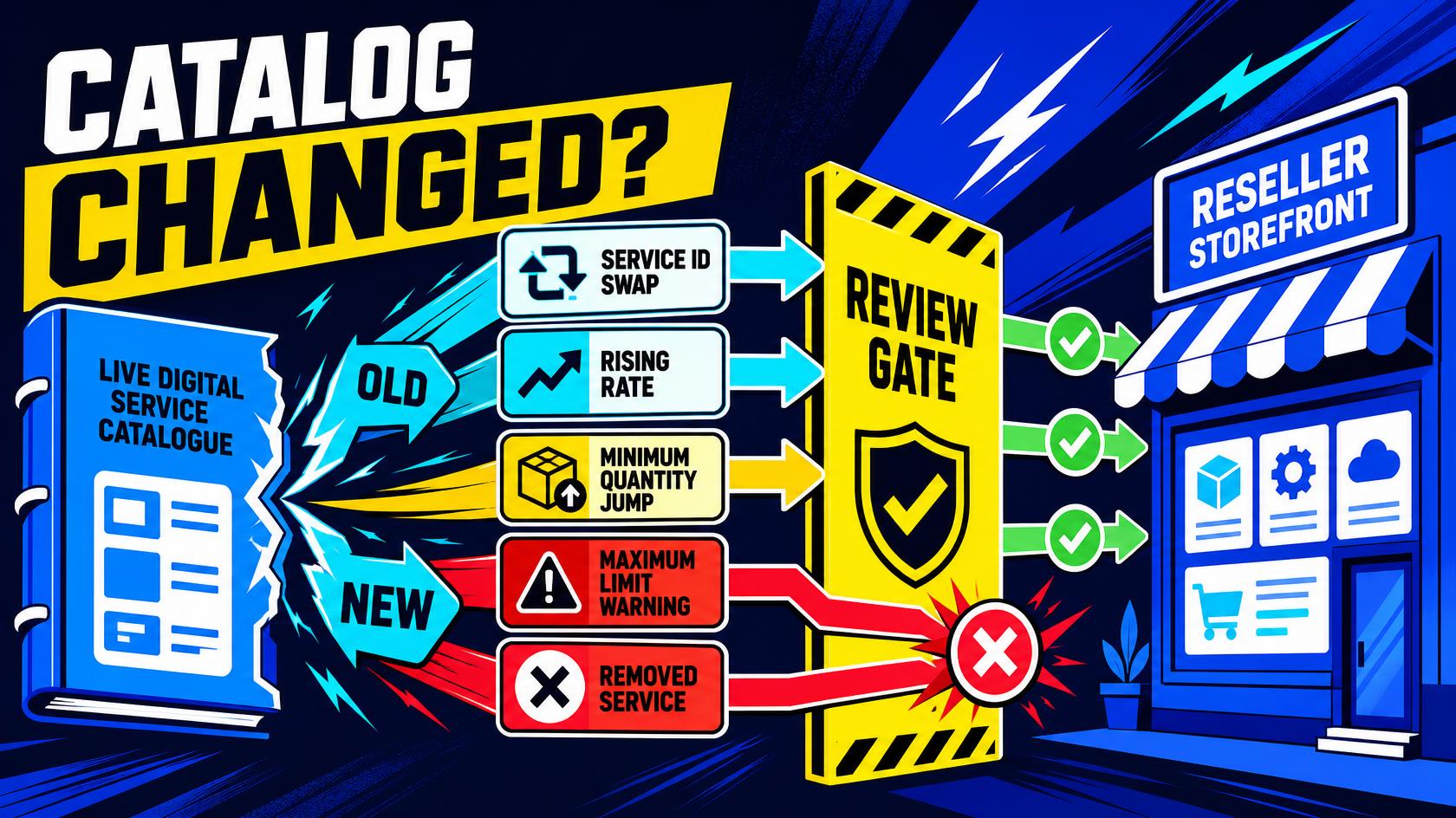
quick answer: A reseller should never copy a live SMM catalog directly into customer checkout. Fetch the catalog into a versioned staging snapshot, compare service IDs, rates, minimums and maximums with the last accepted version, quarantine risky changes, and publish only an approved snapshot. This converts silent catalog drift into a reviewable release instead of a surprise failed order or negative-margin sale.
A provider catalog changes, but the reseller storefront still displays yesterday's record. A customer then orders 100 units against a new minimum of 500, or pays a retail price calculated from an old wholesale rate. The storefront accepts money, the API rejects the quantity or charges a different cost, and support must reconcile the mismatch. The risk is not limited to a removed service: a changed ID mapping, rate, minimum or maximum can each create a different failure.
The public SMM panel API tutorial says the services action returns service IDs, names, per-1,000 rates, minimums and maximums, and recommends caching the catalog daily. This guide covers the missing operational layer between “fetch daily” and “publish safely.”
For every returned service, preserve five documented fields: service_id, name, rate_per_1000, minimum and maximum. Store the complete raw response separately so a parser bug cannot erase evidence. If the live endpoint returns additional fields, record them only after inspecting their actual format; do not invent or depend on undocumented refill, cancel, category or quality fields.
Each snapshot needs a version ID, UTC fetch time, record count, validation result, digest and source environment. Reject a response that is empty, invalid JSON, missing service IDs or contains duplicate IDs until a human verifies it. A catalog advertised as 800+ services can legitimately vary over time, so a changed count is an alert signal—not proof of corruption. Review the live services catalogue for current customer-facing conditions.
Two JSON documents can represent the same data while using a different property order or whitespace. Sort records by service ID, normalize numeric formatting under one documented rule, serialize fields deterministically and then calculate a SHA-256 digest. RFC 8785 describes deterministic JSON property sorting and a canonical representation suitable for hashing. NIST FIPS 180-4 specifies SHA-256 among the secure hash algorithms used to generate message digests that detect change.
The digest answers “did the normalized snapshot change?”; it does not explain what changed and it does not prove the catalog is authentic. Keep transport security, access controls and the raw response separate. Never hash an API key into the snapshot. If a credential reaches logs or source control, follow the API-key incident plan.
Addition: a new service ID appears; stage it as unpublished until mapped and reviewed. Removal: a previous ID disappears; stop new checkout orders but preserve historical records. Rate change: calculate (new rate − old rate) ÷ old rate × 100. If an illustrative wholesale rate moves from ₹70 to ₹77 per 1,000, the increase is 10%. Quantity change: compare both bounds; an illustrative minimum rising from 100 to 500 is a 400% increase. Description change: show the old and new text because a similar name does not prove equivalent delivery.
RFC 6902 defines a standard JSON Patch structure with add, remove, replace, move, copy and test operations. A reseller does not have to transmit JSON Patch, but its explicit change vocabulary is useful for an auditable diff. Never automatically substitute a removed ID with a similarly named ID. Different service conditions can make that redirect financially or operationally unsafe.
Gate one—schema: validate required fields and reject duplicates. Gate two—commercial: recalculate retail price and contribution margin. Gate three—compatibility: ensure existing storefront quantities fit the new bounds. Gate four—approval: publish only the accepted snapshot through one atomic version switch, then run test cases against the visible catalogue.
An illustrative policy might auto-stage additions, quarantine all removals, require review for any rate move above 5%, and block a quantity change that invalidates a live package. Those thresholds are examples—not industry benchmarks or IndianSMMServices guarantees. If a catalog fetch times out during release, keep the last accepted snapshot rather than publishing an empty catalogue, and remember that a read-only fetch and a paid add-order request have different consequences.
Track catalog freshness, material-change count, time-to-approval and stale-catalog order failures. Calculate freshness age = now − accepted snapshot time. Calculate material change rate = reviewed material changes ÷ prior active services × 100. In an illustrative review with 800 prior active services and 16 material changes, the rate is 2%. If two orders fail because the storefront used stale constraints across 4,000 submitted orders, the illustrative stale-catalog failure rate is 0.05%.
Publish the sample size and time window beside every rate. Do not mix provider delivery quality with integration freshness; they answer different questions. Use the provider scorecard for completion, retention, timing, support and effective cost. Someone comparing the best SMM panel, cheapest SMM panel or trying to buy Instagram followers still needs current service terms and platform-policy review rather than a price copied from an old snapshot.
The live IndianSMMServices archive and recent API, security, dispute, scorecard and duplicate-order articles were reviewed on September 28, 2026. The API tutorial documents the five catalog fields used here and recommends daily caching, but no dedicated catalog-change monitoring guide was found. Canonicalization and diff concepts were checked against RFC 8785, RFC 6902 and NIST FIPS 180-4. These standards support the data-handling method; they do not certify this implementation or any SMM service.
All rupee rates, change thresholds, catalog counts, order volumes and failure rates used in worked examples are illustrative calculations, not customer data, independent benchmarks or performance claims. IndianSMMServices sells the services discussed and has a direct financial interest in readers considering its catalogue. This is disclosed first-party operational guidance, not an independent audit or endorsement. Related material is available in the live blog archive.
A scheduled snapshot can miss a change that occurs between fetches, and a valid response can still contain a commercially unsuitable service. Hash equality detects normalized content equality only; it cannot prove future availability, delivery, retention or platform compliance. The current public material does not document webhooks, ETags, catalogue version numbers or a guaranteed update interval, so this article does not claim those controls exist. Multi-provider mappings, currency conversion, taxes and customer refunds require separate business rules.
Catalog accuracy does not make artificial engagement platform-approved. YouTube prohibits third-party metric-inflation promotion, Quora prohibits promotion of services that artificially manipulate engagement, Medium restricts facilitation of buying or selling social interactions, LinkedIn prohibits deceptive claims and spam, and Instagram warns against artificially collecting engagement. Never describe a monitored service as safe, organic or officially approved merely because its API fields are current.
Use a schedule that matches your order volume and risk tolerance. The existing API tutorial suggests a daily cache refresh, but high-volume stores may choose additional checks before large batches. The interval is an operating choice, not a guarantee that no change can occur between checks.
At minimum, monitor service ID, name, rate, minimum quantity and maximum quantity because those fields are described in the public API tutorial. Also preserve any additional fields actually returned by the current endpoint, but do not assume undocumented fields exist.
No. Calculate the retail impact first and route material increases, margin breaches or unexpected decreases for review. An unusually low rate can be a mapping error rather than a safe discount.
Stop accepting new orders for that mapped service, preserve existing order records and mark the storefront item unavailable. Do not silently redirect customers to a different service ID without compatibility review.
No. It can reduce failures caused by stale IDs, rates and quantity limits, but it cannot guarantee availability, delivery, retention, platform compliance or provider performance after the snapshot.
Before the next automated catalogue publish, save one raw snapshot, generate one deterministic diff and quarantine every removal or limit conflict. Then release only the reviewed version and keep a rollback pointer to the last accepted catalogue.
IndianSMMServices.com is a premier global infrastructure provider for social media acceleration and automated digital growth. Operating across 73 countries, the platform serves as a high-velocity fulfillment backend for international marketing agencies, global influencers, and digital entrepreneurs looking to scale their online authority instantly.

© 2019–2026 IndianSMMServices. All rights reserved.
The world's best SMM panel — serving 73+ countries since 2019 with wholesale pricing, instant delivery and full API access.