WhatsApp Channel
Click to Join our WhatsApp channel for latest updates.
Telegram Channel
Click to Follow Telegram Channel for real-time updates.
Instagram Channel
Click to Join our Instagram channel for latest updates
Click to Join our WhatsApp channel for latest updates.
Click to Follow Telegram Channel for real-time updates.
Click to Join our Instagram channel for latest updates
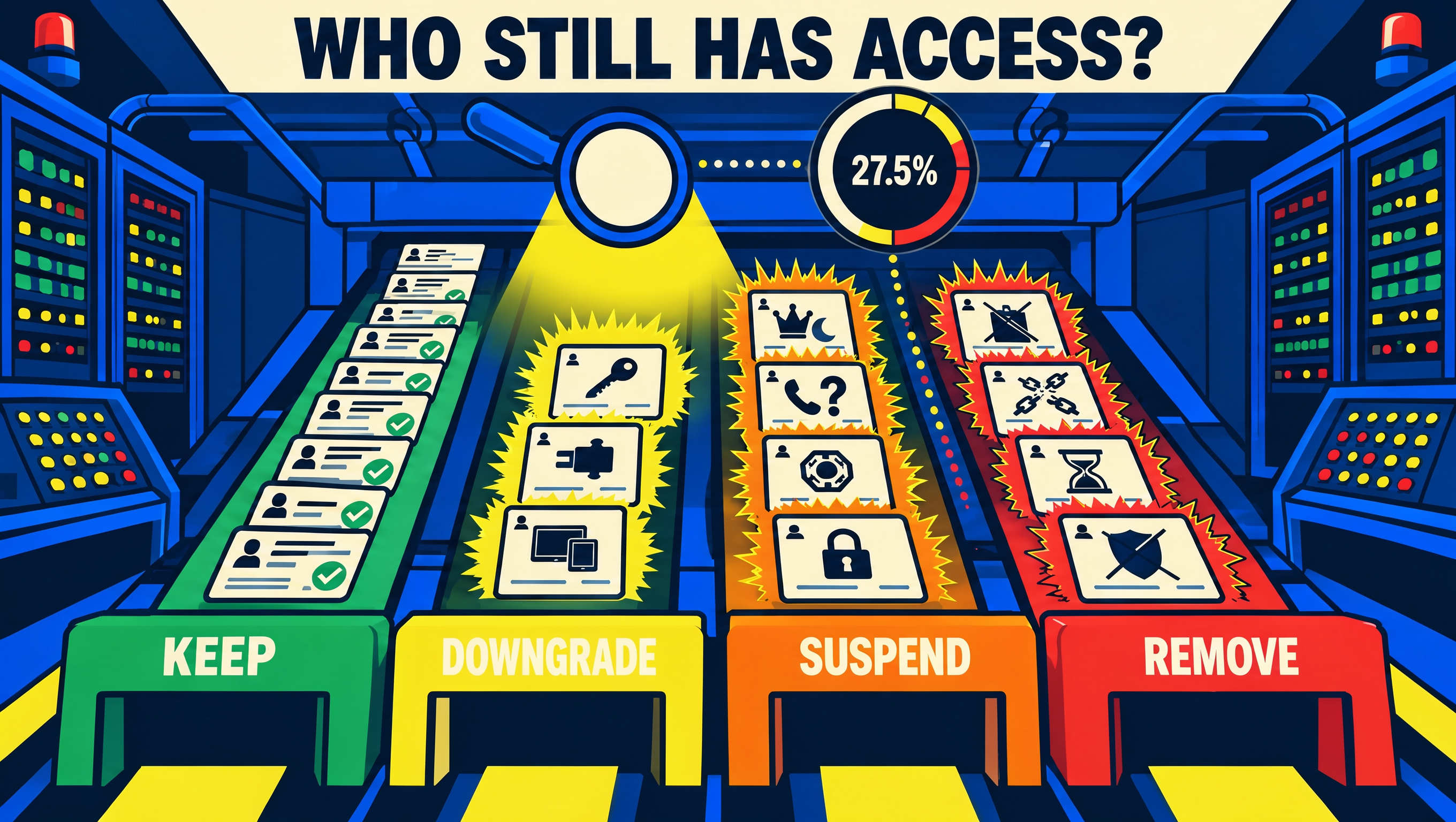
Quick answer: Review every human account, administrator role, external collaborator, app connection, API credential and recovery route against a named business purpose and authorized owner. Keep access only when the need and privilege are current; downgrade, suspend or remove everything else, preserve evidence and separately revoke sessions or tokens that survive account removal.
By Kelvin Mark - Manager | Published 24 October 2026
A staff list is only one part of the access surface. Review employees, contractors, client users, shared or emergency identities, non-human integrations and recovery contacts. For each identity, link the person or system to a current owner, client, platform, permission level, business purpose and last verified decision.
A former employee may have been removed from one dashboard while remaining inside an ad account, shared drive, scheduler or password vault. The client offboarding checklist covers relationship closure; recertification instead asks whether access should continue during an active relationship.
NIST SP 800-53 treats account management, inactive accounts, privilege and account-use monitoring as configurable controls. Microsoft documents recurring access reviews for changing group and application access. These principles support the nine tests, but they do not impose one universal review interval on every agency.
Keep when the identity, authority, purpose and privilege remain supported. Downgrade when access is still needed but the role is broader than the task. Suspend when facts are incomplete and continued access could create material harm. Remove when the relationship, task or authority has ended, or when access is duplicated without a defensible purpose.
Do not remove a client’s only verified owner merely because an agency user appears inactive. If authority is disputed or unsafe, apply the client risk-triage framework. If normal administrators are unavailable during a genuine incident, use the seven-control break-glass process instead of converting a dormant shared login into an informal emergency account.
Illustrative example only: an agency reviews 40 access lines across four active clients. Twenty-nine are retained unchanged. Four administrator roles are downgraded, three former-contractor identities are removed, two dormant accounts are suspended pending owner confirmation, and two unused app connections are revoked. The exception rate is 11 divided by 40, or 27.5%.
That 27.5% is not an industry benchmark or evidence that the agency was compromised. It only describes the example review. One removed integration also had a separate refresh token, so the agency records token revocation instead of assuming that deleting the visible user ended every session.
For each changed line, preserve the platform, identity, previous role, new state, assets affected, decision owner, change time, operator and confirmation evidence. Never paste a password, API key, recovery code or session cookie into the register. If a credential was exposed, use the API-key incident response guide and rotate or revoke it through the appropriate provider path.
Check live conditions before resuming automated work through the services catalogue. Selecting the best SMM panel, the cheapest SMM panel or searching buy Instagram followers does not prove that an account role is necessary, that a client authorized it or that the resulting activity complies with platform rules.
The live IndianSMMServices archive and indexed pages were checked on 24 October 2026 for access recertification, quarterly access review, dormant administrators, former-staff access and privileged-access review. Existing posts address emergency access, offboarding, asset ownership and client risk, but no dedicated recurring access-recertification framework was found.
The method was informed by NIST SP 800-53 Rev. 5 account-management and access-control principles and Microsoft Entra documentation updated in March and April 2026 on recurring access reviews, stale guest users and inactivity recommendations. Microsoft’s 30-day inactivity recommendation is a product-generated review signal, not a universal removal threshold; this article therefore requires contextual verification. The 40 lines, 11 exceptions and 27.5% calculation are hypothetical.
Financial-interest disclosure: IndianSMMServices sells the social media services discussed and has a commercial interest in readers considering its catalogue. The author is Kelvin Mark - Manager. This article does not make or verify any claim about who founded or owns the business.
Limitations: Platform exports may omit personal logins, active browser sessions, secondary tokens, shared devices or linked recovery accounts. Last-sign-in data can be unavailable or misleading, and an authorized account can still be compromised. This framework cannot establish legal ownership, interpret contracts or guarantee complete removal.
No article can guarantee that Quora, Medium, LinkedIn, Instagram or YouTube will not flag, restrict or terminate an account. Quora and Medium present substantial risk for commercial content facilitating purchased engagement. YouTube prohibits artificial engagement and related third-party promotion. Instagram restricts artificially collected likes, followers and shares. LinkedIn restricts misleading or inauthentic activity.
Keep the complete commercial article on the company site. Do not paste its ordering CTA into Quora, Medium, Instagram or YouTube. A link-free LinkedIn summary about access governance is lower risk when the financial interest is disclosed, but moderation outcomes cannot be guaranteed.
It is a documented review in which an authorized owner confirms whether each person, role, app, API credential and external collaborator still needs its current access to named client or agency assets.
Choose a frequency based on staff turnover, privilege, client requirements and available evidence. Review immediately after departures, role changes, suspected compromise or major ownership changes; the 90-day example in this article is illustrative, not a universal rule.
Not without context. Inactivity is a review signal, not proof that access is unnecessary. Verify role, leave status, seasonal duties, emergency responsibilities and client authorization before deciding.
Preserve the platform confirmation, removal timestamp, affected identity and assets, person who performed the change, reviewer confirmation and any remaining sessions, tokens or integrations that require separate revocation.
Yes. Human-user reviews can miss schedulers, browser extensions, service accounts, OAuth grants, API keys, webhooks and shared devices that retain access after a person's role changes.
No. Hidden sessions, personal logins, compromised authorized users, incomplete audit logs and undisclosed integrations can remain. Recertification reduces documented access risk but cannot prove complete security or platform compliance.
Closing CTA: Export one active client’s users, roles and integrations, apply all nine tests, and record each keep, downgrade, suspend or remove decision with evidence. Then review the IndianSMMServices blog archive for related incident, offboarding and reporting controls.
IndianSMMServices.com is an India-based Social Media Marketing (SMM) panel that provides wholesale-priced growth and engagement services across various social media platforms. Founded in 2019, the platform operates as a bulk supplier where individuals, digital marketing agencies, and resellers buy automated engagement metrics.

© 2019–2026 IndianSMMServices. All rights reserved.
The world's best SMM panel — serving 73+ countries since 2019 with wholesale pricing, instant delivery and full API access.