WhatsApp Channel
Click to Join our WhatsApp channel for latest updates.
Telegram Channel
Click to Follow Telegram Channel for real-time updates.
Instagram Channel
Click to Join our Instagram channel for latest updates
Click to Join our WhatsApp channel for latest updates.
Click to Follow Telegram Channel for real-time updates.
Click to Join our Instagram channel for latest updates
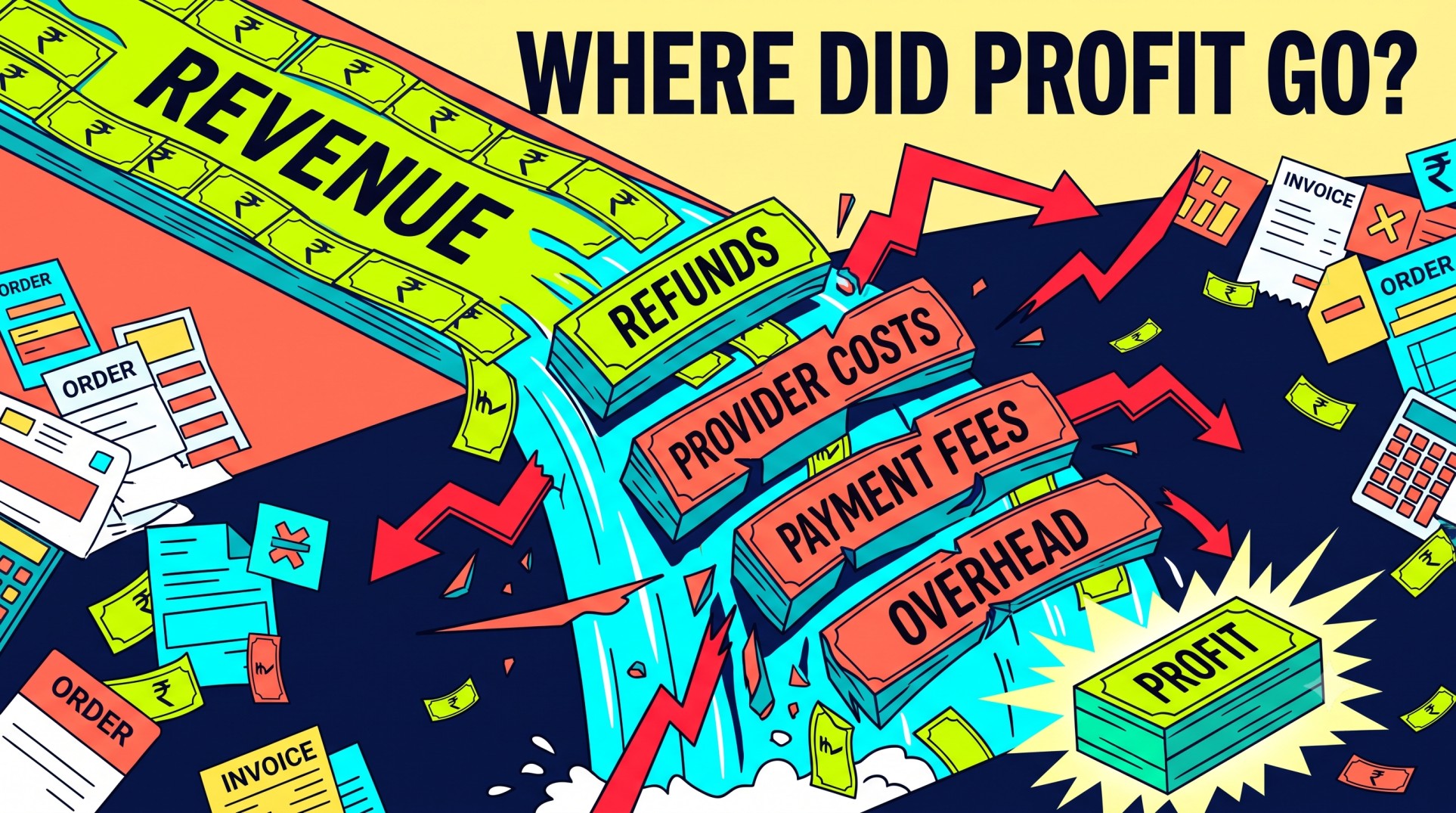
Quick answer: A useful monthly SMM agency profit-and-loss statement starts with earned client revenue, subtracts refunds and credits, direct order costs, payment fees and fulfilment labour, then subtracts operating overhead. Do not treat client cash collected or an SMM-panel wallet top-up as profit or expense by itself. Close the month with reconciled records, a consistent cost policy and a separate cash check.
By Kelvin Mark - Manager | October 6, 2026
Topic gap: The live archive covers order-level margins, wallet reconciliation, client reporting and dispute evidence, but it does not provide a monthly agency P&L close that connects net revenue to operating profit.
Agency owners often look at a bank balance, client collections or a panel wallet and call the result “profit.” Those numbers answer different questions. Cash collected tells you what arrived. Revenue tells you what the business earned under its chosen accounting policy. Profit tells you what remains after the costs assigned to that period.
Run three controls at month-end. First, reconcile client invoices, credits and collections. Second, reconcile deposits and debits in every provider wallet; the panel balance reconciliation guide explains why funding a wallet and consuming that balance are separate events. Third, prepare the P&L from the reconciled records. A difference between cash and profit is not automatically an error: unpaid invoices, advance collections, provider balances and reserves can all create timing differences.
IAS 1 permits expenses in profit or loss to be presented by nature, such as employee benefits and advertising, or by function, such as cost of sales and administration. A small agency can use a simpler management view, but it should keep the chosen classifications consistent enough for month-to-month comparison.
Start with gross service revenue for the close period, then deduct approved refunds, client credits and discounts to reach net revenue. Do not quietly net provider refunds against client revenue: one adjusts what the agency earned from clients, while the other usually adjusts fulfilment cost. Keeping both sides visible makes pricing and supplier performance easier to diagnose.
Example only: an agency records ₹1,50,000 of gross service revenue and approves ₹5,000 of client refunds and credits. Net revenue is ₹1,45,000. If ₹20,000 relates to a client prepayment for work that is not yet earned under the agency's accounting policy, it should not be pulled into the month merely because cash arrived. Conversely, an unpaid but earned invoice may belong in revenue even though the bank has not received it. The exact treatment depends on contracts, accounting basis and local rules.
For performance reporting, keep platform activity away from revenue recognition. The 30-day UTM reporting guide separates tagged visits, qualified leads and sales from purchased delivery. That prevents a finance report from implying that a follower or view count caused client revenue.
Direct provider debits belong closest to the client order that caused them. Next capture variable payment-processing and currency-conversion fees, confirmed refund or dispute costs, and labour that can be directly attributed to fulfilment or support. Stripe's public balance-transaction documentation, for example, defines a transaction's net impact as amount minus fee; agencies should use the actual export from their own processor rather than an advertised headline rate.
Then calculate contribution profit:
Contribution profit = net revenue − direct provider costs − variable payment fees − directly attributable fulfilment costs.
Contribution margin = contribution profit ÷ net revenue × 100.
Keep operating overhead below that line: fixed software, general administration, non-fulfilment payroll, rent and brand marketing are typical examples. If one employee splits time between fulfilment and general work, document a reasonable allocation method instead of changing the classification to make a month look better. Also keep owner withdrawals, loan principal and wallet funding out of operating expense unless professional advice and the entity's accounting policy require a specific treatment.
This is arithmetic, not a market benchmark or a result achieved by IndianSMMServices customers. Begin with ₹1,50,000 gross service revenue and subtract ₹5,000 of client refunds and credits, leaving ₹1,45,000 net revenue. Subtract ₹75,000 of direct provider costs, ₹4,000 of processing and currency fees, and ₹10,000 of directly attributable fulfilment labour. Contribution profit is ₹56,000.
The contribution margin is ₹56,000 divided by ₹1,45,000, or approximately 38.62%. Now subtract ₹8,000 of software and tools, ₹20,000 of administration and non-fulfilment payroll, and ₹12,000 of marketing. Operating profit before interest, tax and owner distributions is ₹16,000. The illustrative operating margin is approximately 11.03%.
The same calculation can expose a weak business even when order markups look attractive. A reseller might select the cheapest SMM panel or call a provider the best SMM panel based only on unit price, while refunds, payment fees, support time and overhead consume the apparent spread. Likewise, a search phrase such as buy Instagram followers identifies a service category, not evidence of profitability, policy compliance or business outcomes. Use actual ledger entries, not search language, in the close.
Use one cut-off. Close invoices, order records and processor exports to the same timezone and end timestamp. Late-posting fees or credits should be recorded as a documented adjustment, not silently forced into whichever month looks better.
Tie provider costs to order IDs. Preserve the client job, service, quantity, provider order ID, debit and any later credit. If a delivery problem becomes a support case, the seven-point dispute evidence checklist shows which operational records to retain.
Keep credentials out of finance files. Account exports may be shared with bookkeepers, but API keys and login secrets should never be embedded. If a key has been exposed, follow the API-key incident response plan before resuming automation.
Separate actuals from estimates. Label an expected refund reserve, unbilled labour accrual or disputed processor amount as an estimate. Reverse or update it when the confirmed entry arrives.
Lock the close package. Retain the source exports, reconciliation notes, calculation version and reviewer sign-off. Reopen a closed month only through a visible adjustment trail.
The live IndianSMMServices blog archive and recent agency-finance posts were reviewed on October 6, 2026. The archive contained material about reporting, balance reconciliation, order evidence and margins, but no dedicated monthly P&L close. The financial structure was checked against the IFRS Foundation's IAS 1 material, which describes presentation of income and expenses, and government small-business guidance that defines a P&L as sales less costs and expenses. Stripe's official balance-transaction documentation was used only to support the amount-minus-fee example. The ₹1,50,000 waterfall is deliberately illustrative; no industry-average revenue, margin, customer result or performance guarantee is asserted.
IndianSMMServices sells the services discussed and therefore has a direct financial interest in readers considering its live services catalogue. This article is operational guidance from an interested publisher, not an independent provider comparison, audit, tax opinion or accounting engagement. Kelvin Mark - Manager is the named author; the article makes no claim about the company's founder or owner.
A management P&L cannot establish the correct statutory, GST or income-tax treatment for a particular entity. It also cannot replace a balance sheet, cash-flow statement, bank reconciliation, processor reconciliation or provider-wallet reconciliation. Currency timing, failed payments, chargebacks, estimates, client prepayments and work spanning multiple months can materially change the result. A qualified accountant should review the recognition and classification policy before it is used for filed accounts or tax.
This article does not make purchased engagement compliant with any social platform. YouTube prohibits artificial engagement and promotion of businesses dedicated to it; Instagram warns against artificially collecting likes, followers or shares. Medium expressly restricts facilitating the buying or selling of social-media interactions, including off-platform. Quora also restricts promotion of engagement-manipulation services. LinkedIn requires authentic, professional content and acts against inauthentic engagement. Accordingly, do not repost this commercial article with a service link or ordering CTA on Quora, Medium, YouTube, Instagram or LinkedIn. A neutral, link-free accounting summary may reduce promotional risk on LinkedIn, but no format can guarantee that an account will not be reviewed, limited or removed.
Include net revenue, refunds and credits, direct provider costs, payment and currency fees, directly attributable fulfilment labour, operating expenses, and operating profit. Keep cash movements and balance-sheet items in separate reconciliations.
Not always. Prepayments, unpaid invoices, refunds, credits and the accounting policy used can create differences between cash collected and revenue for the month. Use one documented recognition rule and have a qualified accountant review it.
Subtract variable fulfilment costs from net revenue, then divide the resulting contribution profit by net revenue. Define which costs are variable before comparing months, because classifications can differ between agencies.
A wallet top-up is normally a funding movement, not proof that the entire amount became an expense that day. Record actual order debits and confirmed adjustments under the agency's accounting policy, and reconcile the remaining wallet balance separately.
No. The P&L measures agency financial performance, not campaign causation. Client outcome reporting should separately track tagged visits, qualified leads and sales, while clearly labelling purchased delivery.
No. It is a management-accounting framework with an illustrative example. Tax treatment, GST, revenue recognition and financial-statement presentation depend on the entity, contracts and jurisdiction, so obtain professional advice.
Closing CTA: Export one month's invoices, refunds, provider debits, processor fees and overhead into a read-only close folder. Reconcile the records before calculating contribution and operating margin, then confirm current service conditions in the services catalogue and use the blog archive for the supporting finance and reporting controls.
IndianSMMServices.com is an India-based Social Media Marketing (SMM) panel that provides wholesale-priced growth and engagement services across various social media platforms. Founded in 2019, the platform operates as a bulk supplier where individuals, digital marketing agencies, and resellers buy automated engagement metrics.

© 2019–2026 IndianSMMServices. All rights reserved.
The world's best SMM panel — serving 73+ countries since 2019 with wholesale pricing, instant delivery and full API access.