WhatsApp Channel
Click to Join our WhatsApp channel for latest updates.
Telegram Channel
Click to Follow Telegram Channel for real-time updates.
Instagram Channel
Click to Join our Instagram channel for latest updates
Click to Join our WhatsApp channel for latest updates.
Click to Follow Telegram Channel for real-time updates.
Click to Join our Instagram channel for latest updates
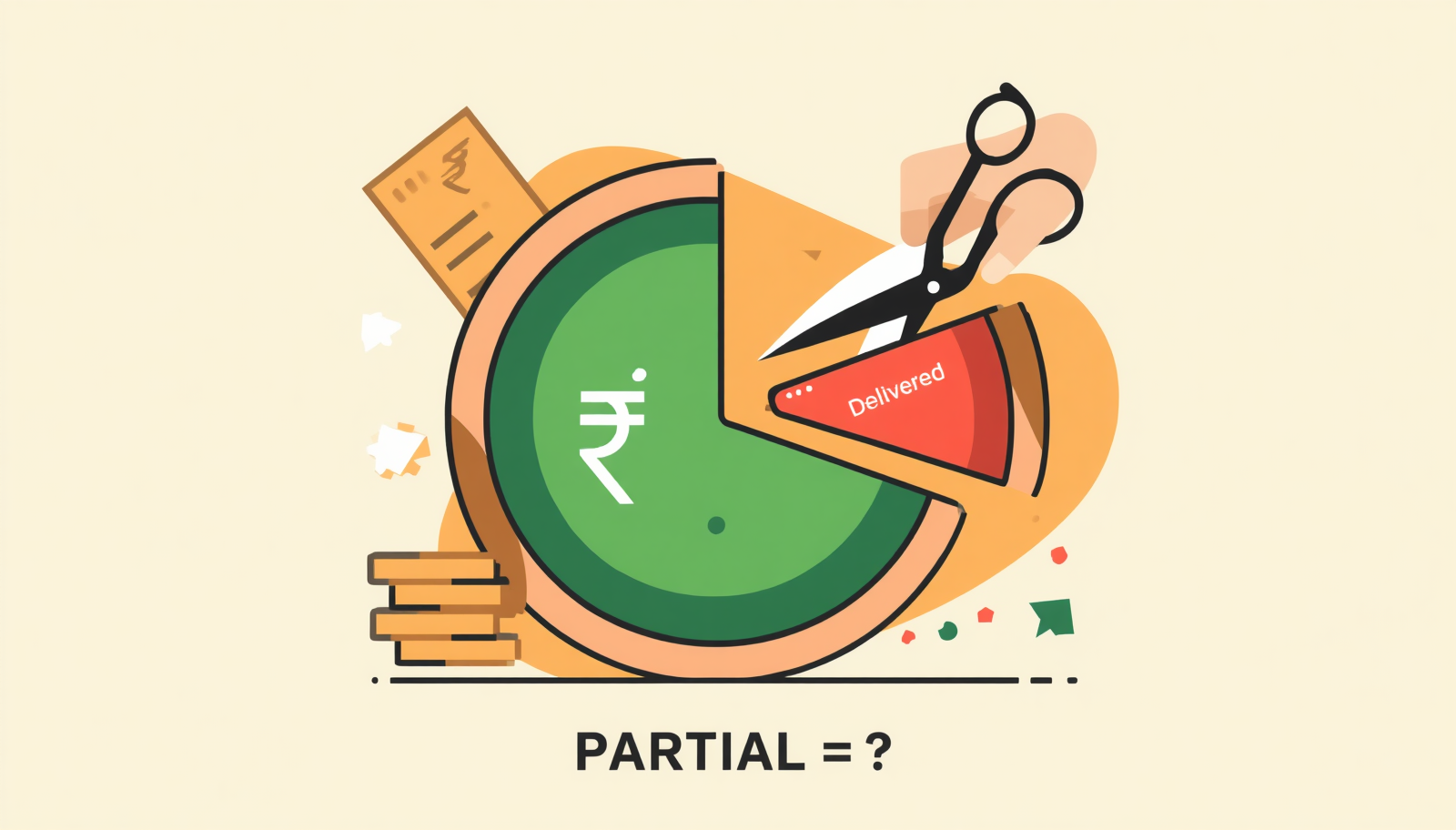
By Kelvin Mark, Manager, IndianSMMServices · Published 14 October 2026 · Prices and terms checked 14 October 2026
Quick answer: For a Partial SMM panel order, credit the client for the undelivered units at the rate you charged the client: remains divided by 1,000, multiplied by your client rate per 1,000. Promise only what your panel's ledger confirms, because the panel's terms treat partial refunds as discretionary.
A Partial status means the order stopped before the ordered quantity was delivered, and the remains field is the count of units that were not. The credit is a proportion, not a judgement call: remains divided by 1,000, multiplied by the rate per 1,000. Run it twice, once at the panel rate to see what you should expect back, and once at your client rate to see what the client is owed.
Here is an illustration using a listing visible on the IndianSMMServices services page on 14 October 2026: service 51576, an Instagram followers service listed at ₹186.9301 per 1,000 with a 100 minimum and 10,000 maximum. Say an agency orders 5,000 and the order ends as Partial with 1,200 remaining. The panel-rate cost of the full order is ₹934.65. The undelivered 1,200 units are worth ₹224.32 at that rate, and the delivered 3,800 units are worth ₹710.33.
Now add a client price. The ₹300 per 1,000 below is invented to make the arithmetic readable; it is not a recommended price. The client paid ₹1,500.00, the pro-rata client credit is ₹360.00, the client keeps ₹1,140.00 of delivered value, and the agency's margin on the delivered units is ₹429.67 (₹1,140.00 minus ₹710.33).
The trap sits in the next line. If the agency credits the client ₹360.00 but the panel returns nothing for the undelivered units, margin collapses to ₹205.35 (₹1,500.00 minus ₹360.00 minus ₹934.65). That is a ₹224.32 swing from one order, which is the whole undelivered panel cost. The formula is easy. The risk is promising the client a credit before the panel ledger shows its side.
Do the arithmetic in integer paise and round once, at the line level, so that the credit plus the retained amount always equals the amount paid. In the example, ₹224.32 plus ₹710.33 equals ₹934.65 exactly.
Agencies often file everything under one complaint, 'the followers did not arrive', and then argue about which rule applies. Splitting the cases first removes most of the argument.
Keeping the three separate also keeps your client messages honest: a Partial order is a delivery shortfall you can quantify to the unit, while a drop is a retention question that needs before-and-after counts. The SMM order dispute evidence checklist covers how to assemble those records for each case.
The IndianSMMServices API page, opened on 14 October 2026, documents a POST endpoint with a status action that returns charge, start_count, status, remains and currency. Its examples show the statuses Partial (with remains of 157) and In progress. It also lists a cancel action that takes up to 100 order IDs, a refill action, and per-service refill and cancel flags.
The same page does not define Pending, Canceled or Completed for orders, does not explain how the charge field is adjusted after partial delivery, and does not state refund conditions. The API order-lifecycle tutorial on the blog describes the status action as returning pending, in progress, completed, partial or canceled, but it does not cover the charge field either. Treat the charge value as a number to log and compare against your balance ledger, not as proof that a credit has been applied.
The refund terms matter just as much as the endpoint. The terms page says partial refunds may be granted at the panel's sole discretion, full-refund eligibility requires cancellation within 24 hours, refunds apply only to card and UPI payments, crypto or wallet deposits are non-refundable, approved refunds take 3 to 5 business days, and completed and delivered services are not refunded. Support availability is listed as 2 PM to 4 PM and 8:30 PM to 10:30 PM, so write your own client response times around that window rather than around a 24/7 promise.
This is the sequence we would run before telling a client a number. It is a suggested workflow built from the fields the API exposes, not a procedure the panel prescribes.
Write your client terms so they never promise more than you can recover. If the panel treats partial refunds as discretionary, your own clause should read 'proportional credit on confirmed remains' rather than 'full refund of anything undelivered'. If crypto and wallet deposits are non-refundable on the panel side, do not promise a cash refund on orders you funded that way. The agency client credit policy guide shows how to turn these limits into the scope and terms gates before the first order.
A related pricing point: a cheapest SMM panel listing is priced low for reasons visible in the service name, for example a mid-drop or no-refill label on the listing for service 51330 at ₹41.1247 per 1,000. A low rate means each partial credit is small in rupees, so the support time per ticket is what eats margin. Price your minimum order and your credit threshold with that in mind.
This post is about accounting for orders, not about whether any order is wise. Platforms and regulators treat purchased engagement as a separate issue from bookkeeping. On 20 October 2020, Meta announced lawsuits against four individuals who ran services selling fake likes and followers, saying they violated Instagram's Terms of Use. In the United States, the FTC's final rule on consumer reviews and testimonials bars selling or buying fake indicators of social media influence, such as followers and views, where the person knew or should have known they were fake and used them to misrepresent influence for a commercial purpose; one law-firm summary reports a penalty of up to $51,744 per violation. Nothing in a credit formula changes that exposure, and no one can guarantee that a purchased order will not be flagged or removed. If you buy Instagram followers for a client, tell the client about the platform risk in writing. This is not legal advice.
On 14 October 2026 we opened the live blog archive (pages 1 to 7) and found no post on partial-order credit math. The nearest posts cover dispute evidence, balance reconciliation, client credit policy and duplicate orders, each of which touches cancellations or refunds without working through the partial case. We then opened the IndianSMMServices API page, the terms page and the services page, and read the five related posts linked here. The rupee example is plain arithmetic on the rate listed that day. We did not place a live partial order, so we have not observed how this panel adjusts the charge field.
External material: the FTC final rule summary and the Meta announcement of 20 October 2020 are cited for context on purchased engagement. Stripe's public billing documentation was read for the general principle that a prorated credit is a percentage of the original charge reflecting partial use; it concerns subscriptions, not SMM orders, and is cited only for that principle.
Disclosed bias: IndianSMMServices sells the services discussed here, so we benefit if you use them. We have tried to keep the advice usable with any provider, and we do not claim results, delivery or non-flagging for any order. The author is listed as Kelvin Mark, Manager, IndianSMMServices.
Partial means the order stopped before the full quantity was delivered. The status response carries a remains field showing how many units were not delivered. The IndianSMMServices API page shows a Partial example with remains of 157 but does not define the status beyond that, so confirm the treatment with the panel in writing.
Divide remains by 1,000 and multiply by the rate per 1,000. Use your client rate for the client credit and the panel rate for the amount you expect back from the panel. For 1,200 undelivered units at the illustrative client rate of ₹300 per 1,000, the client credit is ₹360.00.
No. A canceled status is not proof of a credit. Look for a separate credit entry linked to the original debit. The IndianSMMServices terms tie full-refund eligibility to cancellation within 24 hours and treat partial refunds as discretionary.
Only if the agency can fund it. The panel's terms limit refunds to card and UPI payments and call crypto or wallet deposits non-refundable, so a balance credit and a cash refund are different things. Offer the client a labelled wallet credit unless your own client terms promise cash back.
Not automatically, but read the service name before you price it. A low rate per 1,000 shrinks the rupee value of any partial credit while the support time and client-communication effort stay the same, so margin per ticket falls.
Ask for the partial and cancel rules in writing, test them on a small order, and check whether the credit shows up as a separate ledger line. No panel can promise that every order completes, and no review replaces your own test.
Before you quote a client, check the refill and cancel flags on each service in the IndianSMMServices services list and test the partial-order handling on a small order. We sell the services listed there, we cannot guarantee delivery or that any order will avoid platform action, and your own written terms should say the same.
IndianSMMServices.com is an India-based Social Media Marketing (SMM) panel that provides wholesale-priced growth and engagement services across various social media platforms. Founded in 2019, the platform operates as a bulk supplier where individuals, digital marketing agencies, and resellers buy automated engagement metrics.

© 2019–2026 IndianSMMServices. All rights reserved.
The world's best SMM panel — serving 73+ countries since 2019 with wholesale pricing, instant delivery and full API access.