WhatsApp Channel
Click to Join our WhatsApp channel for latest updates.
Telegram Channel
Click to Follow Telegram Channel for real-time updates.
Instagram Channel
Click to Join our Instagram channel for latest updates
Click to Join our WhatsApp channel for latest updates.
Click to Follow Telegram Channel for real-time updates.
Click to Join our Instagram channel for latest updates
Quick answer: Measure SMM client profitability by subtracting that account's refunds, provider order costs, payment fees and attributable fulfilment or support labour from its net revenue. Review both rupee contribution and contribution margin. Keep shared overhead separate unless the allocation rule is documented, consistent and useful for the decision being made.
By Kelvin Mark - Manager | October 7, 2026
Topic gap: The live archive covers order pricing, monthly agency profit, balance reconciliation and client reporting, but contains no dedicated client-level profitability scorecard that captures support time and account-specific leakage.
A large retainer can look valuable while consuming disproportionate fulfilment time, revisions, refunds and payment costs. A smaller prepaid account may contribute more profit per rupee of revenue. The purpose of a client scorecard is not to label a customer “good” or “bad”; it is to show which commercial terms and operating behaviours consume the spread.
Use two outputs. Client contribution is the rupee amount left after attributable costs. Client contribution margin is that contribution divided by net client revenue. The first shows how much the account contributes toward shared overhead and profit; the second makes differently sized accounts easier to compare.
This is narrower than a whole-business P&L and broader than an order markup. The site's reseller margin calculator helps establish an order price floor. The client scorecard adds the account costs that appear after the quote, including support labour and refunds.
Pass 1 — freeze the client and period. Use one stable client ID, reporting currency, timezone and cutoff. Do not combine two businesses merely because the same person pays both invoices.
Pass 2 — calculate net client revenue. Start with revenue earned under the agency's documented policy, then subtract approved discounts, credits and refunds. Cash collected is a separate liquidity measure.
Pass 3 — attach transaction-level costs. Link each provider debit, processor fee, currency deduction and client-specific tool charge to an invoice, job or order ID. Reconcile prepaid funding separately using the panel balance reconciliation workflow.
Pass 4 — cost recorded labour. Assign fulfilment, revision and support time only when it can be traced reasonably. Xero's project guidance uses staff hourly cost rates to calculate project profitability; QuickBooks likewise supports project income, expenses, timesheets and labour costs. Use a cost rate, not the employee's client billing rate.
Pass 5 — calculate contribution. Client contribution equals net revenue minus attributable provider costs, payment costs, refunds not already netted from revenue, and direct labour. Avoid deducting the same refund twice.
Pass 6 — review before acting. Check unusual entries, compare at least several comparable periods where available, and retain the source package. One month may be distorted by a launch, annual invoice, delayed refund or exceptional support case.
The following figures are illustrative calculations, not customer data, pricing benchmarks or claimed results.
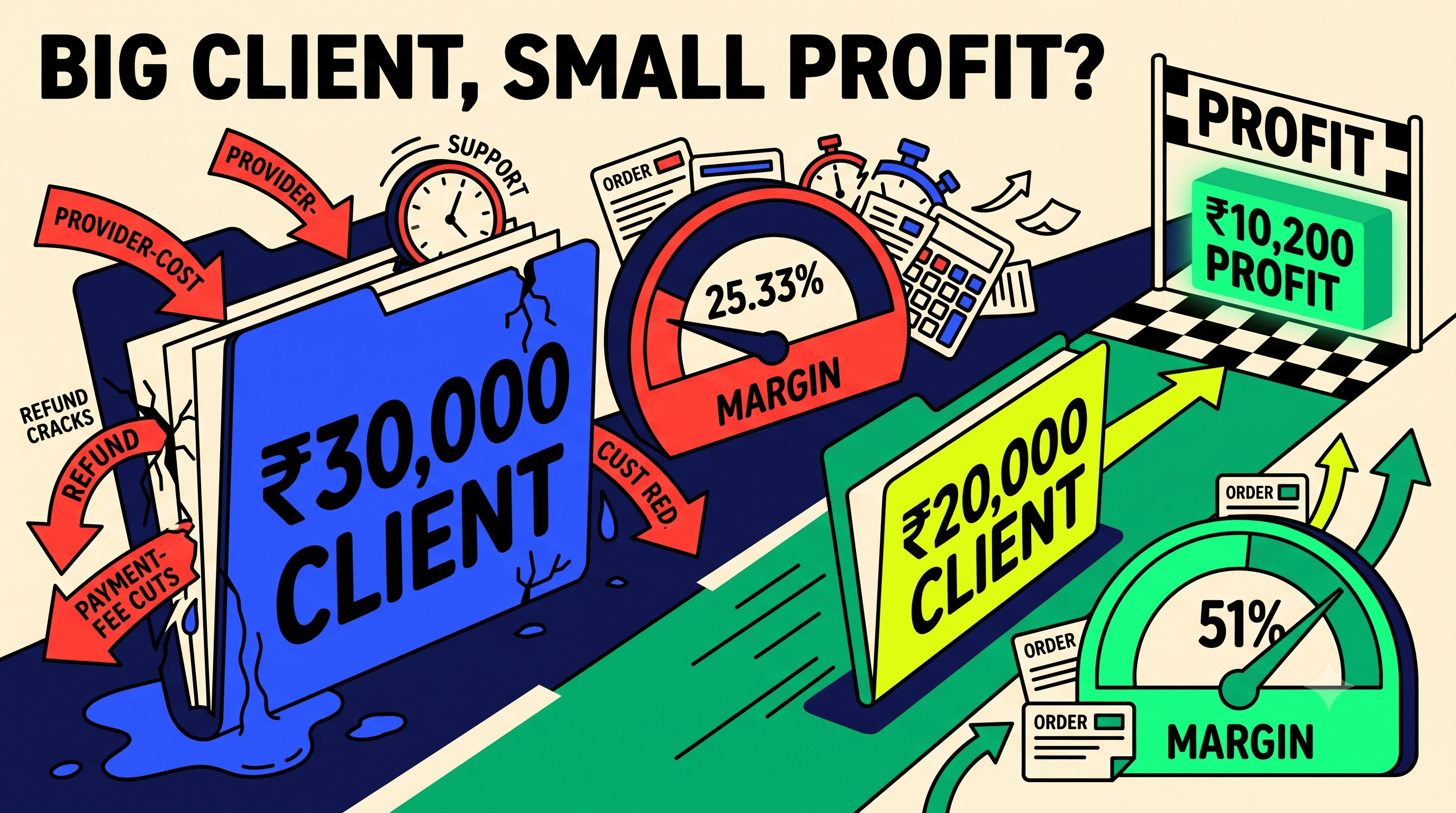
Client A: Net revenue is ₹30,000. Provider costs are ₹12,000, payment fees are ₹900, approved refunds are ₹1,500, and attributable labour is 20 hours at an internal cost of ₹400 per hour, or ₹8,000. Contribution is ₹7,600. The contribution margin is ₹7,600 divided by ₹30,000, or approximately 25.33%.
Client B: Net revenue is ₹20,000. Provider costs are ₹6,000, payment fees are ₹600, there are no approved refunds, and attributable labour is 8 hours at ₹400 per hour, or ₹3,200. Contribution is ₹10,200. The contribution margin is 51%.
Client A generates 50% more net revenue, yet Client B contributes ₹2,600 more in this example. The gap is caused by the cost mix, not a universal conclusion about larger accounts. Before repricing, verify whether Client A's 20 hours include a one-off onboarding project or work that should have been billed separately.
Shared software, management salaries, rent and general marketing still matter, but allocating every rupee equally per client can produce a false sense of accuracy. A client with ten orders may not consume ten times the executive or accounting effort of a client with one order. Choose a driver that reflects the resource: recorded hours for labour-heavy support, transactions for processor administration, or direct assignment when a tool exists only for one account.
Show two views where overhead matters: contribution before shared overhead, and account result after the chosen allocation. Document the driver and keep it consistent. If management changes the driver, show the effect rather than rewriting history silently. Accounting standards discuss systematic allocation in specific contexts, but this management scorecard is not a statutory allocation rule.
The scorecard also cannot turn marketing language into evidence. Selecting the best SMM panel, the cheapest SMM panel, or targeting searches such as buy Instagram followers does not establish client profitability. Only reconciled revenue, cost and time records do.
Margin compression: If the same scope produces a materially lower margin over comparable periods, isolate rate changes, extra support, refunds and payment deductions before increasing price.
Unbilled scope: Repeated revisions, reporting or emergency work may show that the contract does not match delivery. Clarify inclusions, introduce change approval or move the work into a priced package.
Collection risk: A profitable-looking account can still damage cash flow if payment arrives after the agency funds orders. Profitability and credit exposure are different decisions.
Service disputes: Do not assume every drop or delay belongs to the agency. Build an evidence record using the order-dispute checklist, then record only confirmed credits or obligations. Never punish a client for a cost that has not been verified.
The IndianSMMServices live archive and recent finance posts were reviewed on October 7, 2026. Searches for client profitability and profit per client did not identify a dedicated article in the archive. The method was checked against official Xero project guidance describing time and expense tracking with staff hourly cost rates, and current QuickBooks documentation describing project-level income, costs, labour and profit margin. Those products are examples of established project-costing mechanics, not endorsements or requirements.
The ₹30,000 and ₹20,000 cases are transparent hypothetical calculations. No client result, average agency margin, universal hourly cost, competitor price or performance guarantee is claimed. Client outcome measurement remains separate; the 30-day UTM reporting guide explains how to distinguish platform activity from visits, leads and sales.
IndianSMMServices sells the services discussed and has a direct financial interest in readers considering its live services catalogue. This is guidance from an interested publisher, not an independent audit, accounting opinion or recommendation to violate any platform's rules. Kelvin Mark - Manager is the author; no founder or owner identity is asserted.
A client scorecard is only as reliable as its time records, cost links and revenue policy. Unrecorded support time understates cost; arbitrary hourly rates or overhead drivers can overstate it. Different clients may also have onboarding, annual billing or unusual disputes that make one period incomparable. The framework does not determine GST, income-tax, revenue-recognition or statutory reporting treatment and should be reviewed by a qualified accountant before formal use.
This article does not make purchased engagement compliant with social-platform rules. YouTube restricts artificial engagement and promotion of metric-inflation services. Medium restricts facilitation of buying or selling social-media interactions, including off-platform. Quora's advertising rules prohibit artificial metric boosters, while LinkedIn may restrict inauthentic engagement. Instagram also restricts artificially collected engagement. Do not cross-post the commercial article, ordering phrases or service CTA to Quora, Medium, YouTube, Instagram or LinkedIn. A neutral, link-free project-costing summary may be lower risk on LinkedIn, but no presentation can guarantee that an account will not be reviewed, limited or terminated.
Subtract client-specific provider costs, payment fees, refunds, credits and directly attributable labour from that client's net revenue. Divide the result by net revenue to calculate the client contribution margin.
Yes, when the time can be attributed reliably. Multiply recorded support and fulfilment hours by a documented hourly cost rate, while keeping estimates clearly labelled.
No. Allocate shared overhead only through a documented and decision-useful method. Show contribution before shared overhead separately so arbitrary allocations do not hide the operational economics of an account.
Yes. High provider costs, refunds, payment deductions, revisions and support time can leave a large account with a lower contribution margin than a smaller, simpler account.
Verify the data first, then consider repricing, narrowing scope, requiring prepayment, reducing avoidable rework or ending the account under its contract. Do not cut service based on one incomplete month.
No. Client profitability measures the agency's economics. Campaign ROI requires separate evidence about attributed leads, sales and client outcomes, and purchased engagement must be labelled honestly.
Closing CTA: Select one client and reconstruct a single closed month using revenue, linked order costs, fees, refunds and recorded support time. Verify every exception before changing price or scope, then use the live blog archive for the supporting reporting, reconciliation and dispute controls.
IndianSMMServices.com is an India-based Social Media Marketing (SMM) panel that provides wholesale-priced growth and engagement services across various social media platforms. Founded in 2019, the platform operates as a bulk supplier where individuals, digital marketing agencies, and resellers buy automated engagement metrics.

© 2019–2026 IndianSMMServices. All rights reserved.
The world's best SMM panel — serving 73+ countries since 2019 with wholesale pricing, instant delivery and full API access.