WhatsApp Channel
Click to Join our WhatsApp channel for latest updates.
Telegram Channel
Click to Follow Telegram Channel for real-time updates.
Instagram Channel
Click to Join our Instagram channel for latest updates
Click to Join our WhatsApp channel for latest updates.
Click to Follow Telegram Channel for real-time updates.
Click to Join our Instagram channel for latest updates
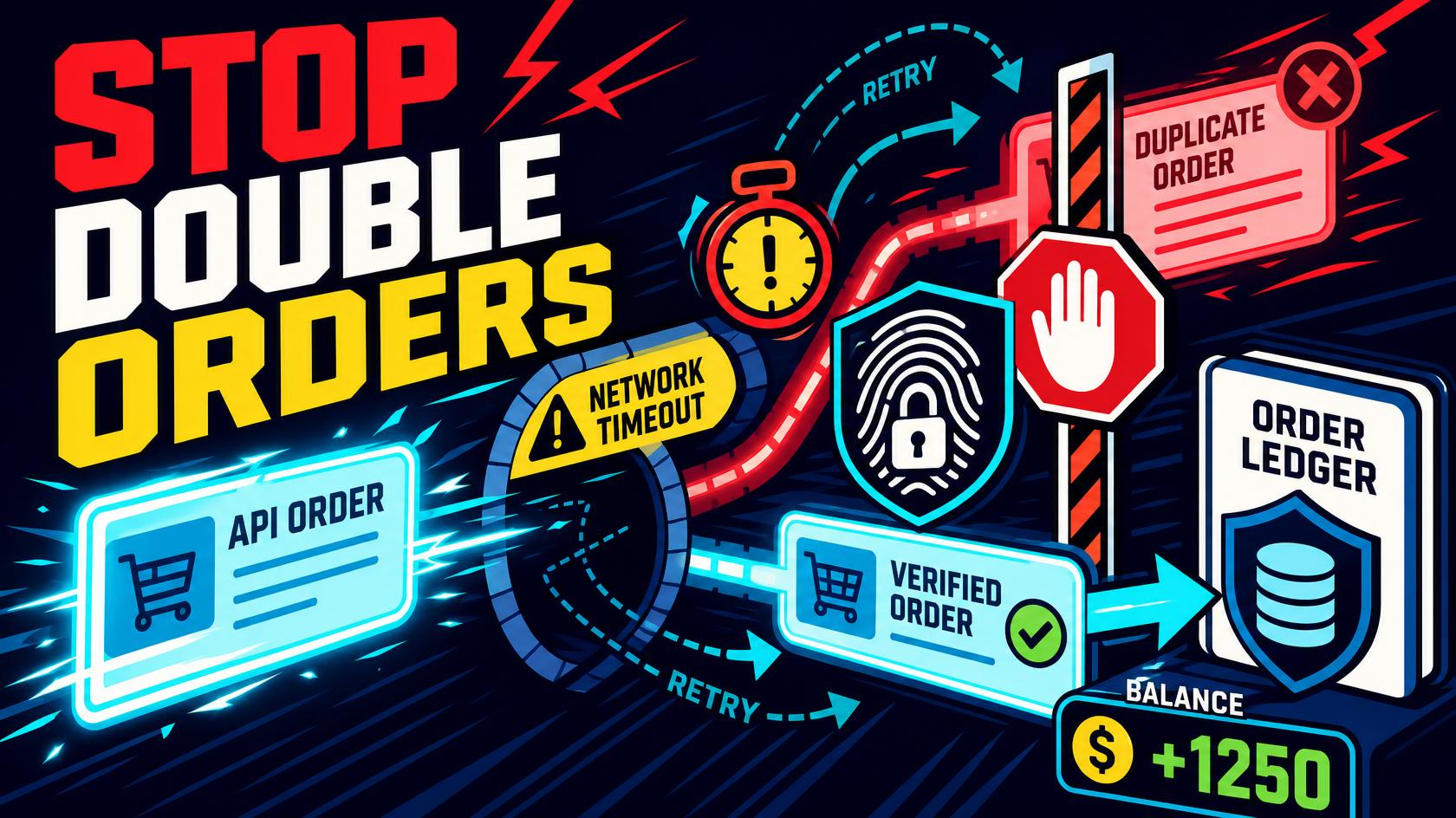
Quick answer: Prevent duplicate SMM API orders by assigning each intended purchase a deterministic fingerprint, reserving that fingerprint in a durable request ledger before the API call, and treating timeouts as an unknown state rather than a failed order. Retry automatically only when the first submission is known not to have reached processing; otherwise reconcile the order ID, logs and balance before a human-approved resubmission.
At second 0, a reseller worker sends an order request. At second 3, the provider may accept it and create an order ID. At second 30, the client times out without receiving that ID. If the worker labels the attempt “failed” and immediately repeats the same POST, it can create a second paid order. The failure is not necessarily at the provider; the response can be lost after processing. RFC 9110 defines an operation as idempotent when multiple identical requests have the same intended server effect as one, and warns clients not to retry a non-idempotent method automatically unless they know its semantics are idempotent or know the original request was never applied.
The existing SMM panel API tutorial shows the add-order POST and status lifecycle. This guide handles the narrower production problem left after that tutorial: how a reseller protects money when the add response is uncertain.
Create a canonical string from five fields: client_order_reference | service_id | normalized_target | quantity | campaign_slot. Hash that string with SHA-256 and store the result under a database unique constraint. An illustrative intent might be ACME-901 | 1234 | instagram.com/example | 1000 | 2026-09-27-AM. The campaign slot matters because two legitimate 1,000-unit orders for the same target on different approved dates must remain distinct.
Normalize carefully: lowercase the hostname, remove tracking parameters, trim whitespace and apply one documented trailing-slash rule. Never include the API key. Never deduplicate on target URL alone. Before building the fingerprint, cache and validate the current service ID, minimum and maximum quantity against the live services catalogue.
A practical request ledger uses six explicit states: reserved, sending, confirmed, rejected, unknown and manually_resolved. Reserve the fingerprint before any network request. Change it to sending when a worker owns the attempt. Store the provider order ID before showing success to the client. A unique fingerprint plus an atomic insert prevents two workers from racing to submit the same intent.
Store the internal request ID, fingerprint, redacted payload, attempt number, UTC timestamps, response code, provider order ID when available, balance snapshots and resolution note. Do not store credentials or complete authorization headers. If a secret enters logs, use the API-key incident response plan.
Green gate: retry only when the request was definitely blocked before submission, such as local validation rejecting an invalid quantity. Red gate: never retry a confirmed order or a provider-declared permanent rejection without correcting the cause and creating a new approved intent. Amber gate: a timeout, connection reset, empty body or unparsable success response becomes unknown and enters reconciliation.
If a green-gate transient request is retried, cap the attempts and use exponential backoff with jitter. AWS documents that jitter spreads clients across randomized delays and recommends limiting retry calls; it does not establish one universal delay schedule for an SMM API. An illustrative client policy is at most three network attempts with maximum waits of 2, 5 and 11 seconds, each randomized downward. Those figures are examples, not IndianSMMServices limits or guarantees.
The order evidence checklist explains how to package timestamps, baselines and status records. Stripe publicly documents idempotency keys up to 255 characters and says keys may be removed after at least 24 hours; PayPal uses its own request IDs and endpoint-specific retention. These are cross-industry examples, not proof that an SMM endpoint accepts either provider's header. Where server-side support is undocumented, the client ledger remains the enforceable control.
Review four monthly figures: total add intents, unknown responses, blocked duplicate attempts and confirmed duplicate orders. Calculate unknown-response rate = unknown results ÷ add intents × 100. If 12 of 8,000 intents become unknown, the rate is 0.15%. Calculate duplicate escape rate = confirmed duplicate orders ÷ add intents × 100. If one duplicate escapes, the rate is 0.0125%. Both examples are illustrative calculations, not IndianSMMServices performance data.
Do not reward engineers for driving the unknown rate to zero by misclassifying uncertainty as failure. The cost metric should include duplicate spend, staff reconciliation time and client credits. Add the results to the five-KPI provider scorecard as an integration-quality metric, not as a claim about follower quality. Whether someone searches for the best SMM panel, cheapest SMM panel or buy Instagram followers, API reliability and platform rules still matter more than a headline unit price.
The live IndianSMMServices archive and its recent API tutorial, security, dispute and scorecard posts were checked on September 27, 2026. The tutorial mentions idempotent retry logic but the archive showed no dedicated duplicate-order control guide. Technical principles were cross-checked against RFC 9110, Stripe's idempotent-request reference, PayPal's idempotency guidance and AWS retry documentation. Stripe and PayPal are cited only as independent implementation examples; their headers and retention rules do not automatically apply here.
All timelines, retry waits, volumes and rates in this article are labelled illustrative. IndianSMMServices sells the services discussed and has a direct financial interest in readers considering its catalogue. This is therefore a disclosed first-party engineering guide, not an independent audit, security certification or performance guarantee. The live blog archive contains the related first-party material reviewed.
A client-side fingerprint can block duplicate intent inside one controlled application, but it cannot prove what a provider processed after a lost response. Balance changes are weak evidence when other jobs run concurrently. The article cannot verify that IndianSMMServices currently accepts an Idempotency-Key header, exposes a request-search endpoint or provides a downloadable order log, so developers must confirm present API capabilities before implementation. Database availability, clock errors, queue redelivery and multiple storefronts also require architecture-specific testing.
This workflow reduces accidental duplicate purchases; it does not make artificial engagement compliant with a social platform. YouTube prohibits content promoting third-party metric-inflation services, Quora prohibits promotion of services that artificially manipulate engagement, Medium restricts facilitation of buying or selling social-media interactions, LinkedIn prohibits misleading commercial content and spam, and Instagram warns against artificially collecting engagement. Do not present automation as platform-approved or promise safe monetization.
Frequently asked questions
Yes. A client can time out after the provider accepts an order but before the response reaches the client. Treat that result as unknown until you reconcile it; do not immediately submit the same paid request again.
This article does not claim that it does. Confirm current API capabilities directly before sending any custom header. The client-side ledger described here is designed for integrations where server-side idempotency is undocumented or unavailable.
Use a normalized client order reference, service ID, canonical target link, quantity and an intentional campaign or schedule slot. Do not use only the target link because legitimate repeat orders can share one URL.
Only failures that your integration can classify as definitely not submitted should be automatic candidates. A timeout, lost connection or malformed success response is ambiguous and should enter reconciliation rather than blind retry.
Keep it for at least the longest period needed for order completion, refill review, billing reconciliation and client reporting under your own operating policy. There is no verified universal retention period for every SMM service.
Closing CTA: Before the next production batch, add one unique intent fingerprint, one durable unknown state and one manual reconciliation queue. Then review current service conditions before enabling automated submission.
IndianSMMServices.com is an India-based Social Media Marketing (SMM) panel that provides wholesale-priced growth and engagement services across various social media platforms. Founded in 2019, the platform operates as a bulk supplier where individuals, digital marketing agencies, and resellers buy automated engagement metrics.

© 2019–2026 IndianSMMServices. All rights reserved.
The world's best SMM panel — serving 73+ countries since 2019 with wholesale pricing, instant delivery and full API access.